March 16th, 2026 | 08:00 CET
3 Renewable Energy Stocks on a Rally – Nordex, Vestas, and RE Royalties
How do you turn wind into money? Is that even possible? Looking at the current momentum in the markets, the answer appears to be a resounding yes. While the world debates climate goals, some companies are making moves that delight investors. Today, we are looking at a trio driving the global energy transition. From the explosive stock surge of a long-established Hamburg-based company to the strategic Far East plans of a Danish global market leader, all the way to an innovative financing model from overseas that is shaking up the sector from a completely different angle. It is about real substance, massive order books, and the question of where long-term returns truly "reside." In the world of renewables, a rather strong wind is currently blowing, revealing opportunities that will not come around again anytime soon.
time to read: 5 minutes | Author: Mario Hose
ISIN: NORDEX SE O.N. | DE000A0D6554 , VESTAS WIND ADR 1/3/DK 1 | US9254581013 , RE ROYALTIES LTD | CA75527Q1081 | TSXV: RE , OTCQX: RROYF
Table of contents:
Author

Mario Hose
Born and raised in Hannover, Lower Saxony follows social and economic developments around the globe. As a passionate entrepreneur and columnist he explains and compares the most diverse business models as well as markets for interested stock traders.
Tag cloud
Shares cloud
Nordex: The Hamburg High-Flier on a Number-Driven Rally
Those who bet on Nordex last year are likely looking at their portfolio today with a broad smile. What is happening at the Hamburg-based wind turbine manufacturer resembles a flawless turnaround. With a massive price jump of over 150% within a single year, the stock has delivered a performance that exceeded even the highest expectations. In mid-March 2026, the stock was trading at around EUR 43, just shy of its multi-week high. Not too long ago, the stock was still at EUR 15. It is not just pure euphoria driving this price, but an operational foundation that management has built over the past few months.
The company is benefiting massively from the demand for onshore wind energy, which extends far beyond Germany. In the last few days alone, orders totaling more than 330 megawatts have come in. Particularly noteworthy is the collaboration with long-time partner wpd. This involves 40 turbines for nine different projects across Germany, from Mecklenburg-Western Pomerania to Hesse. But the real goldmine for Nordex lies not so much in the construction of the turbines themselves, but in what comes after. The contracts are almost without exception linked to long-term premium service agreements, some of which run for over 25 years. This is the wind industry's proverbial "subscription model." It ensures predictable, high-margin revenue, making the company less vulnerable to the fluctuations of the project business.
With revenue of EUR 7.6 billion and a record order intake of over 10 gigawatts in 2025, Nordex is demonstrating that its efficiency measures are paying off. Particularly impressive is the operating EBITDA margin, which climbed to an impressive 12.1% in the last quarter. This shows that costs are under control, even as global supply chains continue to cause occasional problems. For the current year, the company is targeting revenue between EUR 8.2 and 9 billion. Investors are now eagerly awaiting April 27, when the first-quarter report is due to be released. It will be another moment of truth to see whether the Hamburg-based giant can maintain its high pace or whether, for example, the RSI indicator, which is already signaling an overbought situation, suggests a brief consolidation pause.
Vestas: The Danish Flag in Faraway Japan
While Nordex is paving its home turf with wind turbines, the Danish giant Vestas is looking far beyond the horizon. The Danes have realized that the future of wind power may lie not only in Europe, but above all in the waters of Asia. Vestas plans to build its own factory for offshore turbines in Japan. This is a strategic decision of enormous significance that extends far beyond the next quarter. The company has already signed a non-binding memorandum of understanding with the Japanese Ministry of Economy to establish an assembly center for key components by 2029.
Japan is an island nation with limited land area but seemingly endless coastlines. This makes the country an ideal location for offshore technology, a field in which Vestas sets the global standard. The goal is ambitious: by 2039, the assembly center is to become a fully integrated production site. Cities such as Muroran and Kitakyushu are currently being considered as potential sites; with their large ports and industrial infrastructure, they offer perfect conditions for manufacturing components weighing several tons and shipping them directly out to sea.
This Far East offensive shows that Vestas is not resting on its laurels. The company has staying power and is playing the long game. The goal is to build local value chains to protect against competition and secure local political support. It is no coincidence that Vestas is considered a "sustainability favorite." The Danes are driving technological development forward, whether in terms of rotor efficiency or the recyclability of materials. Even though costs for offshore projects have recently risen worldwide, Vestas remains stable in the wind power industry. The strategy with Japan sends a clear signal: We are here to stay and dominate the Asian wind market from the inside out. A highly exciting stock!
RE Royalties: The Clever Financial Heart of the Energy Transition
When people talk about Nordex and Vestas, they are talking about steel, concrete, and massive machines. But how is all of this actually paid for without the developers buckling under the weight of conventional bank loans? This is where RE Royalties comes in, a company that could almost be described as the industry's "silent beneficiary." Instead of building turbines or operating wind farms itself, RE Royalties acts as a specialized financier. The model is as simple as it is ingenious. RE provides capital for green energy projects and, in return, receives a share of the revenue - a so-called royalty.
What makes RE Royalties so attractive is the fact that they combine the best of both worlds. They participate directly in the success of renewable energy but do not bear the operational risks of a plant operator. If a gearbox breaks down or maintenance costs rise, that is the operator's problem, not RE Royalties'. They collect their share of the electricity price generated. At a time when interest rates for traditional loans are often unpredictable, RE Royalties offers project developers a flexible alternative and investors diversified access to a portfolio of wind, solar, and hydroelectric projects.
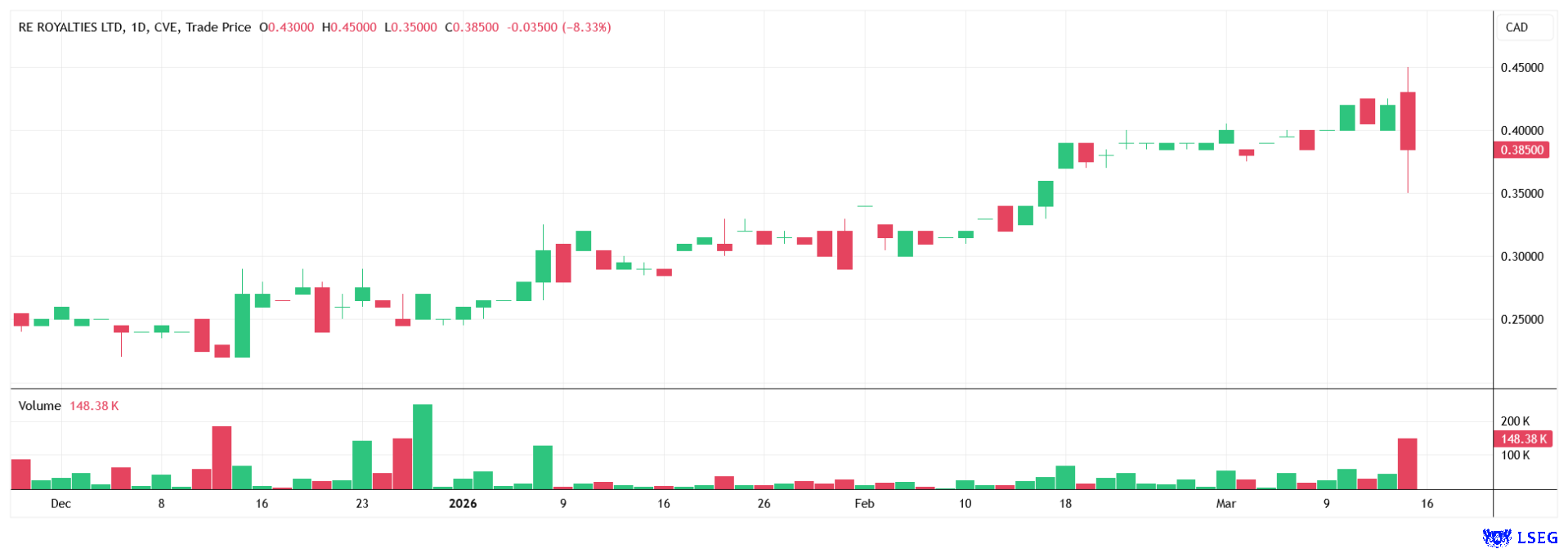
The management of RE Royalties has demonstrated a knack for selecting projects. They invest in established technologies and geographically diversified markets, which significantly reduces the company's overall risk. It is a model designed for steady cash flow. While the stock prices of plant manufacturers like Nordex can often react volatilely to new orders or commodity prices, RE Royalties stands out for its relative stability. One could say they are the financial backbone, pulling a few financial strings behind the scenes. For investors who believe in the long-term success of renewables, this stock is worth serious consideration. It is a smart way to invest in the sector. An interesting company with a promising approach!
Ultimately, investors must ask themselves what role they want to play in the energy transition. Those looking for explosive growth and an impressive turnaround story can hardly ignore Nordex at the moment. The Hamburg-based company has proven that it is back in the Champions League operationally and has done its homework on profitability. On the other hand, those looking for a global market leader with a visionary long-term strategy in Asia will find what they are looking for in Vestas, even if patience is required here until the Japanese factories reach their full potential.
Or RE Royalties. The company is not just a loud market huckster, but rather a kind of financial partner to the renewables sector, demonstrating that money can be made in this space in a relaxed manner. Through its innovative licensing model, RE offers a stability that is rarely found in the often-hectic wind sector.
Or all three stocks, because each has its merits. Together, they paint a picture of an industry that is only just beginning its next surge upward.
Conflict of interest
Pursuant to §85 of the German Securities Trading Act (WpHG), we point out that Apaton Finance GmbH as well as partners, authors or employees of Apaton Finance GmbH (hereinafter referred to as "Relevant Persons") currently hold or hold shares or other financial instruments of the aforementioned companies and speculate on their price developments. In this respect, they intend to sell or acquire shares or other financial instruments of the companies (hereinafter each referred to as a "Transaction"). Transactions may thereby influence the respective price of the shares or other financial instruments of the Company.
In this respect, there is a concrete conflict of interest in the reporting on the companies.
In addition, Apaton Finance GmbH is active in the context of the preparation and publication of the reporting in paid contractual relationships.
For this reason, there is also a concrete conflict of interest.
The above information on existing conflicts of interest applies to all types and forms of publication used by Apaton Finance GmbH for publications on companies.
Risk notice
Apaton Finance GmbH offers editors, agencies and companies the opportunity to publish commentaries, interviews, summaries, news and the like on news.financial. These contents are exclusively for the information of the readers and do not represent any call to action or recommendations, neither explicitly nor implicitly they are to be understood as an assurance of possible price developments. The contents do not replace individual expert investment advice and do not constitute an offer to sell the discussed share(s) or other financial instruments, nor an invitation to buy or sell such.
The content is expressly not a financial analysis, but a journalistic or advertising text. Readers or users who make investment decisions or carry out transactions on the basis of the information provided here do so entirely at their own risk. No contractual relationship is established between Apaton Finance GmbH and its readers or the users of its offers, as our information only refers to the company and not to the investment decision of the reader or user.
The acquisition of financial instruments involves high risks, which can lead to the total loss of the invested capital. The information published by Apaton Finance GmbH and its authors is based on careful research. Nevertheless, no liability is assumed for financial losses or a content-related guarantee for the topicality, correctness, appropriateness and completeness of the content provided here. Please also note our Terms of use.