May 28th, 2026 | 07:00 CEST
WORSE THAN MILLIONS OF COWS: ZEFIRO TAKES ON AMERICA'S CLIMATE KILLER
Millions of abandoned oil and gas wells are silently polluting the atmosphere—largely unnoticed, largely unchecked. Zefiro Methane has set itself the goal of permanently plugging them and is generating revenue from three sources: industry, government, and the carbon credit market. The Canadian company has recognized that America's methane problem can not only be addressed, but also monetized. The stock's valuation still has significant upside potential.
time to read: 7 minutes | Author: Jens Castner
ISIN: ZEFIRO METHANE CORP | CA98926D1069 | NEO: ZEFI
Table of contents:
Author

Jens Castner
The Nuremberg native brings over three decades of capital markets experience, backed by a career shaped by deep market insight and a genuine passion for investing. His journey began in 1994 through an investment club among colleagues – a formative experience that sparked a lifelong dedication to identifying compelling investment opportunities.
Following senior editorial roles at Nürnberger Nachrichten, €uro am Sonntag, and €uro, he went on to serve as Editor-in-Chief of the renowned investor magazine Börse Online from 2014, where he played a key role in shaping high-quality financial journalism for a broad investor audience.
Tag cloud
Shares cloud
METHANE MONSTER UNDER THE PRAIRIE
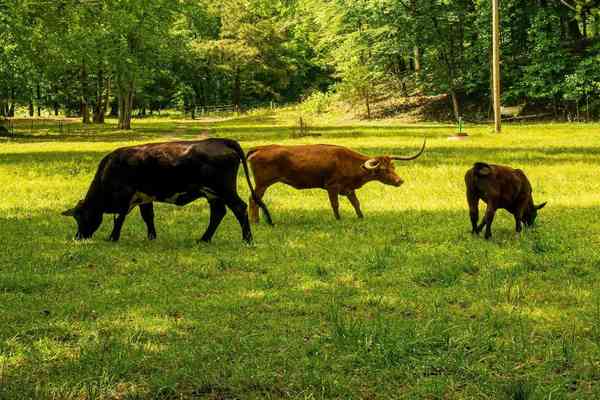
Cows have long been something of a red flag for climate activists. Each cow emits around 100 kg of methane into the atmosphere per year—a greenhouse gas that is about 80 times more harmful than CO₂ over a 20-year period. While emissions can be reduced through certain feed additives, such as red algae, achieving climate neutrality would require changes not only in ruminant diets but also in human eating habits: giving up meat and cheese would reduce livestock farming and, at least in theory, global warming. In practice, however, it is likely difficult, if not impossible, to deprive humanity of steaks and cheeseburgers, especially in "Cattle Country," like the United States.
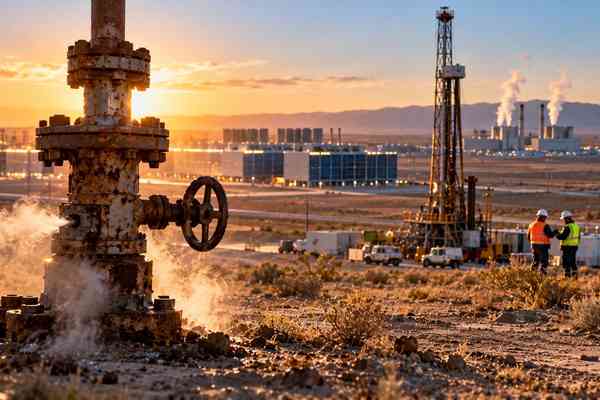
There, in the forests and on the prairie, lies a largely invisible, far greater methane problem: millions of abandoned, unplugged oil and gas wells. In technical terms, these are called "orphan wells"—a term that sounds almost pitiful. But the euphemistic language cannot hide the fact that every single one of these leaking ruins releases as much fossil methane into the air each year as a herd of over 100 cows. Heavily leaking wells, so-called "super-emitters," even emit as much methane as a massive industrial cattle farm with 430 to 780 cows. This is exactly where Zefiro Methane comes in. By systematically locating and permanently plugging abandoned wells, the Canadian environmental services company combats climate change, enabling a single intervention to achieve maximum impact. The sheer number of wells in the US illustrates the scale of the environmental crisis: estimates suggest there are several million unsecured wells, the vast majority of which are leaking and undocumented.
HIGH UNREPORTED NUMBERS
Exactly how many of these methane-leaking wells there are remains a mystery: "On the way to every known well we plug, we discover ten more that nobody knew about," explains Luke Plants, CEO of Zefiro's US subsidiary Plants & Goodwin, which has specialized in the permanent plugging and decommissioning of oil wells for more than 50 years. Currently, over 2.2 million of these wells are officially recorded in 26 states across the United States. That alone would provide Zefiro and Plants & Goodwin with a steady stream of work for years to come. Yet the majority of these wells are hidden in forests, on farmland, or even beneath residential dwellings. Often, there are no records whatsoever, as the operating companies have long since gone bankrupt or can no longer be located. The general public is left to deal with the environmental damage. Although the government is attempting to curb the problem with a USD 4.7 billion subsidy program, given the estimated total costs of USD 400 to USD 600 billion, this remains a drop in the ocean.
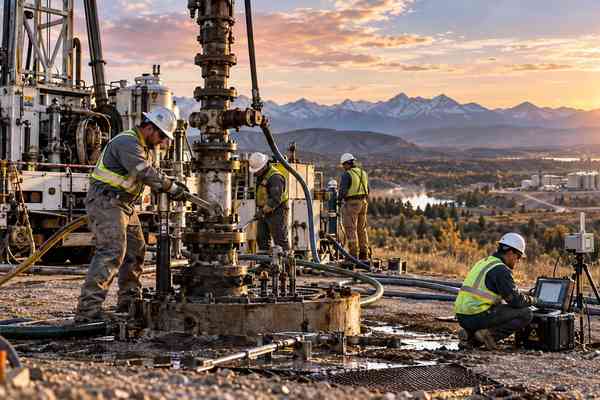
For Zefiro's management, there is therefore no doubt that now is precisely the right time to act. Following the acquisition of Plants & Goodwin in 2023, the Vancouver, Canada-based company acquired the assets and drilling rigs of Viking Well Service a few weeks ago for USD 4.3 million. This not only improves the company's technical and personnel resources but also its geographic presence. Zefiro can now offer its services in 14 US states, up from 9 previously. A recent announcement demonstrates that the new capacities are already having an immediate impact. Starting in June, Plants & Goodwin will deploy two additional mobile drilling rigs for a major client in the US natural gas industry—a business relationship that has existed since 2017 and has now been extended for the ninth consecutive time. A third rig, which is to be deployed in West Virginia and Kentucky, was only available thanks to the Viking asset acquisition, as the existing fleet was already operating at full capacity. In total, at least 26 wells will be sealed in Pennsylvania, New York, West Virginia, and Kentucky as part of this campaign—many of them in hard-to-reach terrain, which requires specialized equipment. In addition, Zefiro has held a stake in Radial Casing Solutions (RCS) since 2024 and owns the exclusive US rights to use their technology. The key RCS product is the REED (Radial Elastomer Expansion Device), a patented tool that hydraulically expands the casing in the wellbore to mechanically plug methane leaks. The first commercial sales using RCS technology at two corporate clients in Pennsylvania were reported in April.
STRONG NUMBERS – AND IT IS GETTING EVEN BETTER
Even without the Viking asset acquisition, which boosts annual revenue by USD 10 million in one fell swoop, the latest figures were impressive. In mid-May, Zefiro Methane reported record revenue of USD 33.2 million for the first nine months of the current 2026 fiscal year, a 36% increase compared to the same period last year. Furthermore, the company reported a positive adjusted quarterly operating result (EBITDA) for the third consecutive quarter—remarkable, given that the winter half-year has typically been weak due to weather conditions.
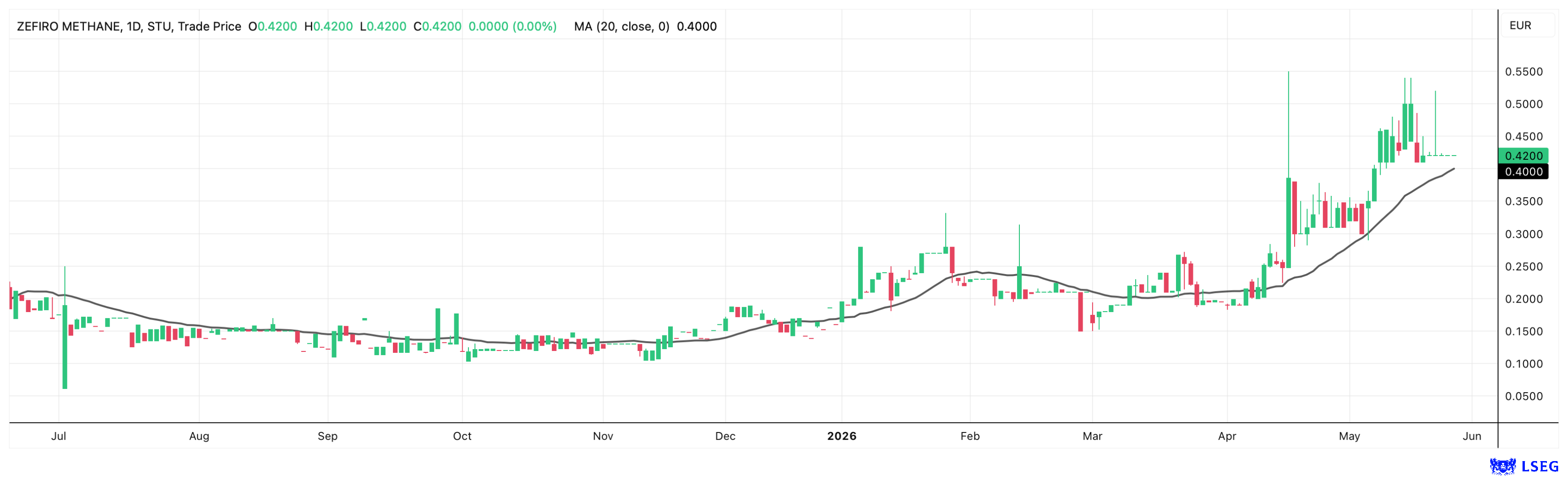
Even though CEO Catherine Flax has not yet commented on when the company is expected to turn a profit after interest, taxes, and depreciation, and therefore a valuation based on the P/E ratio is not possible, the facts point to a favourable share price. Revenue is expected to increase from USD 40 million to at least USD 50 million in the next fiscal year, driven by the Viking asset acquisition. This means the current market capitalization corresponds to a price-to-sales (P/S) ratio of just 1.0—unusual for a company with double-digit growth rates. Moreover, the icing on the cake of the business model has not even really kicked in yet.
TRIPLE THE RETURN ON CLIMATE PROTECTION
Zefiro not only applies for government grants and contracts from the oil and gas industry but also secures additional revenue by tapping into the voluntary carbon market. Under the leadership of experienced financial experts—who, like CEO Flax, were part of the former carbon credit team at JPMorgan—the company is thus transforming environmental protection into a profitable business. Zefiro not only physically seals the sources but also has the methane savings officially certified under the American Carbon Registry (ACR) standards. In this process, the amount of methane prevented is converted into so-called CO₂ equivalents. An independent auditor confirms that gas emissions have been permanently stopped after the sources were plugged. For every ton of carbon dioxide equivalent not emitted, Zefiro receives a tradable CO₂ certificate. Since this involves genuine, measurable, and immediate avoidance, rather than speculative tree planting that could burn down, these certificates are considered extremely high-value. Zefiro sells these CO₂ credits to major global corporations that must meet their net-zero climate targets. Transactions have already been completed with Mercuria Energy America, EDF Trading, and World Kinect Energy Services, a global energy services provider with more than 150,000 customers worldwide.
Zefiro estimates that a rehabilitated well can generate up to 50,000 CO₂ equivalent credits over time, as methane avoidance is weighted extremely heavily in current calculation models. At current market prices of USD 15 to USD 20 per credit, this translates into a revenue potential of USD 750,000 to USD 1 million per well! If Plants & Goodwin were to cap all 25,000 estimated problem wells in its home market of Pennsylvania alone, this would create a potential market of up to USD 25 billion for a single state.
FOSSIL FUEL CONTAMINATION, IMMEDIATE IMPACT
As things stand today, the still relatively small company is, of course, light-years away from such dimensions. But a reality check shows that there is more to the vision of billions in revenue than mere daydreaming. Zefiro has already won around 25% of the contracts awarded under the Infrastructure Investment and Jobs Act in its core regions—and Plants & Goodwin effectively holds a monopoly in some regions, such as New York State. While the US agricultural lobby vehemently opposes any regulation of cattle emissions, no one is blocking the remediation of abandoned oil wells. On the contrary, every sealed well effectively removes hundreds of climate-damaging cows from the market immediately.
The unplugged legacy sites of the fossil fuel industry cause climate damage in the US equivalent to the emissions of a gigantic, fictional herd of at least six million cattle. And even that is only half the truth. Cattle methane is part of a biogenic cycle. Bulls, cows, and calves eat grass that has previously sequestered CO₂ from the atmosphere. After about 12 years, the methane in the air breaks down back into CO₂, which is then absorbed by plants again. Abandoned oil wells, on the other hand, introduce fossil carbon into the system that has been isolated in the ground for millions of years. They permanently increase the absolute amount of greenhouse gases in the atmosphere. And while methane from cattle is diffusely distributed across Earth's surface, abandoned oil wells are highly concentrated fossil-fuel hotspots. For climate protection, this means that a company like Zefiro Methane can eliminate the environmental damage caused by an entire cattle farm with a single technical sealing of a super-emitter source—immediately, permanently, and with minimal bureaucratic effort.
Conflict of interest
Pursuant to §85 of the German Securities Trading Act (WpHG), we point out that Apaton Finance GmbH as well as partners, authors or employees of Apaton Finance GmbH (hereinafter referred to as "Relevant Persons") may hold shares or other financial instruments of the aforementioned companies in the future or may bet on rising or falling prices and thus a conflict of interest may arise in the future. The Relevant Persons reserve the right to buy or sell shares or other financial instruments of the Company at any time (hereinafter each a "Transaction"). Transactions may, under certain circumstances, influence the respective price of the shares or other financial instruments of the Company.
In addition, Apaton Finance GmbH is active in the context of the preparation and publication of the reporting in paid contractual relationships.
For this reason, there is a concrete conflict of interest.
The above information on existing conflicts of interest applies to all types and forms of publication used by Apaton Finance GmbH for publications on companies.
Risk notice
Apaton Finance GmbH offers editors, agencies and companies the opportunity to publish commentaries, interviews, summaries, news and the like on news.financial. These contents are exclusively for the information of the readers and do not represent any call to action or recommendations, neither explicitly nor implicitly they are to be understood as an assurance of possible price developments. The contents do not replace individual expert investment advice and do not constitute an offer to sell the discussed share(s) or other financial instruments, nor an invitation to buy or sell such.
The content is expressly not a financial analysis, but a journalistic or advertising text. Readers or users who make investment decisions or carry out transactions on the basis of the information provided here do so entirely at their own risk. No contractual relationship is established between Apaton Finance GmbH and its readers or the users of its offers, as our information only refers to the company and not to the investment decision of the reader or user.
The acquisition of financial instruments involves high risks, which can lead to the total loss of the invested capital. The information published by Apaton Finance GmbH and its authors is based on careful research. Nevertheless, no liability is assumed for financial losses or a content-related guarantee for the topicality, correctness, appropriateness and completeness of the content provided here. Please also note our Terms of use.