July 9th, 2026 | 07:00 CEST
Why the Base Load Bottleneck Threatens SpaceX and Amazon—and How Standard Uranium Stands to Benefit
When you pick up your smartphone from your nightstand in the morning, you rarely give a thought to the massive infrastructure behind the scenes. But the brave new digital world of global data streams and machine-learning algorithms has an energy-hungry, and sometimes dirty, secret. Artificial intelligence consumes so much electricity that power grids are collapsing one after another. When computing power needs to keep pace with AI innovations, solar farms are no longer enough. Base load power is needed—and nuclear power provides it. So high-tech needs uranium, and that is exactly what brings the tech elite together with resource companies. We explain the connections and highlight the opportunities.
time to read: 3 minutes | Author: Nico Popp
ISIN: SPACE EXPLORATION TECHNOLOGIES CORP | US84615Q1031 | NASDAQ: SPCX , AMAZON.COM INC. DL-_01 | US0231351067 , STANDARD URANIUM LTD. | CA85422Q8487 | TSXV: STND , OTCQB: STTDF
Table of contents:
Author

Nico Popp
At home in Southern Germany, the passionate stock exchange expert has been accompanying the capital markets for about twenty years. With a soft spot for smaller companies, he is constantly on the lookout for exciting investment stories.
Tag cloud
Shares cloud
SpaceX: Going Public at Full Throttle
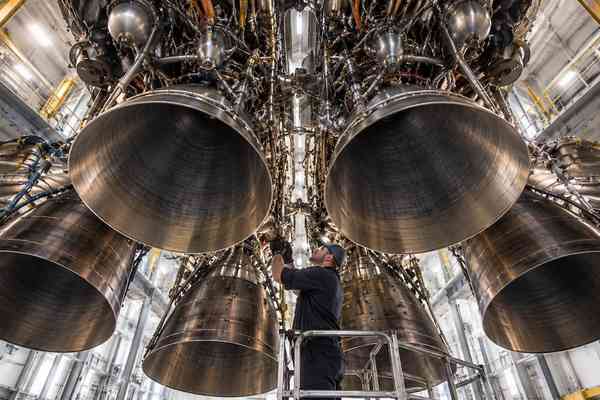
SpaceX's initial public offering (IPO) on the Nasdaq set multiple records. The space company debuted with an implied valuation of approximately USD 1.77 trillion and raised around USD 75 billion in the largest IPO in financial history. Instead of spinning off the Starlink satellite division separately, management deliberately chose to list the entire group. The reasoning behind this is as simple as it is ingenious: Starlink's stable, recurring subscription revenues, which generated USD 11.4 billion in revenue in fiscal year 2025, subsidize the capital-intensive development of the Starship platform. Analysts at Morgan Stanley are extremely optimistic about the future, projecting revenue growth from USD 45 billion in 2026 to USD 319 billion in 2030, as they believe SpaceX will play a key role in orbital computing and AI infrastructure. The investment bank has set a price target of USD 300. This valuation is also driven by technical milestones such as the twelfth test flight of the Starship system in May 2026 from Texas, which, despite an engine failure, ended relatively smoothly with a controlled landing maneuver of the upper stage in the Indian Ocean, even though the first stage was lost.
Amazon Fights Back with Billions in Investments
Amazon is by no means standing idly by while SpaceX pursues its ambitious visions; instead, it is going on the offensive with its own satellite network, Amazon Leo. With a total budget of over USD 10 billion, the tech giant plans to build a fleet of 3,236 satellites to launch commercial broadband operations before the end of this year. Following the successful launch of 29 satellites aboard an Atlas V launch vehicle in early July, Amazon's active fleet in space already comprises 396 satellites. To circumvent its competitors' logistical advantage, Amazon also announced the acquisition of Globalstar for approximately USD 11.57 billion. The strategic core of this acquisition lies in access to the globally harmonized L/S-band mobile satellite spectrum, which allows conventional smartphones to communicate directly with satellites. Beyond its space plans, Amazon's cloud division, AWS, is also reaching the limits of its current energy infrastructure. AWS has already acquired a data center campus from Talen Energy that is directly connected to the Susquehanna nuclear power plant and has invested over USD 500 million in SMR reactors.
Standard Uranium: Breakthrough in the Athabasca Basin
The shift by major tech companies toward nuclear power is meeting a severely undersupplied uranium market. This puts the Canadian junior exploration company Standard Uranium in an excellent position. In the Athabasca Basin, world-renowned for uranium mining, the Canadian company is pursuing a capital-efficient "project generator business model." It grants exploration rights for peripheral projects to partner companies in exchange for fixed investment commitments and equity stakes, while reserving its own liquidity for its 100% owned flagship project, Davidson River. On this 30,737-hectare site, the company launched a summer drilling program covering approximately 8,000 m using two continuously operating drill rigs. In mid-June, management reported significant success: a drill hole in the Bronco Corridor intersected a three-meter-wide zone of anomalous radioactivity, with peak values of 1,650 cps. The geochemical samples are already in the lab to determine the exact uranium content.
Strong Partners and Full Coffers: Exciting Stock
In addition to its main project, Standard Uranium continues to report operational successes on projects licensed to partners. The Corvo project, optioned to Aventis Energy, yielded evidence of a cumulative 23 m of anomalous radioactivity in 7 drill holes during the winter drilling program, which covered 2,457 m across 10 exploration drill holes. Meanwhile, the Rocas project is being explored by Collective Metals under a CAD 4.5 million agreement, with a Phase I drilling program that has tested shallow target structures. To finance its campaigns, Standard Uranium closed the first tranche of a private placement totaling CAD 889,700 in gross proceeds in early July. In May, the company also completed a standalone LIFE offering of CAD 900,000.
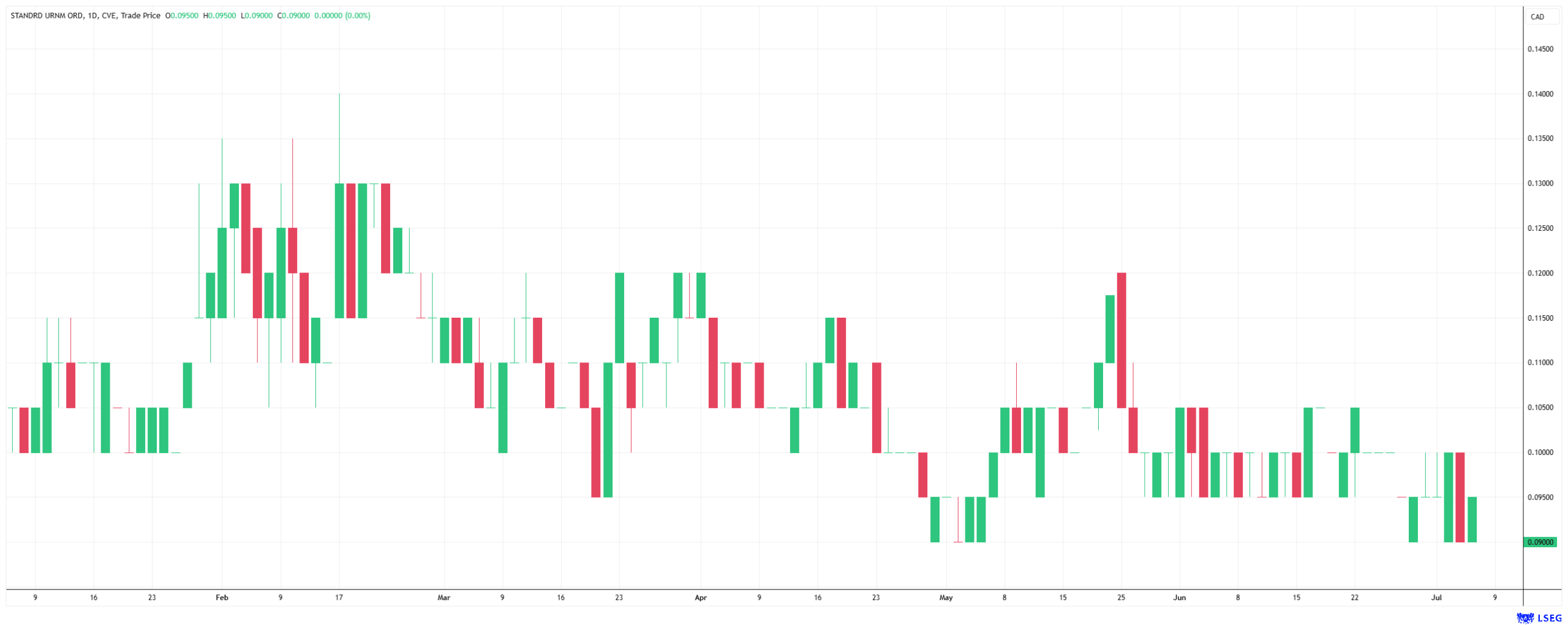
Based on the key data outlined above, Standard Uranium's stock certainly has potential. With a market capitalization of just around USD 10 million, this agile explorer offers investors exposure to new discoveries in the world's richest uranium region. The stock remains speculative, but recent hits with peak values of 1,650 cps show that the company has untapped potential. In addition, Standard Uranium stands out with a massive land portfolio of over 94,476 hectares across the entire basin. Standard Uranium strikes a chord in times of energy hunger and a nuclear power renaissance.
Watch YouTube videoConflict of interest
Pursuant to §85 of the German Securities Trading Act (WpHG), we point out that Apaton Finance GmbH as well as partners, authors or employees of Apaton Finance GmbH (hereinafter referred to as "Relevant Persons") may hold shares or other financial instruments of the aforementioned companies in the future or may bet on rising or falling prices and thus a conflict of interest may arise in the future. The Relevant Persons reserve the right to buy or sell shares or other financial instruments of the Company at any time (hereinafter each a "Transaction"). Transactions may, under certain circumstances, influence the respective price of the shares or other financial instruments of the Company.
In addition, Apaton Finance GmbH is active in the context of the preparation and publication of the reporting in paid contractual relationships.
For this reason, there is a concrete conflict of interest.
The above information on existing conflicts of interest applies to all types and forms of publication used by Apaton Finance GmbH for publications on companies.
Risk notice
Apaton Finance GmbH offers editors, agencies and companies the opportunity to publish commentaries, interviews, summaries, news and the like on news.financial. These contents are exclusively for the information of the readers and do not represent any call to action or recommendations, neither explicitly nor implicitly they are to be understood as an assurance of possible price developments. The contents do not replace individual expert investment advice and do not constitute an offer to sell the discussed share(s) or other financial instruments, nor an invitation to buy or sell such.
The content is expressly not a financial analysis, but a journalistic or advertising text. Readers or users who make investment decisions or carry out transactions on the basis of the information provided here do so entirely at their own risk. No contractual relationship is established between Apaton Finance GmbH and its readers or the users of its offers, as our information only refers to the company and not to the investment decision of the reader or user.
The acquisition of financial instruments involves high risks, which can lead to the total loss of the invested capital. The information published by Apaton Finance GmbH and its authors is based on careful research. Nevertheless, no liability is assumed for financial losses or a content-related guarantee for the topicality, correctness, appropriateness and completeness of the content provided here. Please also note our Terms of use.