March 26th, 2026 | 07:00 CET
What Makes NEO Battery Materials Unique – Drone Defense and Technological Sovereignty: Competing with DroneShield and Amprius
The German Armed Forces are ramping up investments in drone technology, while Ukraine is supporting Middle Eastern countries in strengthening their drone defense capabilities. Small, highly mobile interceptor drones are increasingly becoming the system of choice. At the core of these platforms are batteries, which determine range, climb rate, and payload—and are therefore mission-critical for successful interception. However, supply chains reveal a structural vulnerability: China currently dominates around 80% of global battery production and its critical precursors. This is where the Canadian-South Korean company NEO Battery Materials comes into play. The company is developing high-performance silicon anodes independent of Chinese supply chains and is collaborating with industrial partners such as Taesung and Korea Zinc to scale production. We outline the advantages this solution offers over competitors like Amprius Technologies and explore why vertical integration is crucial and why NEO's batteries can enhance the performance of existing drone systems without requiring major redesigns.
time to read: 2 minutes | Author: Nico Popp
ISIN: NEO BATTERY MATERIALS LTD | CA62908A1003 | TSXV: NBM , OTC: NBMFF , DRONESHIELD LTD | AU000000DRO2 , AMPRIUS TECHNOLOGIES INC | US03214Q1085 | NYSE: AMPX
Table of contents:
Author

Nico Popp
At home in Southern Germany, the passionate stock exchange expert has been accompanying the capital markets for about twenty years. With a soft spot for smaller companies, he is constantly on the lookout for exciting investment stories.
Tag cloud
Shares cloud
DroneShield and the Hardware Limits of Defense
AI-driven drone defense systems have evolved rapidly in recent years. DroneShield focuses on detecting and electronically jamming enemy drones. When jammers fail due to autonomous systems, physical interceptor drones come into play. These interceptors must accelerate within fractions of a second to neutralize agile targets. Conventional batteries with graphite anodes reach their chemical limits here, as they are too heavy or cannot deliver the required energy fast enough. Increasing power density is therefore imperative for Western armies to maintain their own air defense and effectively secure airspace.
Amprius Technologies and the Scaling Problem
To increase energy density, industry is turning to silicon as an anode material, as it has a much higher capacity than graphite. The US company Amprius Technologies is considered a pioneer in this field and produces anodes made of 100% silicon. Amprius' batteries deliver outstanding energy density, but their production relies on the extremely expensive chemical vapor deposition process. Scaling to industrial volumes for large drone fleets is therefore economically challenging. Amprius primarily serves high-end niche markets in aerospace, where cost plays a secondary role. However, the broader military drone market lacks a cost-effective solution that can be seamlessly integrated into existing battery factories. This is where the innovative battery player NEO Battery Materials comes into play.
NEO Battery Materials Provides the Drop-In Solution
NEO Battery Materials has developed a process in which low-cost metallurgical silicon is coated with a nanocoating. This coating solves the problem of silicon expansion during charging and makes the material durable. The competitive advantage over Amprius lies in industrial applicability: NEO's silicon is designed as a drop-in solution. It can be integrated directly into battery manufacturers' existing production lines without expensive retrofits. Adding small amounts of NEO silicon to conventional graphite anodes can materially increase energy density without requiring process changes. To ensure production, NEO maintains partnerships with equipment manufacturer Taesung and zinc producer Korea Zinc.
Vertical Integration Ensures Fleet Upgrades
A key aspect for the Western defense sector is decoupling from Chinese intermediate products. NEO Battery Materials is therefore a vertically integrated player. The company processes silicon from reliable sources into battery material at its commercial facility in South Korea. This 100% China-free supply chain makes NEO a strategically ideal partner for NATO. Another operational advantage is compatibility. Since the material uses existing cell formats, armies can upgrade their drone fleets already in service without making structural changes to the aircraft. This upgrade increases flight time and payload, significantly expanding the operational range of interception units.
Investment Outlook for NEO Stock in the New Security Architecture
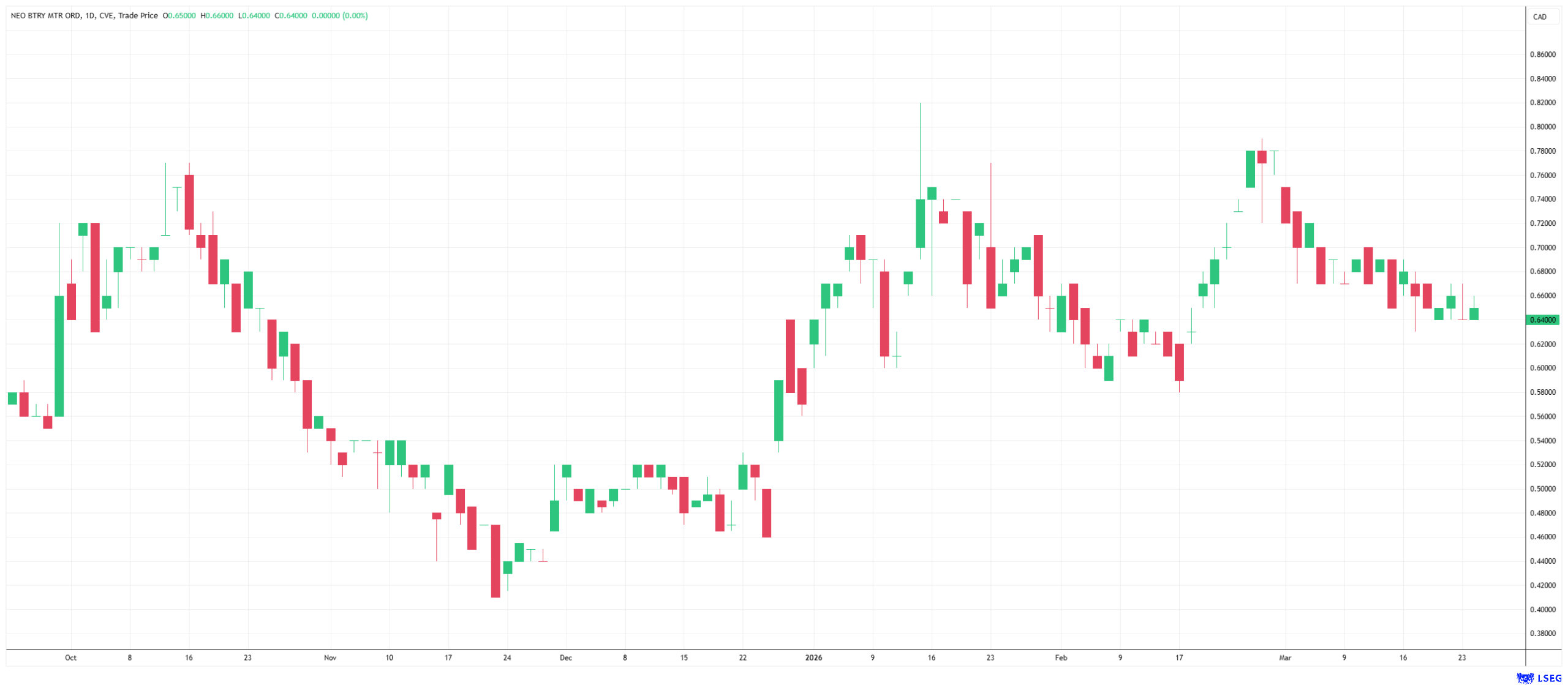
The realignment of military supply chains offers clear opportunities for investors. While players like DroneShield benefit from the demand for defense systems, NEO Battery Materials provides the underlying key technology for unmanned systems. The market environment is characterized by enormous cost pressure amid rising performance requirements, which is why cost-efficient drop-in solutions have an advantage over custom-made products. With a market capitalization of around CAD 90 million, NEO's valuation barely reflects the potential of the North American-South Korean supply chain. Amprius is valued significantly higher on the stock market despite scaling issues. As Western nations are desperately seeking high-performance, China-free battery alternatives, investors find enormous leverage in NEO within a growing geopolitical megatrend. One thing seems certain: even after the war over Iran ends, drones will remain in high demand.
Watch YouTube videoConflict of interest
Pursuant to §85 of the German Securities Trading Act (WpHG), we point out that Apaton Finance GmbH as well as partners, authors or employees of Apaton Finance GmbH (hereinafter referred to as "Relevant Persons") currently hold or hold shares or other financial instruments of the aforementioned companies and speculate on their price developments. In this respect, they intend to sell or acquire shares or other financial instruments of the companies (hereinafter each referred to as a "Transaction"). Transactions may thereby influence the respective price of the shares or other financial instruments of the Company.
In this respect, there is a concrete conflict of interest in the reporting on the companies.
In addition, Apaton Finance GmbH is active in the context of the preparation and publication of the reporting in paid contractual relationships.
For this reason, there is also a concrete conflict of interest.
The above information on existing conflicts of interest applies to all types and forms of publication used by Apaton Finance GmbH for publications on companies.
Risk notice
Apaton Finance GmbH offers editors, agencies and companies the opportunity to publish commentaries, interviews, summaries, news and the like on news.financial. These contents are exclusively for the information of the readers and do not represent any call to action or recommendations, neither explicitly nor implicitly they are to be understood as an assurance of possible price developments. The contents do not replace individual expert investment advice and do not constitute an offer to sell the discussed share(s) or other financial instruments, nor an invitation to buy or sell such.
The content is expressly not a financial analysis, but a journalistic or advertising text. Readers or users who make investment decisions or carry out transactions on the basis of the information provided here do so entirely at their own risk. No contractual relationship is established between Apaton Finance GmbH and its readers or the users of its offers, as our information only refers to the company and not to the investment decision of the reader or user.
The acquisition of financial instruments involves high risks, which can lead to the total loss of the invested capital. The information published by Apaton Finance GmbH and its authors is based on careful research. Nevertheless, no liability is assumed for financial losses or a content-related guarantee for the topicality, correctness, appropriateness and completeness of the content provided here. Please also note our Terms of use.