April 9th, 2026 | 07:10 CEST
Volatus Aerospace: The Drone Supercycle Is Just Starting—and This Undervalued Stock Stands to Soar
Unmanned aviation is no longer a niche market. It is evolving into a cornerstone of modern security and infrastructure architectures. As geopolitical tensions and hotspots expand, and technological advances accelerate the need for real-time aerial intelligence, specialized providers like Volatus Aerospace are positioning themselves for the next growth surge. Volatus's rapidly growing defense business is benefiting from NATO contracts and Canada's defense strategy. With the planned Nasdaq listing, the stock is increasingly coming into focus for investors. Investors still have an opportunity to capture the significant valuation discount.
time to read: 3 minutes | Author: Carsten Mainitz
ISIN: VOLATUS AEROSPACE INC | CA92865M1023 | TSXV: FLT , OTCQB: TAKOF
Table of contents:
Author

Carsten Mainitz
The native Rhineland-Palatinate has been a passionate market participant for more than 25 years. After studying business administration in Mannheim, he worked as a journalist, in equity sales and many years in equity research.
Tag cloud
Shares cloud
Drone Supercycle
Unmanned aviation has undergone a fundamental transformation in recent years. Today, it is an integral part of modern security and information systems. Drones no longer operate in isolation but are part of complex, AI-powered networks that collect, analyze, and utilize data in real time.
Geopolitical tensions and wars have massively accelerated this development. The current wars impressively demonstrate how crucial airborne reconnaissance and autonomous systems have become. Drones are increasingly replacing "traditional," expensive assets such as airplanes or helicopters, while offering greater efficiency and lower risks.
Yet the relevance of drones extends far beyond military applications. New fields of application have emerged in energy supply, infrastructure monitoring, border security, and disaster response, and these are growing dynamically. Volatus Aerospace serves both the civilian and security-critical markets.
Comprehensive Ecosystem
Volatus Aerospace is more than just a drone manufacturer. The company positions itself as an integrated provider of a comprehensive air and data ecosystem and was formed in 2024 through a merger with Drone Delivery Canada. Since then, the Canadian firm has impressively integrated 19 companies. The business model combines manned and unmanned aviation, autonomous control software, data-driven analytics, and long-term service contracts. The company also operates a central Operations Control Center, which enables global mission control.
This integrated approach benefits the broad customer base, which includes industrial companies, government agencies, and security organizations. The company itself can scale significantly. Service contracts provide recurring revenue. The integration of software and AI enables increased value creation throughout the entire chain.
International partnerships and a consistent focus on regulatory requirements are key pillars of the company's strategy. Certifications and standards are decisive competitive advantages, particularly in security-related environments. The Canadian company has also established its own programs for the education and training of drone pilots and specialized personnel and is a NATO partner. More than 100,000 people have been trained worldwide to date. This segment represents an important revenue stream, and customer loyalty further strengthens the company's competitive position.
Valuation and Growth Drivers
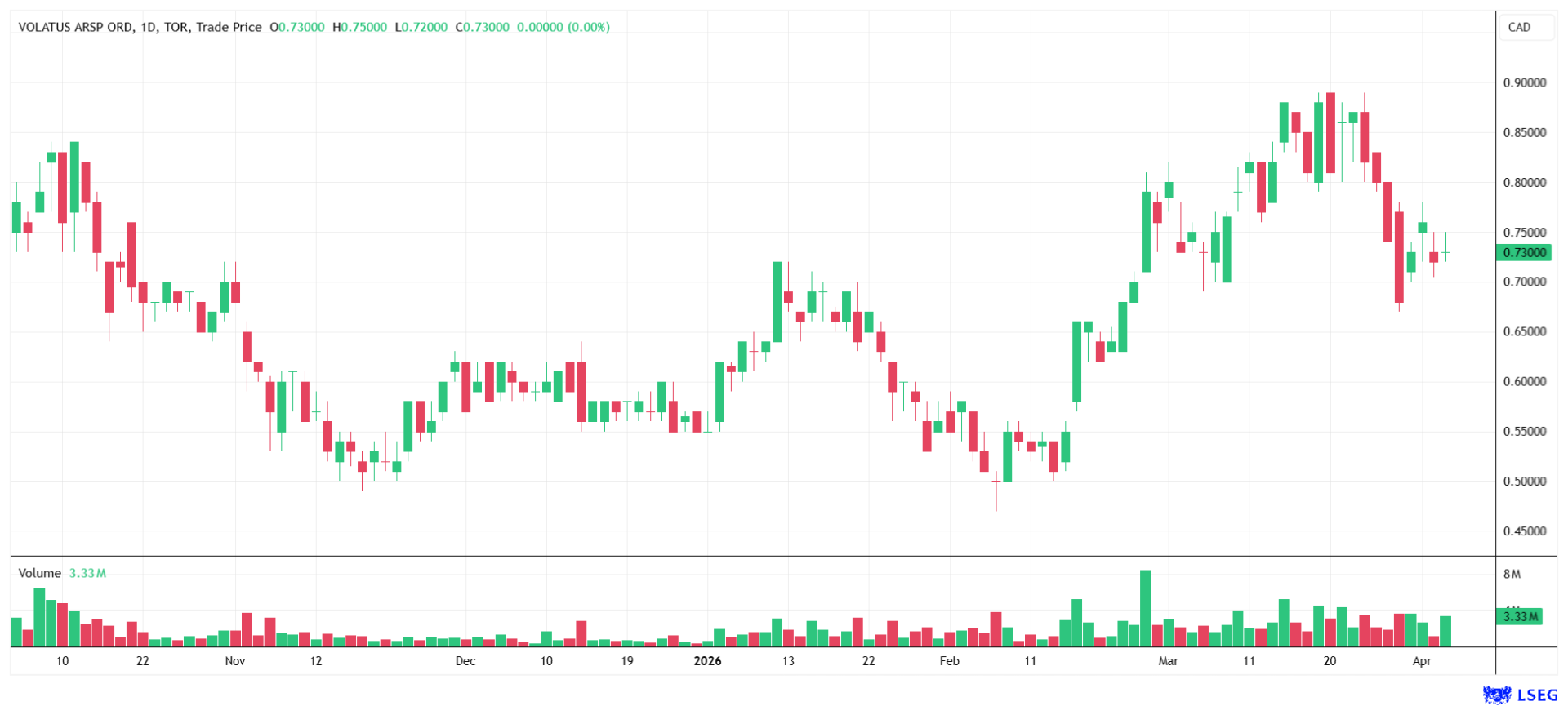
Some competitors in the drone and defense sectors are valued in the billions. Currently, with the stock trading around CAD 0.70, the company is valued at approximately CAD 475 million. The multiples appear moderate. Analysts are setting price targets above the current level. The highest price target of CAD 1.25 is set by experts at the Maxim Group. This implies an upside potential of over 75%.
The next stage of development for the Canadian company will be largely driven by technological innovations. At the center is the company's proprietary platform for autonomous control and data analysis, which operates without GPS. AI plays an increasingly critical role in pattern recognition, 3D reconstruction, and threat analysis, expanding application possibilities and adding value for customers. Extensive patents are in place. In March, the Canadian company launched its first SaaS platform for drone defense. This cloud-based service generates recurring revenue with very high margins.
In addition, the company is further expanding its industrial base. The goal is to create independent and resilient supply chains—a crucial factor given the current geopolitical landscape. The Mirabel site in Québec, Canada, is gradually developing into a center for manufacturing and system integration.
In addition, strategic partnerships ensure access to new markets and technologies. The company recently entered into a partnership with Sentinel R&D with the goal of bringing a Canadian interceptor drone to market.
National strategies to strengthen the defense and aerospace industries provide long-term planning security and promote domestic suppliers. Canada's Defence Industrial Strategy has been in place since the end of last year. Under this strategy, over CAD 80 billion is to be allocated to the domestic defense sector, with a 70% quota. As a NATO partner, the company should also be in a position to secure a slice of this massive pie. The United States' defense budget alone amounts to USD 1.5 trillion. Volatus is ideally positioned to benefit disproportionately from these opportunities.
Conclusion
Volatus is at an exciting juncture in its corporate development. Now is an attractive time for investors to get in. With its scalable and proprietary platform model, the company is well-positioned to benefit from strong market growth. Operational momentum is picking up significantly, driven by NATO contracts and Canada's Defence Industrial Strategy. The stock remains moderately valued. As the Nasdaq listing approaches, the valuation discount will gradually narrow. Analysts assign the shares an upside potential of over 75%.
Conflict of interest
Pursuant to §85 of the German Securities Trading Act (WpHG), we point out that Apaton Finance GmbH as well as partners, authors or employees of Apaton Finance GmbH (hereinafter referred to as "Relevant Persons") may hold shares or other financial instruments of the aforementioned companies in the future or may bet on rising or falling prices and thus a conflict of interest may arise in the future. The Relevant Persons reserve the right to buy or sell shares or other financial instruments of the Company at any time (hereinafter each a "Transaction"). Transactions may, under certain circumstances, influence the respective price of the shares or other financial instruments of the Company.
In addition, Apaton Finance GmbH is active in the context of the preparation and publication of the reporting in paid contractual relationships.
For this reason, there is a concrete conflict of interest.
The above information on existing conflicts of interest applies to all types and forms of publication used by Apaton Finance GmbH for publications on companies.
Risk notice
Apaton Finance GmbH offers editors, agencies and companies the opportunity to publish commentaries, interviews, summaries, news and the like on news.financial. These contents are exclusively for the information of the readers and do not represent any call to action or recommendations, neither explicitly nor implicitly they are to be understood as an assurance of possible price developments. The contents do not replace individual expert investment advice and do not constitute an offer to sell the discussed share(s) or other financial instruments, nor an invitation to buy or sell such.
The content is expressly not a financial analysis, but a journalistic or advertising text. Readers or users who make investment decisions or carry out transactions on the basis of the information provided here do so entirely at their own risk. No contractual relationship is established between Apaton Finance GmbH and its readers or the users of its offers, as our information only refers to the company and not to the investment decision of the reader or user.
The acquisition of financial instruments involves high risks, which can lead to the total loss of the invested capital. The information published by Apaton Finance GmbH and its authors is based on careful research. Nevertheless, no liability is assumed for financial losses or a content-related guarantee for the topicality, correctness, appropriateness and completeness of the content provided here. Please also note our Terms of use.