May 15th, 2026 | 09:00 CEST
USD 1.5 Trillion US Defence Budget for 2027 – Up 44% Year over Year: Volatus Aerospace Provides the Drone Technology
The new US defence budget request for 2027 is a bombshell at USD 1.5 trillion. That is 44% more than the previous year. But the real bombshell is the strategic realignment. A full USD 63 billion is earmarked for unmanned systems alone. One Canadian company is ideally equipped for this, though it comes from an unusual background. Instead of relying solely on military technology, Volatus Aerospace has spent years monitoring pipelines, power lines, and offshore wind farms. This commercial foundation could now prove to be a decisive advantage.
time to read: 5 minutes | Author: Armin Schulz
ISIN: VOLATUS AEROSPACE INC | CA92865M1023 | TSXV: FLT , OTCQB: TAKOF
Table of contents:
Author

Armin Schulz
Born in Mönchengladbach, he studied business administration in the Netherlands. In the course of his studies he came into contact with the stock exchange for the first time. He has more than 25 years of experience in stock market business.
Tag cloud
Shares cloud
From Inspector to Defence Supplier
Anyone who has spent years flying over thousands of kilometres of pipelines and power lines on behalf of energy providers learns something that cannot simply be gleaned from textbooks. Namely, how to operate reliably, cost-effectively, and above all, safely under real-world conditions. It is precisely this experience that sets Volatus apart from the many drone startups that come along with flashy presentations but little operational substance.
The Montreal-based company has gradually built a position that is virtually impossible to replicate today. While competitors are still fighting for the first BVLOS approvals, Volatus is already flying night missions over hundreds of kilometres with one of the first approvals of its kind in Canada. That may sound like an obsession with technical details, but in the defence business, it is the be-all and end-all.
Governments do not buy prototypes; they buy operational capability.
The Shift to Washington
The massive US investments in autonomous systems are not a guaranteed win for every drone company. Those looking to benefit need more than just a camera in the sky. What is required are platforms that integrate seamlessly into existing NATO structures, feature encrypted data links, and operate reliably under extreme conditions. Volatus Aerospace has specifically focused on this, developing long-range systems capable of staying airborne for between 8 hours and 7 days, alongside a control centre in Vaughan that manages missions across continents.
The company's European defence division recently grew by 150% to over CAD 10 million in revenue. This is no coincidence, but the result of a clear strategy launched years ago, long before current budget cuts dominated the headlines.
The following video provides an in-depth look at the company.
Mirabel: Where the future is being built
The heart of the expansion is in Quebec. In Mirabel, an innovation and manufacturing center is being built on an area of nearly 5,000 sqm, with the option to expand to more than three times that size, designed to break the dependence on foreign supply chains. Starting this summer, medium- and large-sized drone systems, which are of interest to both commercial and military customers, will roll off the production line here.
The business case is simple but compelling. At full capacity, 7–10 systems can be manufactured per month, each with a value of around CAD 1.5 million. The investment will be recouped after 50 to 60 units are sold. By comparison, current annual revenue is a fraction of that figure. This is the scaling potential that analysts are currently focusing on.
Key Figures to Note
The 2025 fiscal year brought a solid 26% increase in revenue to CAD 34.2 million. Even more impressive is the growth in the defence segment. Here, revenue has nearly quintupled within two years. The fourth quarter alone contributed CAD 7.3 million, an 8% increase over the same period last year.
On the other side of the income statement, as expected, there is an operating loss of just under CAD 15 million. That may sound daunting at first, but it is typical for a company in the investment phase. The trend is more important. Adjusted EBITDA improved by 25%. And the balance sheet is very robust, with CAD 41 million in cash.
Volatus Aerospace was scheduled to release its first-quarter 2026 results yesterday, May 14, 2026, after market close. These results are expected to be particularly exciting, as they could be the first to reflect the full impact of recent NATO contracts and the company's ongoing expansion. Analysts expect a significant acceleration. If this has caught your attention, it may be worth reviewing the new figures. We will provide an update on the Q1 numbers on Monday, May 18, 2026.

Pipeline as a Silent Value Driver
What can obscure the view of day-to-day business is the view of what is yet to come. The total order pipeline—that is, potential deals in various stages of negotiation—amounts to CAD 647 million, according to analysts. That is a multiple of current revenue and demonstrates the scale of what is underway here.
The Canadian government's BOREALIS program is particularly exciting. CAD 70 million is earmarked for autonomous Arctic missions. Volatus has advanced from an initial pool of 200 applicants to a shortlist of 25. The final decision will be made later this year. Whoever wins the contract here secures not only a large volume of business but, above all, a strategic foothold in a region that is becoming increasingly important in terms of security policy.
Software Boost for Margins
An often-overlooked element is the growing importance of software in the business model. With SKYDRA, Volatus has launched a SaaS platform for drone defence and mission planning. Gross margins in this segment are 80–85%, a completely different ballgame compared to hardware sales. This will significantly boost profitability once the platform gains broader adoption.
Industry experts estimate that the drone defence market could grow to over USD 20 billion by 2030. Volatus Aerospace is an early mover here, with a cloud-based solution that does not require a large initial investment from the customer. This is precisely the recipe for success in the government and military sectors. There are low barriers to entry, followed by organic growth through subscriptions.
Analyst Estimates and Price Targets
The experts are united in their positive outlook. Stifel sets the price target at CAD 1.00 and highlights the strong balance sheet and the potential of the Mirabel plant. Canaccord Genuity arrives at the same target of CAD 1.00 but emphasizes the strategic positioning in the context of the new Canadian defence strategy. Ventum Capital Markets is slightly more cautious at CAD 0.95 but sees significant upside potential from the pipeline. Haywood and the Maxim Group go a step further with CAD 1.00 and CAD 1.25, respectively. At the current price level of around CAD 0.69, this implies upside potential of up to 81%.
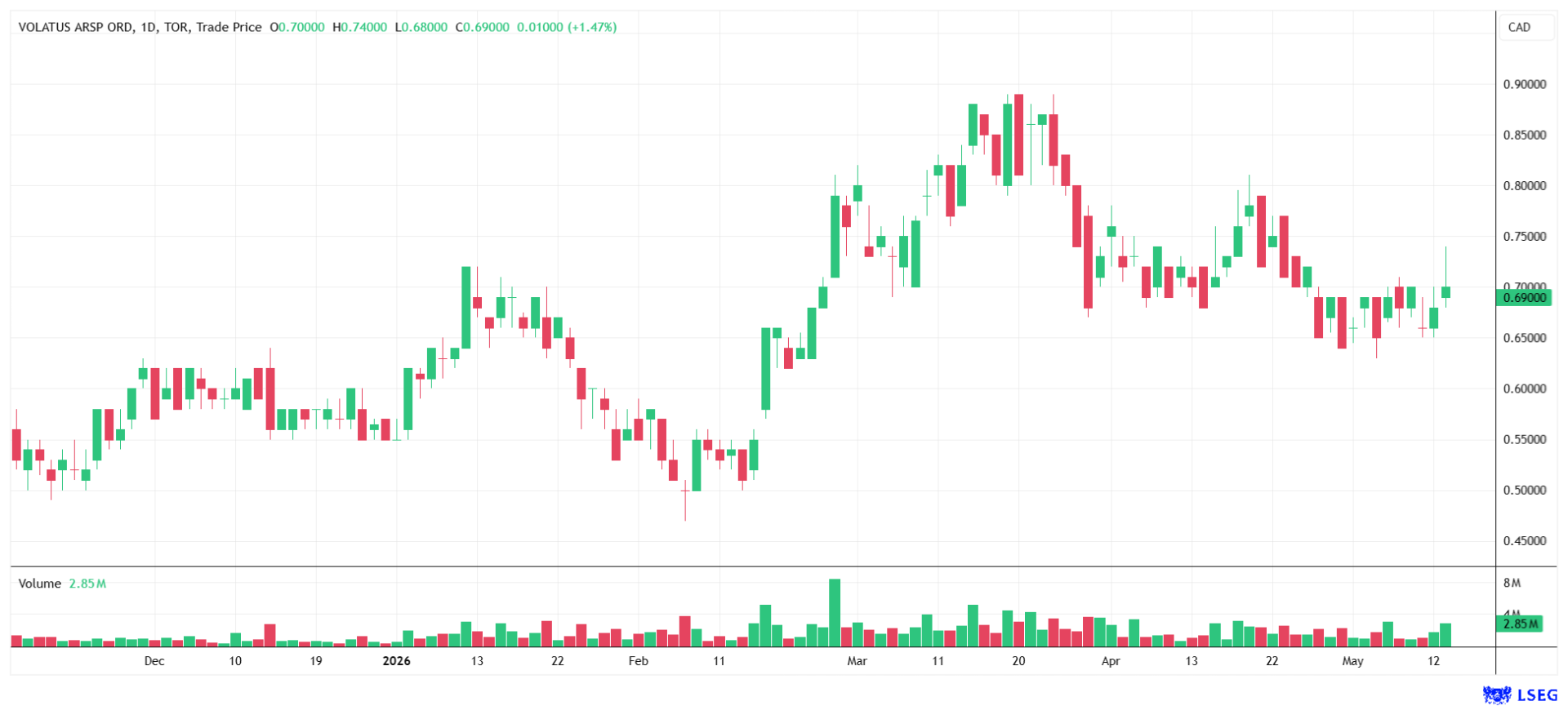
Volatus Aerospace is no bluff. Its commercial track record provides the operational foundation, while the US budget boost and Canada's new procurement rules offer political tailwinds. The Mirabel facility delivers the scale, and the software delivers the margins. Analysts see prices between CAD 0.95 and 1.25, well above the current level. Those who get in now are not buying a guessing game, but a clear roadmap. The coming quarters will show how quickly the ship picks up speed. The course is set. Time is on the side of those who got in early.
Conflict of interest
Pursuant to §85 of the German Securities Trading Act (WpHG), we point out that Apaton Finance GmbH as well as partners, authors or employees of Apaton Finance GmbH (hereinafter referred to as "Relevant Persons") currently hold or hold shares or other financial instruments of the aforementioned companies and speculate on their price developments. In this respect, they intend to sell or acquire shares or other financial instruments of the companies (hereinafter each referred to as a "Transaction"). Transactions may thereby influence the respective price of the shares or other financial instruments of the Company.
In this respect, there is a concrete conflict of interest in the reporting on the companies.
In addition, Apaton Finance GmbH is active in the context of the preparation and publication of the reporting in paid contractual relationships.
For this reason, there is also a concrete conflict of interest.
The above information on existing conflicts of interest applies to all types and forms of publication used by Apaton Finance GmbH for publications on companies.
Risk notice
Apaton Finance GmbH offers editors, agencies and companies the opportunity to publish commentaries, interviews, summaries, news and the like on news.financial. These contents are exclusively for the information of the readers and do not represent any call to action or recommendations, neither explicitly nor implicitly they are to be understood as an assurance of possible price developments. The contents do not replace individual expert investment advice and do not constitute an offer to sell the discussed share(s) or other financial instruments, nor an invitation to buy or sell such.
The content is expressly not a financial analysis, but a journalistic or advertising text. Readers or users who make investment decisions or carry out transactions on the basis of the information provided here do so entirely at their own risk. No contractual relationship is established between Apaton Finance GmbH and its readers or the users of its offers, as our information only refers to the company and not to the investment decision of the reader or user.
The acquisition of financial instruments involves high risks, which can lead to the total loss of the invested capital. The information published by Apaton Finance GmbH and its authors is based on careful research. Nevertheless, no liability is assumed for financial losses or a content-related guarantee for the topicality, correctness, appropriateness and completeness of the content provided here. Please also note our Terms of use.