July 7th, 2026 | 06:55 CEST
Tungsten Emergency: Why Almonty Is Exceptionally Positioned - Sandvik and Lockheed Martin Under Pressure
Beijing's tightened export controls on critical raw materials such as tungsten show how heavily the West depends on established supply chains. China still controls around 80% of global tungsten production. In response to this threat, from January 1, 2027, the US will ban the import of tungsten from China, Russia, Iran, and North Korea for military purposes. This regulatory turning point and a surge in demand from the defense sector drove the world market price for ammonium paratungstate (APT) from historic lows in the low triple-digit range per metric tonne unit (MTU = 10 kg) to well over USD 3,000 per MTU. We take a closer look at the market and show how investors can profit from the tungsten emergency.
time to read: 3 minutes | Author: Nico Popp
ISIN: ALMONTY INDUSTRIES INC. | CA0203987072 | TSX: AII , NASDAQ: ALM , ASX: AII , LOCKHEED MARTIN DL 1 | US5398301094 , SANDVIK AB | SE0000667891
Table of contents:
Author

Nico Popp
At home in Southern Germany, the passionate stock exchange expert has been accompanying the capital markets for about twenty years. With a soft spot for smaller companies, he is constantly on the lookout for exciting investment stories.
Tag cloud
Shares cloud
Sandvik Focuses on Innovation and the Circular Economy
The Swedish industrial group Sandvik plays a doubly significant role in the tungsten value chain. With revenue of around SEK 121 billion, the group is, on the one hand, one of the world's largest industrial buyers of tungsten carbide for drilling and cutting tools. At the same time, its subsidiary Sandvik Coromant is committed to the circular economy and is aiming for a 100% take-back rate for used carbide tools by 2028. However, this fundamentally smart system reaches its limits because tungsten carbide is continuously worn away under mechanically extreme stresses, such as those encountered during milling high-strength armour steels. This share of material is lost forever, which is why every industrial cycle is inevitably dependent on tungsten mined from the ground. To secure this supply, Sandvik operates the Mittersill mine in Austria through its subsidiary Wolfram Bergbau und Hütten AG, where more than 500,000 t of ore are mined annually at a grade of 0.25% tungsten trioxide.
Lockheed Martin: Tungsten in Demand
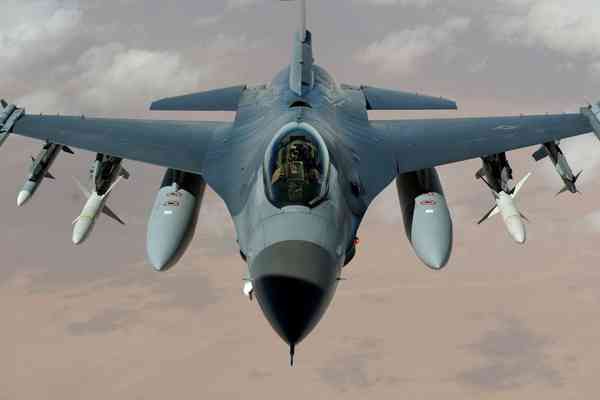
As a leading systems integrator in the defense industry, Lockheed Martin stands at the end of the tungsten value chain. Given Lockheed's enormous order backlog, tungsten availability is a top priority. Lockheed Martin and the Pentagon rely on audits and strict contracts to ensure that tungsten does not originate from China. This increases pressure on the black sheep of the industry and favours companies that demonstrably operate in secure jurisdictions. Such as Almonty Industries.
Almonty Industries: The Sangdong Mine as the Heart of the Western Ecosystem
Almonty Industries has developed step by step into the leading Western supplier of tungsten in recent years. Its business model is based on operating mines in politically stable jurisdictions in order to guarantee the West an independent and secure supply. The undisputed flagship project in the portfolio is the Sangdong mine in South Korea, whose processing plants recently officially came online. At the end of the first quarter of 2026, Almonty held a stockpile of around 120,000 t of raw ore with an average grade of 0.24% tungsten trioxide.
In the second quarter of 2026, the company mined a further 19,700 t of ore at a higher grade of 0.35% tungsten trioxide. In total, 139,700 t of ore with a blended grade of about 0.25% tungsten trioxide are awaiting processing. At current record prices, this corresponds to an estimated raw material value of around USD 68 million. Sangdong's exceptional geological quality is evident by comparison: Sangdong's lower-concentration development ore has three times higher tungsten content than the ore of the established Panasqueira mine in Portugal. Key figures of other competing projects are in some cases significantly worse and are therefore unlikely to be competitive. Because Sangdong's operating cash costs per MTU are in the low triple-digit range, Almonty boasts a hefty margin second to none.
Diversification, Side Projects, and the US Resurgence
Alongside the huge Sangdong mine and the long-standing cash cow Panasqueira, Almonty is pushing ahead with the Gentung Browns project in the US state of Montana. After receiving the still-outstanding permits, the project is scheduled to begin production as early as the end of 2026. With a targeted annual production of 140,000 MTU, Almonty will thereby become the leading operator of a tungsten mine on US soil. The political tailwind from Washington to prioritize domestic sources of critical raw materials should additionally play into Almonty's hands at Gentung Browns. In addition, the company holds two further properties in Spain, which, however, are currently not producing.
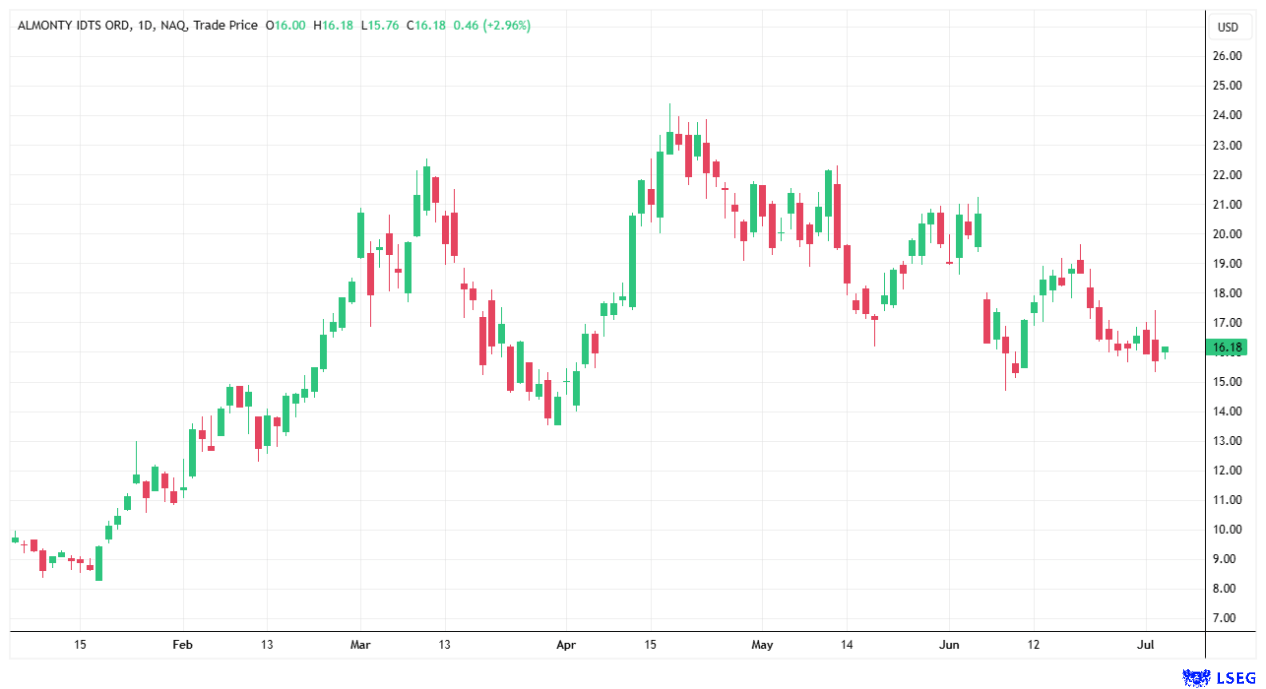
Following the issuance of a USD 800 million convertible senior notes offering a few weeks ago, Almonty has sufficient capital on hand to continue growing. In addition to acquiring another mine, entering tungsten processing is also conceivable. Since acquiring the Panasqueira mine in 2016, the company has preserved a rich store of tungsten expertise and operates what it says is the world's most advanced tungsten laboratory. After the share broke many records in 2025, the stock has since been trending sideways. This can be an opportunity for investors with staying power - Almonty is uniquely positioned and is ramping up Sangdong at the best possible time. This will become apparent in the coming quarterly figures. More and more renowned analyst firms, such as Bank of America and Cantor Fitzgerald, also have the stock on their radar and set price targets well above the current share price.
Watch YouTube videoConflict of interest
Pursuant to §85 of the German Securities Trading Act (WpHG), we point out that Apaton Finance GmbH as well as partners, authors or employees of Apaton Finance GmbH (hereinafter referred to as "Relevant Persons") currently hold or hold shares or other financial instruments of the aforementioned companies and speculate on their price developments. In this respect, they intend to sell or acquire shares or other financial instruments of the companies (hereinafter each referred to as a "Transaction"). Transactions may thereby influence the respective price of the shares or other financial instruments of the Company.
In this respect, there is a concrete conflict of interest in the reporting on the companies.
In addition, Apaton Finance GmbH is active in the context of the preparation and publication of the reporting in paid contractual relationships.
For this reason, there is also a concrete conflict of interest.
The above information on existing conflicts of interest applies to all types and forms of publication used by Apaton Finance GmbH for publications on companies.
Risk notice
Apaton Finance GmbH offers editors, agencies and companies the opportunity to publish commentaries, interviews, summaries, news and the like on news.financial. These contents are exclusively for the information of the readers and do not represent any call to action or recommendations, neither explicitly nor implicitly they are to be understood as an assurance of possible price developments. The contents do not replace individual expert investment advice and do not constitute an offer to sell the discussed share(s) or other financial instruments, nor an invitation to buy or sell such.
The content is expressly not a financial analysis, but a journalistic or advertising text. Readers or users who make investment decisions or carry out transactions on the basis of the information provided here do so entirely at their own risk. No contractual relationship is established between Apaton Finance GmbH and its readers or the users of its offers, as our information only refers to the company and not to the investment decision of the reader or user.
The acquisition of financial instruments involves high risks, which can lead to the total loss of the invested capital. The information published by Apaton Finance GmbH and its authors is based on careful research. Nevertheless, no liability is assumed for financial losses or a content-related guarantee for the topicality, correctness, appropriateness and completeness of the content provided here. Please also note our Terms of use.