July 7th, 2026 | 07:15 CEST
This Market Is Growing 17.1% Annually: Bayer and KWS SAAT Rethink Their Strategies – MustGrow Biologics Gains Momentum
Created and published on behalf of MustGrow Biologics Corp.
It is not only drought that is putting pressure on farmers. Regulators are increasingly banning chemical active ingredients that have been used for decades in an effort to protect soils and consumers. Already, 168 countries have significantly restricted or completely banned the use of approximately 568 chemical pesticides. At the same time, the European Union aims to have at least 25% of its agricultural land farmed organically by 2030. As many highly effective products are being phased out, farmers around the world are facing growing challenges. The question of how to maintain crop yields under these changing conditions has become a key concern for industry. This trend is fueling the biopesticides market, which, according to current industry forecasts by Fortune Business Insights, is expected to grow at a compound annual growth rate (CAGR) of 17.1%, reaching USD 40.61 billion by 2034.
time to read: 3 minutes | Author: Nico Popp
ISIN: MUSTGROW BIOLOGICS CORP. | CA62822A1030 | TSXV: MGRO , OTCQB: MGROF , BAYER AG NA O.N. | DE000BAY0017 , KWS SAAT KGAA INH O.N. | DE0007074007
Table of contents:
Author

Nico Popp
At home in Southern Germany, the passionate stock exchange expert has been accompanying the capital markets for about twenty years. With a soft spot for smaller companies, he is constantly on the lookout for exciting investment stories.
Tag cloud
Shares cloud
Bayer: Pressure to act at the chemical giant
Agrochemical specialist Bayer is under high pressure in the current market environment. To keep its Crop Science agricultural division profitable and to manage the fallout from the US glyphosate lawsuits, CEO Bill Anderson is driving a fundamental restructuring. By the end of 2026, Bayer aims to save around EUR 2 billion. In fiscal year 2025, the group as a whole generated revenue of EUR 45.575 billion and EBITDA before special items of EUR 9.669 billion. The Crop Science division contributed EBITDA before special items of EUR 4.188 billion to this, representing a 3.2% decline from the previous year. While the seed business grew, classic crop protection segments such as the insecticide business slumped by 12%. Because the company has committed to reducing the ecological footprint of its crop protection portfolio by 30% by 2030, the group urgently needs new, highly efficient biological technologies to close revenue gaps.
KWS Saat relies on innovation
KWS Saat, based in Einbeck, focuses on the beginning of the agricultural value chain. Under the leadership of Executive Board Spokesperson Felix Büchting, the SDAX-listed company is recording stable growth and, with equity of EUR 1.6 billion and a market capitalization of around EUR 2.3 billion, is regarded as financially strong. In fiscal year 2024/2025, KWS generated revenue of approximately EUR 1.68 billion at an operating EBITDA margin of around 20%. Strategically, the group relies on state-of-the-art breeding methods and secured access to patented CRISPR-Cas systems through a worldwide licensing agreement to achieve even more precise resistance to plant pests. For the immediate protection of the seedling in moist soil, the company developed the KWS INITIO seed treatment line. In cooperation with Biotenzz, a spin-off of TU Graz, KWS embeds beneficial bacterial strains in microscopic capsules that only take effect after sowing – a process that enables yield increases of up to 5% in sugar beet. This shows that innovation is still possible in agriculture, too.
MustGrow Biologics is revolutionizing the industry
At the intersection of ecological research and commercial agriculture, the Canadian agtech company MustGrow Biologics occupies a key position. The management team relies on the natural biological defence mechanism of the mustard plant. The patented process concentrates the active ingredient, AITC, into a stable liquid formulation called TerraMG™. This biological liquid can be applied via standard irrigation, injection and spray systems, which makes application considerably easier for farmers compared with the mechanical incorporation of mustard meal.
Extensive field studies conducted on approximately 40 hectares of farmland in Western Canada have validated its effectiveness. In a wet growing season, the pre-registered biocontrol product TerraMG™ reduced the concentration of clubroot spores in the soil, thereby enabling higher yields. In the area of biofertility, the company markets the organic product TerraSante™, which demonstrated significant improvements in quality and yield for potatoes in field trials. The market potential for intensively farmed high-value crops in the US alone covers approximately 5.6 million acres. The company estimates that even with a market penetration of just 3.3% and a single annual application, it could generate approximately USD 100 million in revenue.
Partnership with Bayer: Major Vote of Confidence – Stock Appears Undervalued
MustGrow's commercialization strategy is built around partnerships with global industry leaders to navigate the capital-intensive regulatory approval process. The most significant milestone to date is an exclusive licensing and collaboration agreement with Bayer for the EMEA region. Under the agreement, Bayer assumes full responsibility for conducting and funding all regulatory studies, laboratory testing, and approval procedures. MustGrow expects the combined value of the upfront payment, milestone payments, and Bayer-funded development activities to total USD 35–40 million over the next five to seven years.
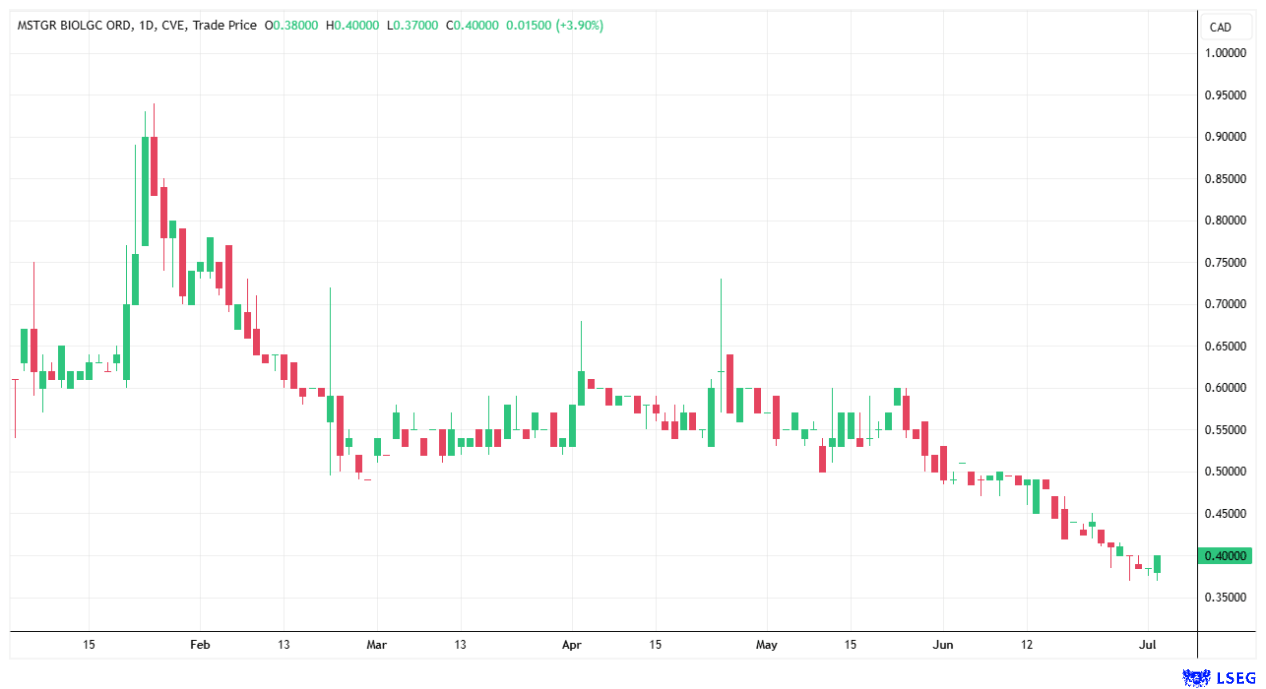
Analysts and market observers view the collaboration between MustGrow and Bayer as particularly promising, as it secures distribution channels and enables further innovation. Since MustGrow also pursues a high-margin licensing and contract manufacturing model, thereby avoiding large capital investments, the risk for MustGrow shareholders appears manageable. Although the stock has recently declined, its current market capitalization of only about CAD 28 million is likely to attract bargain hunters. Since MustGrow can solve pressing problems in the agricultural sector and has strong ties to the industry's major players, investors should keep an eye on the stock.
Conflict of interest
Pursuant to §85 of the German Securities Trading Act (WpHG), we point out that Apaton Finance GmbH as well as partners, authors or employees of Apaton Finance GmbH (hereinafter referred to as "Relevant Persons") may hold shares or other financial instruments of the aforementioned companies in the future or may bet on rising or falling prices and thus a conflict of interest may arise in the future. The Relevant Persons reserve the right to buy or sell shares or other financial instruments of the Company at any time (hereinafter each a "Transaction"). Transactions may, under certain circumstances, influence the respective price of the shares or other financial instruments of the Company.
In addition, Apaton Finance GmbH is active in the context of the preparation and publication of the reporting in paid contractual relationships.
For this reason, there is a concrete conflict of interest.
The above information on existing conflicts of interest applies to all types and forms of publication used by Apaton Finance GmbH for publications on companies.
Risk notice
Apaton Finance GmbH offers editors, agencies and companies the opportunity to publish commentaries, interviews, summaries, news and the like on news.financial. These contents are exclusively for the information of the readers and do not represent any call to action or recommendations, neither explicitly nor implicitly they are to be understood as an assurance of possible price developments. The contents do not replace individual expert investment advice and do not constitute an offer to sell the discussed share(s) or other financial instruments, nor an invitation to buy or sell such.
The content is expressly not a financial analysis, but a journalistic or advertising text. Readers or users who make investment decisions or carry out transactions on the basis of the information provided here do so entirely at their own risk. No contractual relationship is established between Apaton Finance GmbH and its readers or the users of its offers, as our information only refers to the company and not to the investment decision of the reader or user.
The acquisition of financial instruments involves high risks, which can lead to the total loss of the invested capital. The information published by Apaton Finance GmbH and its authors is based on careful research. Nevertheless, no liability is assumed for financial losses or a content-related guarantee for the topicality, correctness, appropriateness and completeness of the content provided here. Please also note our Terms of use.