April 10th, 2026 | 07:00 CEST
The Geological "Unicorn" the Market Refuses to See: Yet Power Metallic Mines Already Has the Big Players on Board
There are moments in the commodities industry when the data speaks so clearly that one has to wonder why the market hasn't caught on. Power Metallic Mines appears to be in exactly such a phase. On one side, spectacular drill results, world-class metallurgy, and high-profile investors point to generational potential. On the other, the market remains cautious, skeptical, and stuck in a wait-and-see mode for "the next study." Those who recognize this disconnect may be looking at one of the rare asymmetric opportunities in today's commodities market.
time to read: 5 minutes | Author: Armin Schulz
ISIN: POWER METALLIC MINES INC. | CA73929R1055 | TSXV: PNPN , OTCBB: PNPNF
Table of contents:
Author

Armin Schulz
Born in Mönchengladbach, he studied business administration in the Netherlands. In the course of his studies he came into contact with the stock exchange for the first time. He has more than 25 years of experience in stock market business.
Tag cloud
Shares cloud
World A – The Silent Avalanche of Facts
In the James Bay region of Québec, a drilling program is underway that amazes even industry veterans. Six rigs are in continuous operation, 100,000 m are budgeted, and the results coming out of the lab month after month read like a single confirmation of the extraordinary.
The most recent drill hole from March 2026, PML-26-049, intersected a 16.55-meter-long section containing 10.08% pure copper, equivalent to 15.11% copper equivalent. CEO Terry Lynch commented simply: "Once again, an impressive list of results from the Lion Zone." That alone would be remarkable. But the story gets better the more holes you look at. Of 95 published drill holes in the Lion Zone, 78 delivered intervals of more than 11 m with over 4.5% copper equivalent. The zone begins practically at surface, now extends to a depth of 750 m, and remains consistent in quality.
But World A is not just about drill data. There is metallurgy. In January, the company released the results of a locked-cycle test conducted by SGS, the world's leading testing institute. The figures: 98.9% recovery for copper, 96.8% for platinum, 93.9% for palladium. SGS itself noted: "These results point to potential opportunities for converting the concentrate into value-added products, including advanced materials for various economic sectors such as battery and energy storage, electrification, clean energy, and advanced manufacturing." Management had previously made a conservative estimate of 80%. According to the new calculation, the recoverable metal volume increases by more than 18% on a purely mathematical basis.
Then there is the shareholder structure. Robert Friedland, the discoverer of Voisey's Bay, holds around 4% and led the last two financing rounds. His reaction to the first spectacular drill holes? In a conversation with CEO Terry Lynch, he said that either the core must have been tampered with, or it was a geological unicorn—a "duck-billed platypus" deposit that shouldn't actually exist. Since he ruled out tampering, only the latter remained. And such deposits, according to Friedland, have, in his experience, invariably turned out to be very large.
Gina Rinehart also got on board later. CEO Terry Lynch himself holds about 16% and has bought more than 700,000 shares on the market in the past 90 days, plus invested another CAD 500,000 through option exercises - a clear signal.
World B – The Market That Refuses to Believe
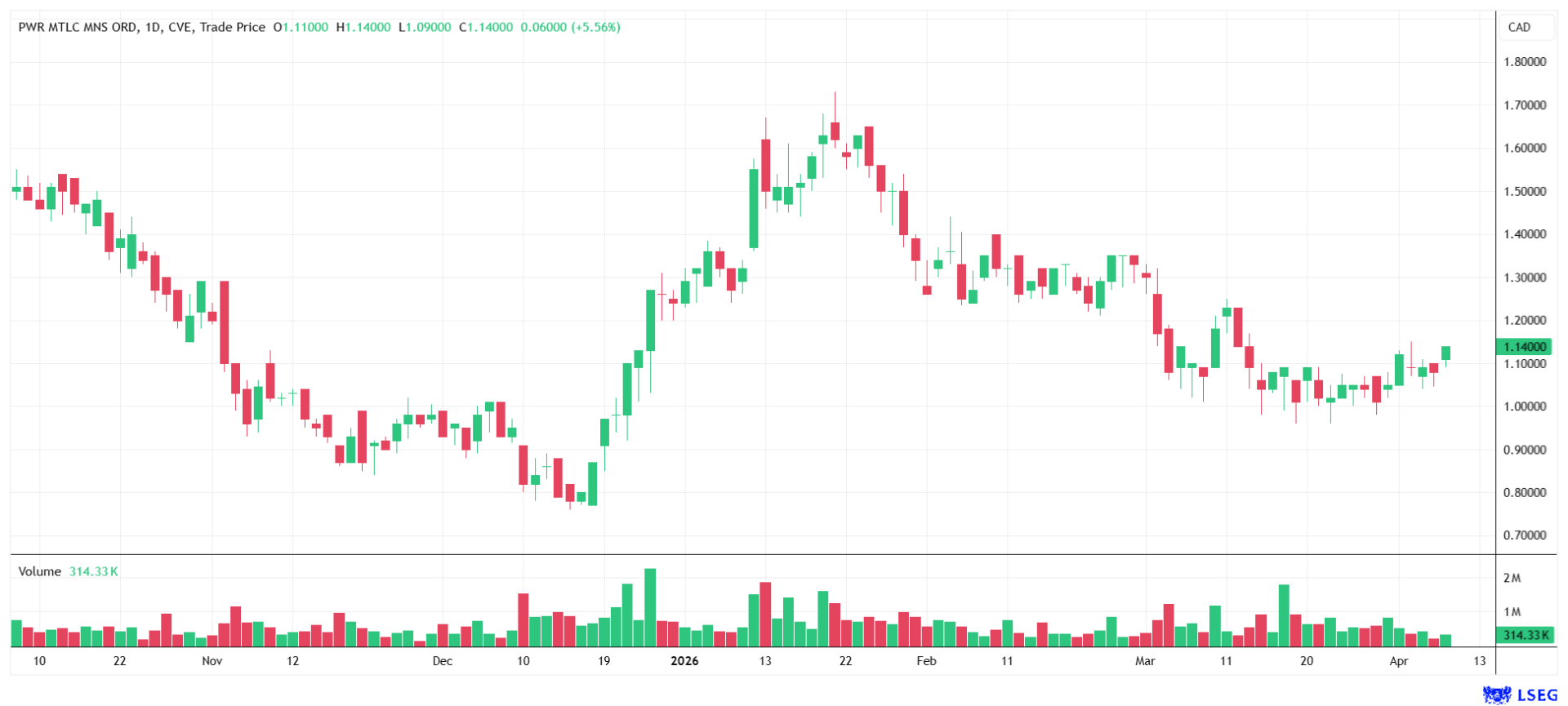
And despite all this? The stock has not really gained momentum in recent months. An outstanding performance in the first year was followed by a sideways trend. Management has several explanations for this.
First: profit-taking by early investors - a normal phenomenon. Second: the challenging market environment for junior mining. But the third point is the decisive one. The market apparently has difficulty interpreting the right metrics. Analyst firms estimate the size of the Lion Zone at 8–13 million tons with a copper equivalent of 5–7%. But estimates are not official resources under NI 43-101.
The metallurgical study released in January was a prime example of the discrepancy between technical perfection and market reaction. Many market participants expected recovery rates of around 80%, a reasonable assumption. The company delivered a 95% total recovery rate, 98.9% for copper. This should have eliminated all remaining technical risks. Instead, the stock price moved only briefly before drifting back down.
Lynch drew a clear lesson from this. The market does not believe in analyst reports; it believes in documented studies. A drill result is one thing. A Preliminary Economic Assessment (PEA) with Capex figures, cash flow projections, and a clear roadmap to the mine—that is something else entirely.
Why the PEA Will Change Everything
This is exactly where the strategic course correction comes in. Originally, the PEA was planned for the end of the year. Now it is being brought forward. The technical report is expected to be available in August or September at the latest, even before the major industry conference in Beaver Creek.
What can investors expect from the PEA? Management anticipates a total investment of between CAD 400 and 600 million, depending on the scale. That sounds like a lot of money, but for a mine of this quality, it is manageable. Modern open-pit copper mines often cost several billion CAD. The key lies in the tax benefits. The Canadian federal government grants a 30% credit on critical minerals, and the province of Québec adds another 25%. Both are refundable tax credits that are paid out in cash.
An obvious comparison is Canada Nickel, a company that developed a similar polymetallic project in the region and was recently acquired for just under USD 3.8 billion. According to the CEO, the recoverable metal reserves in the ground are quite comparable. Power Metallic is currently valued at a fraction of that. The message is clear: once the development steps are completed, a similar valuation logic should apply.
The Bet on Convergence
For the investor, the question arises: Which world are you living in? Those who see only World B are waiting for the PEA, for the New York Stock Exchange listing, for the next major drilling success.
Those who understand World A know that the fundamental facts are already on the table. The geology is exceptional, the metallurgy is better than expected, financing is secured, and the insiders have their own fortunes on the line.
Management speaks openly of a "district play"—the possibility that multiple mines could develop over the years within the same concession area. The land package has already increased sixfold. Systematic exploration of these areas is still in its early stages. According to company officials, investors here are not only getting a project with clear economic prospects but also the option for further growth without paying a premium for it at this time. GBC Research sees a price target of CAD 2.85.
The stock is currently trading at CAD 1.14.
At Power Metallic Mines, two worlds collide. One is filled with a wealth of drill meters, double-digit copper grades, and nearly perfect metallurgy. The other hesitates and waits for the next official study. The PEA, which is set to be released by the end of the second quarter at the latest, should bridge the gap. Those who wait until then to get in may already be paying the higher price for the recognized truth. Those who understand the discrepancy today secure the advantage of being part of one of the rarest deposit types worldwide, in a top jurisdiction, with billionaires risking their own money. The question is not if, but when the market will wake up.
Conflict of interest
Pursuant to §85 of the German Securities Trading Act (WpHG), we point out that Apaton Finance GmbH as well as partners, authors or employees of Apaton Finance GmbH (hereinafter referred to as "Relevant Persons") currently hold or hold shares or other financial instruments of the aforementioned companies and speculate on their price developments. In this respect, they intend to sell or acquire shares or other financial instruments of the companies (hereinafter each referred to as a "Transaction"). Transactions may thereby influence the respective price of the shares or other financial instruments of the Company.
In this respect, there is a concrete conflict of interest in the reporting on the companies.
In addition, Apaton Finance GmbH is active in the context of the preparation and publication of the reporting in paid contractual relationships.
For this reason, there is also a concrete conflict of interest.
The above information on existing conflicts of interest applies to all types and forms of publication used by Apaton Finance GmbH for publications on companies.
Risk notice
Apaton Finance GmbH offers editors, agencies and companies the opportunity to publish commentaries, interviews, summaries, news and the like on news.financial. These contents are exclusively for the information of the readers and do not represent any call to action or recommendations, neither explicitly nor implicitly they are to be understood as an assurance of possible price developments. The contents do not replace individual expert investment advice and do not constitute an offer to sell the discussed share(s) or other financial instruments, nor an invitation to buy or sell such.
The content is expressly not a financial analysis, but a journalistic or advertising text. Readers or users who make investment decisions or carry out transactions on the basis of the information provided here do so entirely at their own risk. No contractual relationship is established between Apaton Finance GmbH and its readers or the users of its offers, as our information only refers to the company and not to the investment decision of the reader or user.
The acquisition of financial instruments involves high risks, which can lead to the total loss of the invested capital. The information published by Apaton Finance GmbH and its authors is based on careful research. Nevertheless, no liability is assumed for financial losses or a content-related guarantee for the topicality, correctness, appropriateness and completeness of the content provided here. Please also note our Terms of use.