May 20th, 2026 | 08:00 CEST
The Defence and Commodities Crisis: Lockheed Martin, Glencore, and Antimony Resources' Unique Opportunity
Created and published on behalf of Antimony Resources Corp.
Export restrictions and skyrocketing commodity prices – the shifting geopolitical availability of strategic metals is posing challenges for the Western defence industry. While raw material procurement was for decades merely a logistical task within the framework of a functioning globalized economy, secure access to conflict-free deposits now determines the defence capabilities of Western nations. The significance of this structural shift is particularly evident in the case of antimony, an indispensable key component for civilian technologies and defence equipment. Since the United States has no domestic antimony production, the development of new mining projects in stable North American jurisdictions is of the utmost importance. In this market environment, the Canadian mining company Antimony Resources is coming into the spotlight of global defence and raw materials corporations.
time to read: 4 minutes | Author: Nico Popp
ISIN: ANTIMONY RESOURCES CORP | CA0369271014 | CSE: ATMY , OTCQB: ATMYF , LOCKHEED MARTIN DL 1 | US5398301094 , GLENCORE PLC DL -_01 | JE00B4T3BW64
Table of contents:
Author

Nico Popp
At home in Southern Germany, the passionate stock exchange expert has been accompanying the capital markets for about twenty years. With a soft spot for smaller companies, he is constantly on the lookout for exciting investment stories.
Tag cloud
Shares cloud
China's Antimony Monopoly and Its Impact on Supply Chains
The West's defence supply chain suffers from a one-sided dependency. According to the United States Geological Survey, China controls nearly half of global antimony mine production and was responsible for 63% of US imports in the past. The Chinese Ministry of Commerce deliberately uses this dominance as a geopolitical lever. Initial export restrictions in August 2024 were followed in December 2024 by a complete ban on exports of antimony, gallium, and germanium to the United States. The US think tank, the Center for Strategic and International Studies, classifies this measure as direct retaliation against US sanctions on the Chinese semiconductor industry.
The direct consequences for the market were drastic. While Chinese shipments to the US plummeted by 97% following the initial restrictions, the strategic raw material saw a historic price surge. Analysts at GBC report that the price of antimony skyrocketed from around USD 10,000 per ton in 2020 to a peak of approximately USD 60,000 per ton. Since the element is needed not only for civilian high-tech applications but also for military sensors, flame retardants, and—crucially—for primers and ignition systems in a wide variety of ammunition types, the Western defence industry is under pressure to act.
Lockheed Martin: Record Orders in the Shadow of Supply Risks
As the world's leading defence contractor, Lockheed Martin is under pressure to ramp up production capacity for guided missiles and precision-guided munitions—a pressure that has intensified since the outbreak of the Iran war. The ignition systems for these weapon systems are critically dependent on high-purity antimony trisulfide, for which there is no equivalent substitute. While Lockheed Martin relies on a massive order backlog of USD 186 billion, it will only be able to fully fulfill these orders if it has access to raw materials. According to reports from the research firm Morningstar, delayed deliveries and general margin pressure in fixed-price development programs have weighed on Lockheed's business.
Glencore: Logistical Dominance and Focus on Defence Raw Materials
The Swiss commodities giant Glencore is benefiting significantly from the increasing nationalization of raw materials by combining metal mining with a global trading platform. In fiscal year 2025, the group generated adjusted EBITDA of USD 13.5 billion on total revenue of USD 247.54 billion. Glencore's preliminary annual report shows that the industrial division contributed USD 9.9 billion to this figure, supported by strong operating EBITDA margins of 30% in the metals segment.
Glencore continues to optimize its defence-relevant portfolio and is expanding its presence in North America. With the Horne smelter in Quebec, the company operates the largest metallurgical processing facility for complex ores and electronic scrap on the North American continent. As confirmed by Reuters reports, the conglomerate is also in advanced negotiations with Perpetua Resources regarding a strategic partnership for antimony refining in the US, as smelting capacity is in urgent demand.
Antimony Resources: Huge Antimony Project in New Brunswick, Canada
In this competitive environment, Antimony Resources is positioning itself as an antimony pure play and a potential acquisition target. The company controls the Bald Hill project in the Canadian province of New Brunswick, which was optioned by Globex Mining in 2025. The project area covers 37 km² in Queens County. The geology is characterized by three antimony-rich zones with a known strike length of 600 to 700 m and a depth of at least 350 m. Since the mineralization is open in all directions, the project on the North American East Coast offers great potential.
A technical report in accordance with the NI 43-101 mining standard defined an exploration target for the main zone of approximately 2.71 million tons of ore with an average grade of 3% to 4% antimony. This corresponds to a potential metal content of 81,000 to 108,000 t, making Bald Hill one of the most significant undeveloped projects in North America. The operational quality is underpinned by excellent drilling results. Drill hole BH-25-08 returned spectacular 14.91% antimony over 3.00 m, while the deep drill hole BH-26-10, with 1.37% antimony over 14.15 m, confirmed the continuity of the system at depth.
Antimony Resources Shines with Experienced Management
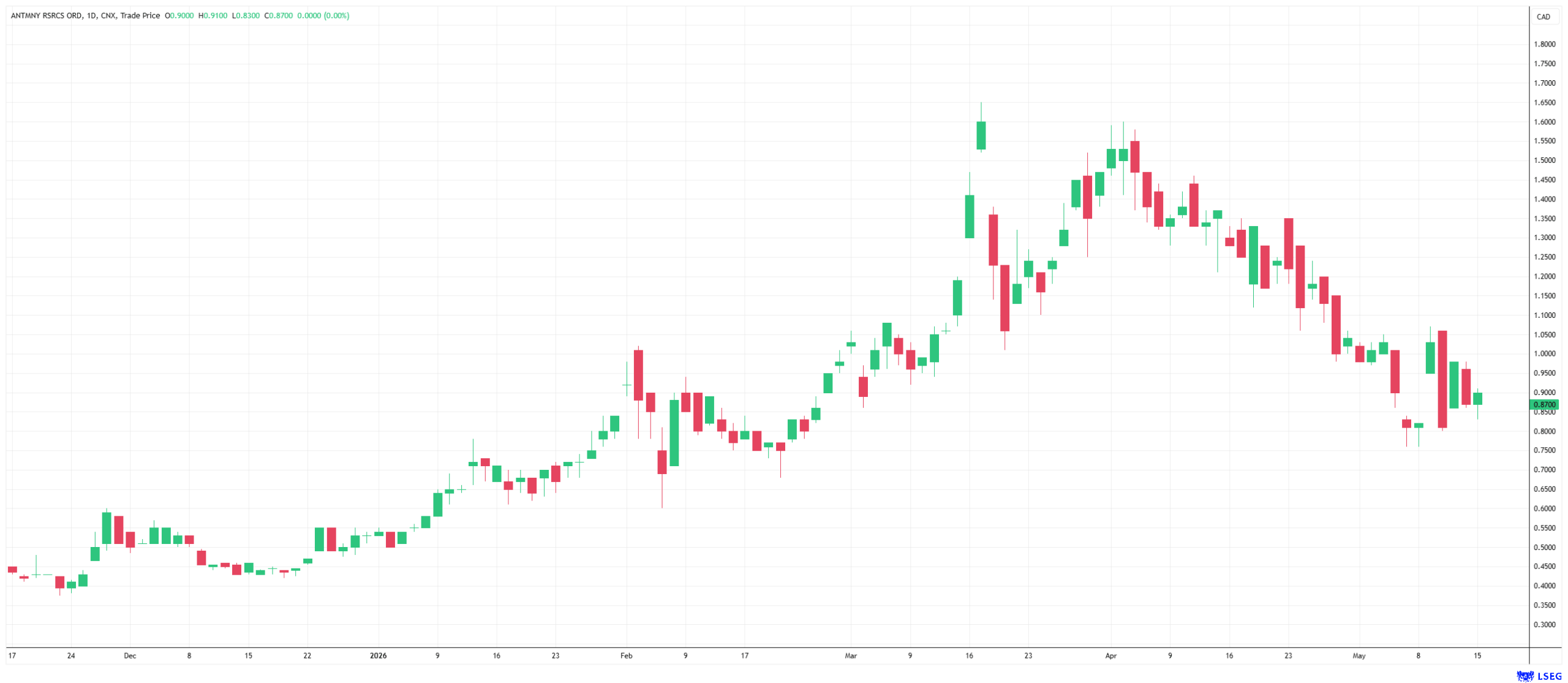
Analysts at GBC report that, with a cash balance of CAD 8.24 million as of the end of February 2026, management has sufficient liquidity to fully fund the upcoming drilling and permitting program. The analysts' price target is CAD 3.00, well above the current price of around CAD 0.87. An additional 19,000 m of drilling is planned for the second and third quarters of 2026 to present an official resource estimate by early 2027. The operational risk of this young company is also mitigated by experienced geologist Jim Atkinson, in his role as CEO. Atkinson has extensive experience with industry giants such as Newmont and BHP. He was also chief geologist at the producing Lake George antimony mine in New Brunswick—historically the only producing antimony mine in North America.** Since promising antimony deposits in politically stable regions are rare, investors should take a closer look at Antimony Resources—both defence giants like Lockheed and commodities giants like Glencore are likely to be closely monitoring this up-and-coming company.
Watch YouTube videoConflict of interest
Pursuant to §85 of the German Securities Trading Act (WpHG), we point out that Apaton Finance GmbH as well as partners, authors or employees of Apaton Finance GmbH (hereinafter referred to as "Relevant Persons") may hold shares or other financial instruments of the aforementioned companies in the future or may bet on rising or falling prices and thus a conflict of interest may arise in the future. The Relevant Persons reserve the right to buy or sell shares or other financial instruments of the Company at any time (hereinafter each a "Transaction"). Transactions may, under certain circumstances, influence the respective price of the shares or other financial instruments of the Company.
In addition, Apaton Finance GmbH is active in the context of the preparation and publication of the reporting in paid contractual relationships.
For this reason, there is a concrete conflict of interest.
The above information on existing conflicts of interest applies to all types and forms of publication used by Apaton Finance GmbH for publications on companies.
Risk notice
Apaton Finance GmbH offers editors, agencies and companies the opportunity to publish commentaries, interviews, summaries, news and the like on news.financial. These contents are exclusively for the information of the readers and do not represent any call to action or recommendations, neither explicitly nor implicitly they are to be understood as an assurance of possible price developments. The contents do not replace individual expert investment advice and do not constitute an offer to sell the discussed share(s) or other financial instruments, nor an invitation to buy or sell such.
The content is expressly not a financial analysis, but a journalistic or advertising text. Readers or users who make investment decisions or carry out transactions on the basis of the information provided here do so entirely at their own risk. No contractual relationship is established between Apaton Finance GmbH and its readers or the users of its offers, as our information only refers to the company and not to the investment decision of the reader or user.
The acquisition of financial instruments involves high risks, which can lead to the total loss of the invested capital. The information published by Apaton Finance GmbH and its authors is based on careful research. Nevertheless, no liability is assumed for financial losses or a content-related guarantee for the topicality, correctness, appropriateness and completeness of the content provided here. Please also note our Terms of use.