January 28th, 2026 | 07:15 CET
Silver soon at USD 200? Buying at elevated levels or seizing opportunities with CSG, American Atomics, and Carl Zeiss Jena
After a nervous start to the year, commodities and energy issues are once again firmly in focus on global capital markets. Recent discussions around trade tariffs and geopolitical dependencies, topics that also dominated the World Economic Forum in Davos, have triggered pronounced volatility. At the same time, heightened volatility is opening up attractive opportunities for investors. Whether silver, copper, nickel, lithium, or uranium, these metals are essential for industry, the energy transition, and electromobility. Their growing strategic importance is driving up prices and increasingly acting as an inflationary force in Western economies. The underlying factors include disrupted supply chains, export-policy uncertainties, and a tight structural supply deficit. In China, for example, solar module manufacturers are reportedly beginning to stockpile silver, as physical material is becoming increasingly difficult to source. As a result, the price of silver has multiplied within just one year, and physical demand now significantly exceeds global annual production. Investors should take note.
time to read: 5 minutes | Author: André Will-Laudien
ISIN: AMERICAN ATOMICS INC | CA0240301089 , CSG NV | NL0015073TS8 , CARL ZEISS MEDITEC AG | DE0005313704
Table of contents:
Author

André Will-Laudien
Born in Munich, he first studied economics and graduated in business administration at the Ludwig-Maximilians-University in 1995. As he was involved with the stock market at a very early stage, he now has more than 30 years of experience in the capital markets.
Tag cloud
Shares cloud
American Atomics – Fuel for the AI age
Since Donald Trump took office, investors have clearly focused on uranium as a raw material. This is because the revival of nuclear energy is taking place in an environment of enormously increasing energy demands, with AI data centers, global population growth, and industrial expansion pushing existing networks to their limits. Studies such as the World Nuclear Outlook Report predict a significant expansion of global nuclear capacity by 2050, which will structurally redefine fuel demand and emphasize the role of uranium as a base load fuel. At the same time, the World Nuclear Association (WNA) Nuclear Fuel Report forecasts an increase in global uranium demand of nearly 30% by 2030, as more and more countries use nuclear energy to achieve CO₂ targets.
This growth in demand is meeting with a supply that is difficult to expand in the short term, as new mines and processing plants require long lead times. As a result, uranium prices have risen significantly in recent years, with spot prices in the range of approximately USD 70 to USD 95 per pound and long-term forecasts pointing to further increases. In this fundamental context, American Atomics is positioning itself as a potential value lever in the nuclear fuel sector through the consistent verticalization of its value creation. Instead of merely exploring resources, the Company is building an integrated value chain from mining and processing to innovative fuel technologies.
Geographically, the focus is on historically productive uranium basins such as the Lisbon Valley District in Utah, which could accelerate the transition from exploration to production. Proximity to existing infrastructure, such as licensed processing facilities, reduces operational hurdles and logistical risks. The time factor is particularly important for investors here, as the markets demand a rapid and consistent shift towards securing resources. Letters of intent are of little help here; what is needed is a structured plan, including resource estimation, PEA, and subsequent mine development.
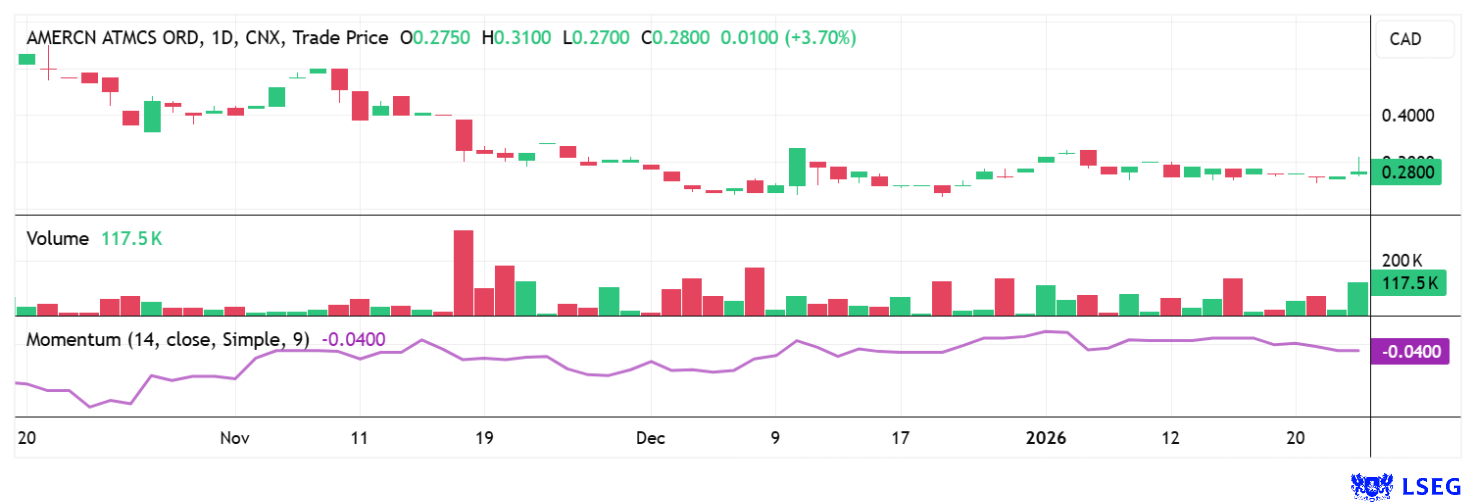
To this end, American Atomics is driving forward technological initiatives to achieve tangible progress in the typical uranium processing steps that are neglected by many other junior mines. Participation in political consortia to strengthen domestic supply chains signals a strategic alignment with government priorities. Given the structural supply gap and political support for nuclear baseload power, this niche offers an attractive risk-reward profile for risk-conscious investors. The valuation is still manageable at around CAD 12 million, but that could change rapidly!
IIF moderator Lyndsay Malchuk interviewed co-founder Connor Lynch about American Atomics' strategic direction.
CSG N.V. – A new defense stock on the stock market
In addition to securing long-term base loads, the current geopolitical environment has established a consensus on the need for independent military power. Investors welcome this turnaround after 75 years of peace in Europe, as defense stocks no longer have to suffer ESG penalties overnight. On the contrary, European and international defense stocks were among the best performers in 2025. A Czech industrial group with a majority focus on defense, called CSG N.V., took advantage of this. The stock went public in Amsterdam on Friday and made a brilliant market debut. With a valuation of around EUR 30 billion and just under EUR 4 billion in capital raised, the initial listing even set new records since Porsche's IPO. The Czechoslovak Group (CSG), led by majority shareholder Michal Strnad, placed shares with a total volume of an astonishing EUR 3.8 billion. Institutional demand in particular was huge. At the start of trading, the share price immediately shot up 32% above the issue price of EUR 25, briefly reaching EUR 36.70 the following day before falling back to around EUR 32 in the middle of the week. Volatility is high, as a fair market value has yet to be found.
Investor Strnad himself realized a volume of around EUR 2.55 billion from the sale; in addition, the Company will receive EUR 750 million in fresh capital for further expansion. Although demand for the initial offering was impressive, it remains to be seen how much upside the stock market will allow the stock in the future, as it already has a 2026 price-to-sales ratio of over 4. Investors should keep a close eye on how the next few days unfold, as the initial offering price of just under EUR 37 has already generated a profit of almost 50% for the initial subscribers.
Carl Zeiss Meditec – When expectations are not met
Another high-tech company is Carl Zeiss Meditec. The TecDAX stock suffered a sharp decline in January. The sharp drop in the share price is the result of a series of adverse events that have shaken market confidence in the long term. The trigger was a profit warning that came unusually early after the previously confirmed outlook, fueling doubts about the quality of management's forecasts. The situation was exacerbated by the already known departure of CEO Maximilian Foerst, which further increased uncertainty about strategic continuity. As a result, several analyst firms lowered their price targets, in some cases significantly, and questioned the assumption of a rapid margin recovery in particular. While some institutions maintained their fundamentally positive long-term theses, they also pointed to weaker demand in the core markets of the US and China, as well as declining internal sales assumptions. As a result, Carl Zeiss Meditec's share price fell from EUR 45 to below EUR 30 in just 15 trading days. According to somewhat outdated estimates on the LSEG platform, the 2026 P/E ratio is now around 15 and will fall to around 8.8 by 2029. mwb research has downgraded the stock to "Hold" with a price target of EUR 31, while Bernstein has also made a drastic cut to "Market Perform" with a price target of EUR 31 after EUR 50.55. Some experts consider the decline in margins to be sustainable, making a rapid price recovery unlikely.**
The restructuring of energy markets is increasingly varying from region to region, particularly between the US and Europe. In North America, security of supply is becoming a priority, which is leading to a political and strategic revaluation of baseload technologies such as nuclear energy. At the same time, the expansion of SMRs is increasing demand for reliable uranium supply chains. This benefits companies that integrate themselves early on into a Western-controlled nuclear value chain. American Atomics is positioning itself less as a pure exploration story and more as a lever for the return of nuclear power as a strategic energy source. We do not currently view CSG and Carl Zeiss Meditec as urgent investments.
Conflict of interest
Pursuant to §85 of the German Securities Trading Act (WpHG), we point out that Apaton Finance GmbH as well as partners, authors or employees of Apaton Finance GmbH (hereinafter referred to as "Relevant Persons") currently hold or hold shares or other financial instruments of the aforementioned companies and speculate on their price developments. In this respect, they intend to sell or acquire shares or other financial instruments of the companies (hereinafter each referred to as a "Transaction"). Transactions may thereby influence the respective price of the shares or other financial instruments of the Company.
In this respect, there is a concrete conflict of interest in the reporting on the companies.
In addition, Apaton Finance GmbH is active in the context of the preparation and publication of the reporting in paid contractual relationships.
For this reason, there is also a concrete conflict of interest.
The above information on existing conflicts of interest applies to all types and forms of publication used by Apaton Finance GmbH for publications on companies.
Risk notice
Apaton Finance GmbH offers editors, agencies and companies the opportunity to publish commentaries, interviews, summaries, news and the like on news.financial. These contents are exclusively for the information of the readers and do not represent any call to action or recommendations, neither explicitly nor implicitly they are to be understood as an assurance of possible price developments. The contents do not replace individual expert investment advice and do not constitute an offer to sell the discussed share(s) or other financial instruments, nor an invitation to buy or sell such.
The content is expressly not a financial analysis, but a journalistic or advertising text. Readers or users who make investment decisions or carry out transactions on the basis of the information provided here do so entirely at their own risk. No contractual relationship is established between Apaton Finance GmbH and its readers or the users of its offers, as our information only refers to the company and not to the investment decision of the reader or user.
The acquisition of financial instruments involves high risks, which can lead to the total loss of the invested capital. The information published by Apaton Finance GmbH and its authors is based on careful research. Nevertheless, no liability is assumed for financial losses or a content-related guarantee for the topicality, correctness, appropriateness and completeness of the content provided here. Please also note our Terms of use.