April 30th, 2026 | 07:05 CEST
Physical Shortage: Bank of America Turns Super-Bullish on the Silver Price!
Starting in early 2024, the silver price entered rally mode. Physical shortages and rapidly growing demand caused the price to surge sixfold at its peak. However, at the end of January and the end of February 2026, two severe setbacks halted the remarkable rally. First, there was a technical sell-off. A month later, with the start of the war in the Persian Gulf, the price dropped another notch. Meanwhile, the price has consolidated in the USD 70-80 per ounce range. The physical scarcity remains, as does the strong demand. Bank of America has now made headlines with a bullish report. Silver Viper would also stand to benefit from a renewed bull run. The Canadian company is aggressively advancing exploration at their La Virginia project in Mexico and reporting high silver grades!
time to read: 3 minutes
|
Author:
Tarik Dede
ISIN:
SILVER VIPER MINER. CORP. | CA8283344098 | TSXV: VIPR , OTCQB: VIPRF
Table of contents:
Author

Tarik Dede
Even as a high school student in northern Germany, he developed a strong interest in the “Neuer Markt” and the dynamics of the equity markets. Small- and mid-cap companies were at the center of his focus from the very beginning. After completing his training as a certified bank clerk, he deepened his economic expertise through formal studies in economics as well as through various positions within Frankfurt’s financial sector. Today, he has been actively involved in the capital markets for more than 25 years, both professionally and as a private investor.
Tag cloud
Shares cloud
Silver: Is USD 300 a realistic scenario?
These are volatile times in the silver market. The war, energy prices, and fears of a global recession are dominating the headlines. Yet the structural factors for the silver market have hardly changed. The Silver Institute is forecasting a supply deficit again this year. Demand is thus exceeding supply for the sixth consecutive year. Bank of America (BofA) has now made headlines with a sensational study. In an extremely optimistic scenario, analysts projected a price range of between USD 135 and USD 309 per ounce of silver. Currently, the price is hovering around USD 75. The bankers point primarily to the gold-silver ratio: BofA draws on historical comparisons, particularly with the year 1980. At that time, the gold-silver ratio fell to about 14:1. That means that for one ounce of gold, you received 14 ounces of silver. Should gold continue its record-breaking run, the report states, such a ratio would mathematically catapult silver into the USD 300 range. Today, the ratio stands at about 60:1.
In addition, the report highlights strong industrial demand from the solar industry. The figures speak volumes: China reported its highest monthly import volume in history in March. Approximately 836 tons of silver were imported, representing a 173% increase over the 10-year March average. Compared with the previous month of February, the 78% increase is also very significant.
Silver Viper in the Sweet Spot
If these forecasts come even close to being realized, Silver Viper will find itself in a sweet spot. With its flagship project "La Virginia" in the Mexican state of Sonora, the Canadian company is developing one of the country's most promising silver projects. The deposit is characterized by a low-sulfidation epithermal system typical of the Sierra Madre Occidental (SMO) precious metal belt. Mineralization occurs in quartz veins and breccias embedded within volcanic rock. Tectonic fault zones caused the gold and silver to be deposited in concentrated "ore pockets."
In any case, the latest drill results underscore the project's potential. For instance, drill hole LV25-339 in the El Rubi sub-area returned 14.6 m grading 1.49 g/t gold and 66.7 g/t silver. Certain sections yielded nearly 200 g/t silver. Other drill holes showed even higher values, grading 347.7 g/t silver (LV26-343), including sections exceeding 1,000 g/t.
CEO Steve Cope presented the company's plans for 2026 at the 18th International Investment Forum (IIF).
New Resource Estimate on the Horizon
To date, the project has a resource estimate from 2021, totalling 253,000 ounces of gold equivalent (AuEq) in the indicated category and 445,000 ounces of gold equivalent in the inferred category. Since then, Silver Viper has invested heavily in exploration and plans to present an updated study as early as the current second quarter. While La Virginia is more gold-rich, Silver Viper expects higher silver grades at its second project, Coneto. It is located near world-class silver mines in the Durango Silver Belt. More than 40 epithermal quartz veins have already been discovered at Coneto, which in Mexico typically indicate very high silver grades. This year, the company plans to analyze the existing historical data from over 50,000 meters of drilling and publish a modern resource estimate toward the end of the year.
The Stock Is Now Cheaper
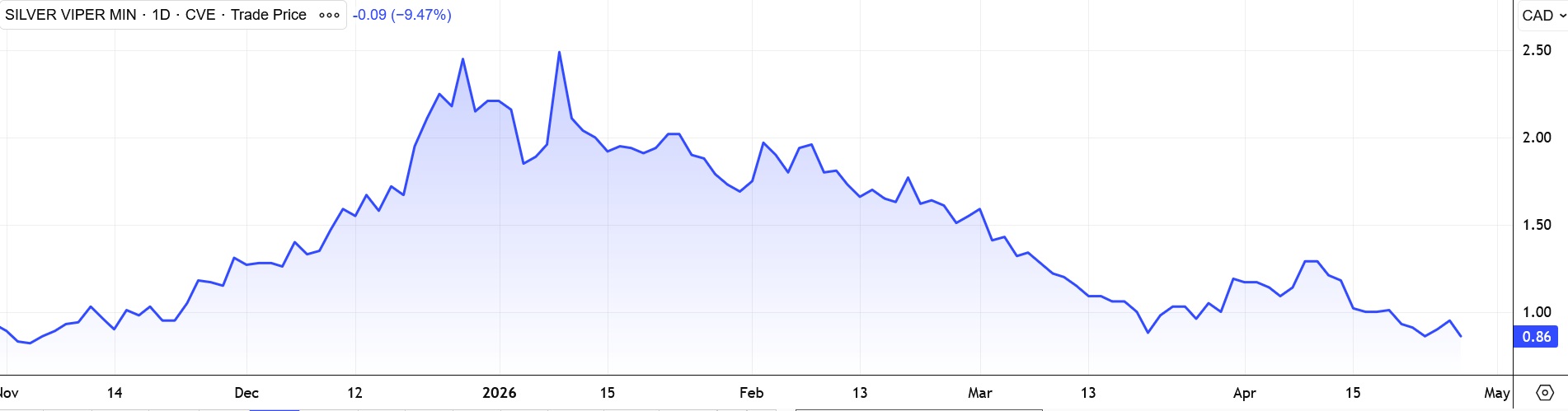
At the turn of the year, Silver Viper shares were temporarily trading at CAD 2.50. Currently, the stock is trading at roughly two-thirds below that level. Here, the high volatility in the silver price has led to significant profit-taking. Nevertheless, Silver Viper currently carries a market capitalization of around CAD 80 million. The upside potential remains substantial if the company continues to deliver strong drilling results. Accordingly, the stock has the potential to benefit not only from rising silver prices.
Conflict of interest
Pursuant to §85 of the German Securities Trading Act (WpHG), we point out that Apaton Finance GmbH as well as partners, authors or employees of Apaton Finance GmbH (hereinafter referred to as "Relevant Persons") may hold shares or other financial instruments of the aforementioned companies in the future or may bet on rising or falling prices and thus a conflict of interest may arise in the future. The Relevant Persons reserve the right to buy or sell shares or other financial instruments of the Company at any time (hereinafter each a "Transaction"). Transactions may, under certain circumstances, influence the respective price of the shares or other financial instruments of the Company.
In addition, Apaton Finance GmbH is active in the context of the preparation and publication of the reporting in paid contractual relationships.
For this reason, there is a concrete conflict of interest.
The above information on existing conflicts of interest applies to all types and forms of publication used by Apaton Finance GmbH for publications on companies.
Risk notice
Apaton Finance GmbH offers editors, agencies and companies the opportunity to publish commentaries, interviews, summaries, news and the like on news.financial. These contents are exclusively for the information of the readers and do not represent any call to action or recommendations, neither explicitly nor implicitly they are to be understood as an assurance of possible price developments. The contents do not replace individual expert investment advice and do not constitute an offer to sell the discussed share(s) or other financial instruments, nor an invitation to buy or sell such.
The content is expressly not a financial analysis, but a journalistic or advertising text. Readers or users who make investment decisions or carry out transactions on the basis of the information provided here do so entirely at their own risk. No contractual relationship is established between Apaton Finance GmbH and its readers or the users of its offers, as our information only refers to the company and not to the investment decision of the reader or user.
The acquisition of financial instruments involves high risks, which can lead to the total loss of the invested capital. The information published by Apaton Finance GmbH and its authors is based on careful research. Nevertheless, no liability is assumed for financial losses or a content-related guarantee for the topicality, correctness, appropriateness and completeness of the content provided here. Please also note our Terms of use.