
February 24th, 2026 | 08:00 CET
Panasonic, Samsung SDI, and NEO Battery Materials: Three paths into the battery age
Whether it is due to failures on the part of the Western automotive industry or China's locational advantages, Beijing dominates the global battery market and openly uses this power as a geopolitical lever. Since November 2025, drastically tightened export regulations have been in place for lithium batteries, graphite anode materials, and related equipment. Production machinery and technologies are also affected. This is a wake-up call for Western industry - and an opportunity for investors: Non-Chinese battery manufacturers are increasingly coming into focus on the stock market, whether they are established players such as Panasonic and Samsung SDI or newcomers such as NEO Battery Materials.
time to read: 6 minutes | Author: Mario Hose
ISIN: NEO BATTERY MATERIALS LTD | CA62908A1003 , PANASONIC CORP. | JP3866800000 , SAMSUNG SDI GDR(144A)/4 | US7960542030
Table of contents:
Author

Mario Hose
Born and raised in Hannover, Lower Saxony follows social and economic developments around the globe. As a passionate entrepreneur and columnist he explains and compares the most diverse business models as well as markets for interested stock traders.
Tag cloud
Shares cloud
Panasonic: Aggressive realignment is progressing
For Panasonic, a 25-year dry spell is coming to an end: Despite a profit warning at the beginning of the month, the stock has climbed to its highest level on the Tokyo Stock Exchange since the 2008/09 financial crisis. In the past quarter, the battery and electronics giant suffered a 4% decline in sales and a net loss of JPY 17.1 billion (approximately EUR 90 million). The group has therefore slightly lowered its profit forecast for the current fiscal year, which ends on March 31. Profit attributable to free shareholders is now expected to land at JPY 102.80 (EUR 0.57). Previously, management led by CEO Yuki Kusumi had assumed JPY 111.36.
There is good reason why the share price has risen nonetheless: the group had already announced in advance that restructuring costs running into the billions would weigh on earnings. In this respect, the negative surprise was limited. Analysts are no longer focusing on past figures, but on the positive aspects of the latest quarterly report. And there are plenty of those. The aggressive realignment toward high-growth areas such as energy storage systems for AI data centers is progressing. The Connect segment, which is active in areas such as process automation and avionics (electronic control systems in aircraft), recorded particularly strong growth. In addition, the ongoing restructuring, which includes the elimination of up to 12,000 jobs, is expected to generate savings of JPY 145 billion per annum starting in the new fiscal year (beginning April 1). Analysts' estimates are correspondingly optimistic, predicting that earnings will double to more than JPY 220 per share (EUR 1.21) by 2028. This would put the price-to-earnings ratio (P/E) between 11 and 12 – a moderate valuation for a company that plays a key role in numerous future-oriented areas.
Thanks to the savings, the group should also be able to bridge a longer dry spell in the electric mobility segment: Among other things, Panasonic operates two lithium-ion battery plants in the US states of Nevada and Kansas. The latter was only inaugurated in the summer of 2025 and covers an area of 300 hectares – equivalent to more than 225 American football fields.
Due to US President Donald Trump's negative stance on issues such as climate protection and e-mobility, it will now take longer for the investment to pay off.
Samsung SDI: End of the downward spiral
Former stock market darling Samsung SDI, which is BMW's battery partner, among other things, had also come under massive pressure due to the US's departure from e-mobility – and is currently celebrating a spectacular stock market comeback thanks to new optimism. Since the turn of the year, it has risen by more than 40%. The decisive price driver came from an unexpected source: Boston Dynamics, the American subsidiary of the South Korean Hyundai Group, presented a humanoid robot at the CES technology fair in Las Vegas that is to be used in industrial assembly processes from 2028 at the latest. The press described the 1.88-meter-tall assembly line worker of the future as "as flexible as a Russian ballet dancer and as strong as a bull." It goes by the name of Atlas and is said to be able to lift 50 kg with its human-like hands. It works completely autonomously with AI support – and even changes its own batteries. At least some analysts suspect that these could come from South Korea: from Samsung SDI, to be precise. Like Panasonic, the group is also well established in the business of energy storage solutions for data centers.
Nevertheless, with a P/E ratio of almost 25 based on earnings estimates for 2027, the valuation is significantly more ambitious than that of its Japanese competitor. At the equivalent of just under EUR 18 billion, Samsung SDI's market capitalization is only about half that of Panasonic. However, in addition to the battery business, the Japanese company's product portfolio also includes air conditioning systems, consumer electronics, household appliances, and much more.
NEO Battery Materials: The hidden gem from Canada
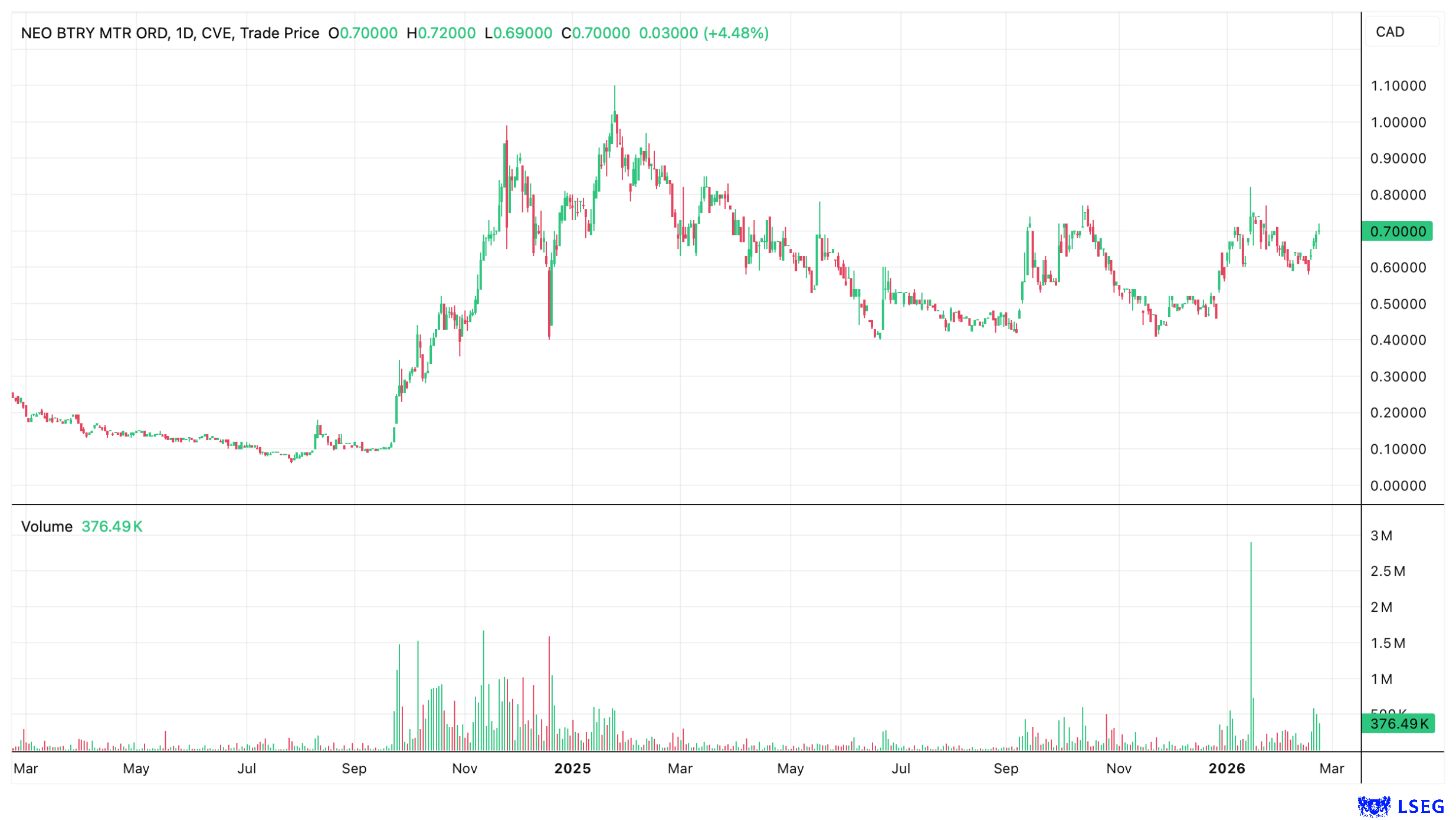
In addition to the two Asian billion-dollar companies, a small Canadian company that recently attracted attention with a technological breakthrough has been appearing on investors' radars for some time now: NEO Battery Materials, or NBM for short. A surveillance drone equipped with NBM technology was able to increase its flight time from 29.9 to 59.2 minutes compared to standard batteries, most of which are mass-produced in China – and that in sub-zero temperatures. **This represents an increase of 98%. These are not laboratory measurements, but live field tests under real conditions, where most battery manufacturers have failed to deliver on their promises so far. Since NBM's batteries are neither larger nor heavier than the current competing models, this is being celebrated as a minor sensation at the company's headquarters in Toronto.
The secret to success is silicon anodes. While conventional battery concepts based on graphite anodes are increasingly reaching their physical limits, silicon reinforcement is considered the next big step in performance enhancement. NBM Drone Cells deliver over 50% more capacity and 40% higher energy density than comparable competitor models. Charging time is cut in half, while service life is extended.
With a market capitalization of around CAD 100 million, equivalent to approximately EUR 64 million, NEO Battery Materials is a minnow compared to its two competitors and has so far been largely ignored by analysts. No significant sales have been recorded to date, and it is uncertain when the company will break even. This puts NBM in good company with other battery startups – some of which, however, are valued ten times higher. On the plus side, NBM not only has letters of intent but also several million-dollar orders that will be processed in the coming years. Compared to similarly structured competitors, NEO Battery Materials offers significantly higher price potential if successful.
The management team, led by CEO Spencer Huh, has already set the course for success: the company is on the cusp of transitioning from a research-based to a manufacturing company. The production facility in South Korea, the CEO's country of origin, is already operational. To ensure that nothing is left to chance, Seok Joung Youn, Head of Manufacturing and Facility Operations, oversees the production process. As a former executive at Samsung SDI, Youn is very familiar with the high-quality standards of the industry. In addition, thanks to an innovative, patented coating process called NBMSiDE, the plant in Gyeonggi-do Province can produce at a significantly lower cost than its competitors, who struggle with complex gas phase deposition methods. NBM has also already secured excellent contacts with the procurement departments of the South Korean armed forces: high-ranking military personnel have been hired as consultants, led by former four-star general Chang Jun Ko, who was recently appointed to the board of directors.
Despite the hype surrounding drones, robots, and data centers, the automotive business is by no means dead. Outside the US, the transition to e-mobility remains a declared political goal, and NBM has now received two battery orders from a Fortune 500 automaker – one of them, surprisingly, even from North America. This should also give a boost to the industry giants from Japan and South Korea.
Conclusion: Three paths into the battery age
The three companies offer different risk-return profiles. Panasonic is the solid restructuring case with a moderate valuation and broad business model, Samsung SDI is the more ambitiously valued growth candidate with strong momentum, and NEO Battery Materials is the speculative hidden gem with the greatest price potential – but also the highest risk. Those who bet on all three cover the entire spectrum of one of the most exciting investment theses of the decade.
Conflict of interest
Pursuant to §85 of the German Securities Trading Act (WpHG), we point out that Apaton Finance GmbH as well as partners, authors or employees of Apaton Finance GmbH (hereinafter referred to as "Relevant Persons") currently hold or hold shares or other financial instruments of the aforementioned companies and speculate on their price developments. In this respect, they intend to sell or acquire shares or other financial instruments of the companies (hereinafter each referred to as a "Transaction"). Transactions may thereby influence the respective price of the shares or other financial instruments of the Company.
In this respect, there is a concrete conflict of interest in the reporting on the companies.
In addition, Apaton Finance GmbH is active in the context of the preparation and publication of the reporting in paid contractual relationships.
For this reason, there is also a concrete conflict of interest.
The above information on existing conflicts of interest applies to all types and forms of publication used by Apaton Finance GmbH for publications on companies.
Risk notice
Apaton Finance GmbH offers editors, agencies and companies the opportunity to publish commentaries, interviews, summaries, news and the like on news.financial. These contents are exclusively for the information of the readers and do not represent any call to action or recommendations, neither explicitly nor implicitly they are to be understood as an assurance of possible price developments. The contents do not replace individual expert investment advice and do not constitute an offer to sell the discussed share(s) or other financial instruments, nor an invitation to buy or sell such.
The content is expressly not a financial analysis, but a journalistic or advertising text. Readers or users who make investment decisions or carry out transactions on the basis of the information provided here do so entirely at their own risk. No contractual relationship is established between Apaton Finance GmbH and its readers or the users of its offers, as our information only refers to the company and not to the investment decision of the reader or user.
The acquisition of financial instruments involves high risks, which can lead to the total loss of the invested capital. The information published by Apaton Finance GmbH and its authors is based on careful research. Nevertheless, no liability is assumed for financial losses or a content-related guarantee for the topicality, correctness, appropriateness and completeness of the content provided here. Please also note our Terms of use.