January 26th, 2026 | 07:25 CET
NEO Battery Materials positions itself for the battery revolution
Artificial intelligence, autonomous systems, drones, and robotics are causing global energy demand to skyrocket. But this is precisely where the weak point of digitalization becomes apparent. Conventional lithium-ion batteries are reaching their physical limits in terms of charging time, energy density, and cost. NEO Battery plans to break through this bottleneck. With innovative silicon anode technology, the Company promises significantly higher capacities, ultra-fast charging, and massive cost advantages. Initial partnerships with major customers, concrete supply agreements, and the expansion of production capacities are fueling imagination and increasingly bringing the battery specialist into the focus of investors.
time to read: 4 minutes | Author: Stefan Feulner
ISIN: NEO BATTERY MATERIALS LTD | CA62908A1003
Table of contents:
Author

Stefan Feulner
The native Franconian has more than 20 years of stock exchange experience and a broadly diversified network.
He is passionate about analyzing a wide variety of business models and investigating new trends.
Tag cloud
Shares cloud
Platform provider for the next generation of batteries
The ongoing electrification of industry, mobility, and digital infrastructure is increasingly shifting the technological bottleneck toward energy storage. While computing power, sensor technology, and software are becoming ever more powerful, conventional lithium-ion batteries are reaching their physical limits. This is precisely what NEO Battery Materials focuses on. The Company does not see itself as a traditional cell manufacturer, but rather as an integrated innovation platform for high-performance batteries that combines material development, electrode manufacturing, and battery design in a scalable business model.
NEO Battery pursues a vertically integrated platform approach along the entire battery value chain. The focus is on developing proprietary silicon anode materials that specifically address the performance bottlenecks of today's batteries. This core business is complemented by in-house electrode manufacturing, battery development, and engineering services. The Company thus positions itself as a Western one-stop solution for battery innovations, especially for applications with high performance requirements.
A central element is the foundry model for electrode manufacturing. Similar to the semiconductor industry, where specialized contract manufacturers such as TSMC handle production, NEO Battery enables its customers to manufacture customized electrodes without having to make high investments in production equipment themselves. This model opens up significant revenue and cash flow potential for the Company while reducing barriers to entry for new customers.
NBMSiDE® as the answer to the limitations of graphite
The technological basis of the business model is the proprietary silicon anode technology NBMSiDE®. While graphite as a standard anode material is increasingly reaching its performance limits, silicon offers a significantly higher theoretical energy density. NEO has succeeded in addressing the classic weaknesses of silicon anodes, such as volume expansion, cycle stability, and high costs, through material and process innovations.
NBMSiDE® achieves 40 to 70% higher capacity compared to conventional solutions while enabling a reduction in manufacturing costs of more than 60%. Battery tests have achieved ultra-fast charging times of up to 5 minutes. In addition, the technology is protected by eleven granted and pending intellectual property rights and is designed for scaling to industrial production volumes.
AI, robotics, and geopolitical realignment as growth drivers
The market potential for high-performance battery solutions is growing rapidly. This development is being driven in particular by AI data centers, autonomous systems, drones, robotics, and military applications, where energy density, charging speed, and reliability are crucial.
NEO Battery is receiving additional tailwind from geopolitical developments. China currently accounts for around 77% of global battery production. The increasing focus of Western countries on supply chain security, onshoring, and technological sovereignty is strengthening suppliers who can offer high-performance alternatives outside China. NEO Battery is deliberately positioning itself as such a Western alternative with a high degree of adaptability and customer-specific development expertise.
Partnerships as the key to commercialization
The Company, valued at around CAD 92 million, has already begun the transition from the development phase to commercialization. NEO is working with several Fortune 500 OEMs from Asia and North America. Initial commercial deliveries are pending as part of ongoing qualification and pilot programs. In addition, there are multi-year supply agreements with a total volume of around CAD 10 million in the field of high-performance batteries for drone and robotics applications.
The development in the defense and security sector is particularly strategic. NEO is working with partners to develop customized battery solutions for military drone systems. Target values of over 300 Wh/kg and a more than 25% increase in flight time underscore the performance profile of the technology. Interest in the Company's solutions extends geographically from North America to Europe and Asia. A strategic milestone is the cooperation with the Korea Institute for Defense Industry (KOIDI), an institution closely associated with the South Korean Ministry of Defense that specifically promotes the expansion and competitiveness of the national defense sector.
At the same time, the industrial base is being expanded. A battery component factory with a capacity of 250 MWh is currently being implemented, as is an expansion for prismatic and cylindrical cell formats with a planned annual capacity of 20 MWh. Silicon anode production is also to be gradually scaled up to 20 tons per year.
To accelerate growth, the Canadians recently successfully completed a capital increase of approximately CAD 7 million. A total of 11.67 million share certificates were placed at an issue price of CAD 0.60. In addition, subscribers received one warrant per share with an exercise price of CAD 0.85 and a three-year term.
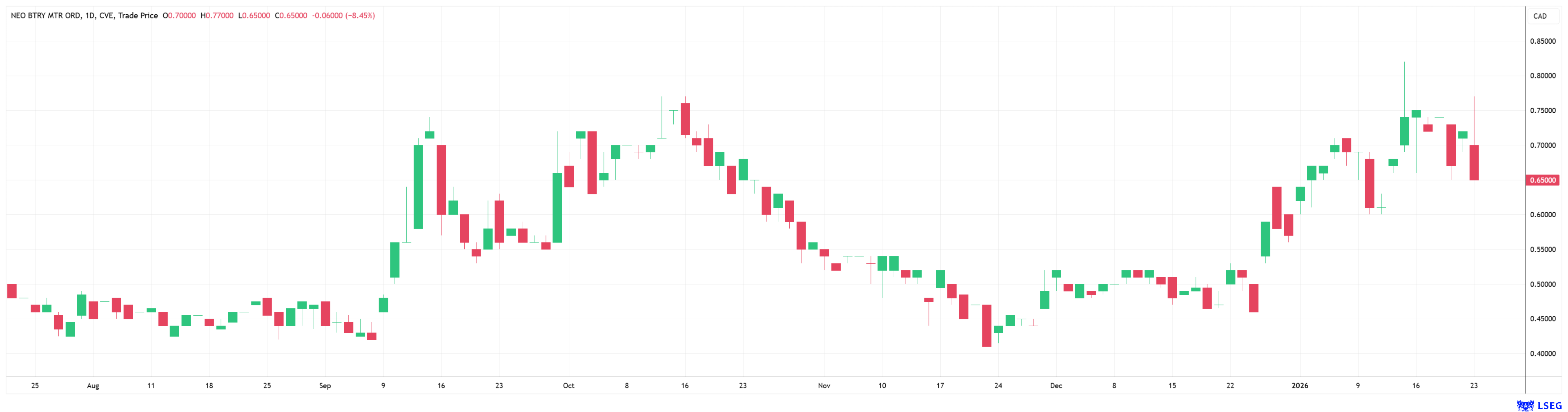
NEO Battery Materials combines material innovation, a foundry approach, and engineering expertise into a business model that could bring enormous economies of scale. Unlike many pure battery start-ups, the Company already has concrete customer projects, a growing sales pipeline, and a clearly defined scaling strategy. If it succeeds in further expanding its production capacities and converting pilot projects into recurring orders, NEO Battery could become an important building block of the Western battery and energy storage industry.
Conflict of interest
Pursuant to §85 of the German Securities Trading Act (WpHG), we point out that Apaton Finance GmbH as well as partners, authors or employees of Apaton Finance GmbH (hereinafter referred to as "Relevant Persons") may hold shares or other financial instruments of the aforementioned companies in the future or may bet on rising or falling prices and thus a conflict of interest may arise in the future. The Relevant Persons reserve the right to buy or sell shares or other financial instruments of the Company at any time (hereinafter each a "Transaction"). Transactions may, under certain circumstances, influence the respective price of the shares or other financial instruments of the Company.
In addition, Apaton Finance GmbH is active in the context of the preparation and publication of the reporting in paid contractual relationships.
For this reason, there is a concrete conflict of interest.
The above information on existing conflicts of interest applies to all types and forms of publication used by Apaton Finance GmbH for publications on companies.
Risk notice
Apaton Finance GmbH offers editors, agencies and companies the opportunity to publish commentaries, interviews, summaries, news and the like on news.financial. These contents are exclusively for the information of the readers and do not represent any call to action or recommendations, neither explicitly nor implicitly they are to be understood as an assurance of possible price developments. The contents do not replace individual expert investment advice and do not constitute an offer to sell the discussed share(s) or other financial instruments, nor an invitation to buy or sell such.
The content is expressly not a financial analysis, but a journalistic or advertising text. Readers or users who make investment decisions or carry out transactions on the basis of the information provided here do so entirely at their own risk. No contractual relationship is established between Apaton Finance GmbH and its readers or the users of its offers, as our information only refers to the company and not to the investment decision of the reader or user.
The acquisition of financial instruments involves high risks, which can lead to the total loss of the invested capital. The information published by Apaton Finance GmbH and its authors is based on careful research. Nevertheless, no liability is assumed for financial losses or a content-related guarantee for the topicality, correctness, appropriateness and completeness of the content provided here. Please also note our Terms of use.