March 12th, 2026 | 08:00 CET
Mining without excavators: Franco-Nevada, Triple Flag, and Globex Mining compared
After a long dry spell, mining stocks are back in vogue. However, operating mines comes with its own risks. Geological challenges, technical failures, rising energy costs, or labor strikes can quickly disrupt operations. There is, however, a clever alternative: so-called royalty and streaming companies. These firms benefit from mining activity without having to drill holes in the ground themselves. In this article, we compare three representatives of this business model across different size classes: Franco-Nevada, an established industry giant; Triple Flag Precious Metals, a mid-tier player; and Globex Mining Enterprises, a (still) small but particularly diversified challenger.
time to read: 6 minutes | Author: Mario Hose
ISIN: GLOBEX MINING ENTPRS INC. | CA3799005093 , FRANCO-NEVADA CORP. | CA3518581051 , WHEATON PREC. METALS | CA9628791027 , TRIPLE FLAG PRECIOUS METALS CORP | CA89679M1041 | TSX: TFPM
Table of contents:
Author

Mario Hose
Born and raised in Hannover, Lower Saxony follows social and economic developments around the globe. As a passionate entrepreneur and columnist he explains and compares the most diverse business models as well as markets for interested stock traders.
Tag cloud
Shares cloud
Solid capital structures
The business model of royalty companies is as elegant as it is lucrative. They provide mining companies with capital – often in the early, risky phase of a project – and in return receive the right to a percentage share of future production or sales, known as royalties. This means that they do not employ miners, purchase excavators, or maintain expensive mining infrastructure. Nevertheless, they quietly collect their share as soon as a mine begins production. As a result, they generally boast solid balance sheets and generate high free cash flows. However, although the overwhelming majority of these companies are based in Canada, not all royalty companies are the same. They differ considerably in terms of size, portfolio breadth, and structure - and thus also in terms of their risk/reward profile for investors.
The market is primarily focused on two giants: Wheaton Precious Metals and Franco-Nevada. Both are worth more than USD 50 billion on the stock market and are valued at P/E ratios of around 30. One current advantage for Franco-Nevada is that, unlike Wheaton, the group's portfolio includes more than just metals. Between 15% and 20% of its license revenues come from the energy sector, primarily crude oil and natural gas. Since the escalation of tensions involving Iran, oil prices have risen sharply and profits are booming. This is not yet reflected in the figures for the fourth quarter of 2025, published a few days ago, as the outbreak of war on February 28 naturally does not yet play a role in them. Even so, the sharp rises in gold and silver prices were enough to deliver record results. Quarterly revenue rose 86% to USD 597.3 million, far exceeding the analyst consensus of USD 532.8 million. Adjusted net income climbed even more disproportionately, up 94% to USD 356.2 million, or USD 1.85 per share. The results for the full year 2025 are similarly impressive: a 64% increase in revenue to USD 1.82 billion and a 74% increase in adjusted earnings to USD 5.58 per share.
Unbroken growth
However, it was not only the rise in precious metal prices that contributed to these record figures; the volume mined also rose by double digits. The gold equivalent ounces (GEOs) figure, which is highly regarded in the industry, rose by 12% to 519,106 in 2025. CEO Paul Brink expects 510,000–570,000 GEOs for this year. However, this guidance does not yet include the Cobre Panamá project, where operations are currently suspended for political reasons. If production resumes, another 150,000–175,000 GEOs per year could be added.
The unbroken growth, high margins, and the fact that Franco-Nevada is debt-free put the seemingly high valuation with a forward P/E ratio of around 30 into perspective. At the same time, the record figures posted by the industry giant are raising hopes for good results from smaller challengers such as Globex Mining. After a small loss in the same period last year, the company had already reached the break-even point in the third quarter with earnings of CAD 0.08 per share. Estimates of CAD 0.10 per share are now circulating for the last quarter of the year, with the caveat that analysts have so far paid little attention to the company. Only Red Cloud Securities, a Canadian research and consulting firm specializing in mining stocks, regularly covers the royalty company. For risk-tolerant investors, this has the appeal of being able to bet on a largely undiscovered gem. No other royalty company of this size offers a comparable range of commodities.
Healthy mix
Globex Mining's portfolio comprises 270 sites, some of which are in the exploration and development stages, while others are already in the royalty stage. CEO and major shareholder Jack Stoch, a geologist with 40 years of industry experience, sees the so-called project generator model as the key to success: properties are acquired, developed, and then passed on to third parties in exchange for royalties or option payments. The company holds 107 royalty agreements generating cash flow, and there are seven more with ongoing options. The company is also debt-free and holds a publicly traded stock portfolio estimated to be worth more than CAD 30 million.
The range of raw materials includes base metals such as copper, nickel, zinc, and lead, precious metals such as gold, silver, platinum, and palladium, as well as specialty metals such as lithium, cobalt, vanadium, scandium, and rare earths. In addition, there are industrial minerals such as kaolin, talc, and magnesite. Globex is therefore less of a bet on individual metals and more of a broadly diversified investment in a wide range of critical raw materials with a variety of uses – from the energy transition to the defense industry. The mining areas are located almost exclusively in politically stable regions of North America. One of the few non-American locations is the Bräunsdorf license area in Saxony, which covers the western part of the famous Freiberg silver mining district, where precious metals, zinc, and lead have been mined for around 850 years.
Becoming a multi-billionaire in ten years
The example of Triple Flag Precious Metals shows the scale that well-diversified royalty companies can achieve in a short period of time. Founded in Toronto in 2016, the company has grown in less than a decade to become a serious mid-cap player in the royalty sector with a market capitalization of around USD 8 billion. Triple Flag holds interests in a total of 239 locations, including 34 producing mines and numerous development and exploration projects, primarily in Australia and America. The focus is clearly on precious metals: gold and silver make up the lion's share of the portfolio. However, copper, nickel, lead, and zinc also contribute to cash flow and a healthy balance sheet structure. Like its industry peers, Franco-Nevada and Globex Mining, the company is debt-free and has more than USD 1 billion in liquidity.
Strong figures, strong momentum
The 2025 financial year was also record-breaking in this respect: Triple Flag generated revenue of USD 388.7 million and sold 113,237 GEOs – the ninth consecutive year of production growth. Operating cash flow per share climbed to USD 1.54, a jump of 45%, driven by higher volumes and sharply rising precious metal prices. After a loss in the previous year, net profit reached USD 1.18 per share.
The downside: Triple Flag expects lower production of only 95,000–105,000 GEOs in 2026, mainly due to a planned decline in the large-scale Cerro Lindo silver stream project. However, the dip is not expected to last: in its medium-term planning through 2030, the management team led by CEO Tom Bilsen, who has only been in office since December 2025, is targeting 140,000–150,000 GEOs per year, supported by a broad portfolio of growing assets.
The result of our review
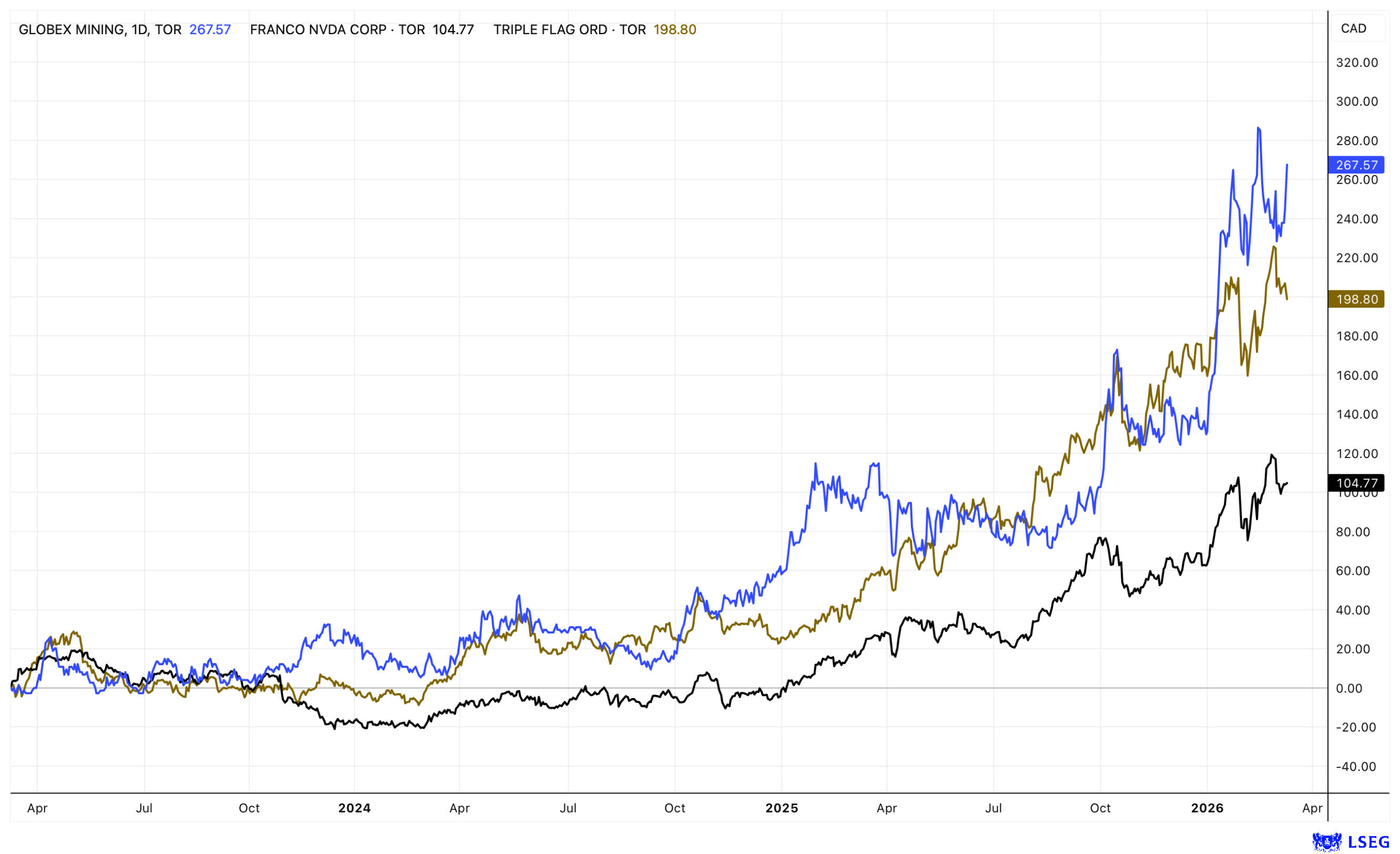
All three royalty companies in our comparison are debt-free, which offers enormous advantages and, above all, significantly lower risks compared to traditional mining companies. However, the differences are enormous: Franco-Nevada shines with solidity, but its valuation is steep. Challenger Globex Mining offers the greatest opportunities, but as a small-cap, it also carries the highest risks, although its unusually broad commodity portfolio significantly mitigates these. Triple Flag could be something of a healthy middle ground, were it not for the announced decline in production this year. It is unclear whether and to what extent the stock market has already processed this. For now, both the large and the small players appear attractive for different reasons.
Conflict of interest
Pursuant to §85 of the German Securities Trading Act (WpHG), we point out that Apaton Finance GmbH as well as partners, authors or employees of Apaton Finance GmbH (hereinafter referred to as "Relevant Persons") may hold shares or other financial instruments of the aforementioned companies in the future or may bet on rising or falling prices and thus a conflict of interest may arise in the future. The Relevant Persons reserve the right to buy or sell shares or other financial instruments of the Company at any time (hereinafter each a "Transaction"). Transactions may, under certain circumstances, influence the respective price of the shares or other financial instruments of the Company.
In addition, Apaton Finance GmbH is active in the context of the preparation and publication of the reporting in paid contractual relationships.
For this reason, there is a concrete conflict of interest.
The above information on existing conflicts of interest applies to all types and forms of publication used by Apaton Finance GmbH for publications on companies.
Risk notice
Apaton Finance GmbH offers editors, agencies and companies the opportunity to publish commentaries, interviews, summaries, news and the like on news.financial. These contents are exclusively for the information of the readers and do not represent any call to action or recommendations, neither explicitly nor implicitly they are to be understood as an assurance of possible price developments. The contents do not replace individual expert investment advice and do not constitute an offer to sell the discussed share(s) or other financial instruments, nor an invitation to buy or sell such.
The content is expressly not a financial analysis, but a journalistic or advertising text. Readers or users who make investment decisions or carry out transactions on the basis of the information provided here do so entirely at their own risk. No contractual relationship is established between Apaton Finance GmbH and its readers or the users of its offers, as our information only refers to the company and not to the investment decision of the reader or user.
The acquisition of financial instruments involves high risks, which can lead to the total loss of the invested capital. The information published by Apaton Finance GmbH and its authors is based on careful research. Nevertheless, no liability is assumed for financial losses or a content-related guarantee for the topicality, correctness, appropriateness and completeness of the content provided here. Please also note our Terms of use.