May 5th, 2026 | 07:10 CEST
How to Capitalize on Two of the Greatest Crises of Our Time – Thanks to Novo Nordisk, MustGrow Biologics, and Bayer
Created and published on behalf of MustGrow Biologics Corp.
While the world battles an obesity epidemic that has turned Novo Nordisk into a cash cow, a potential conflict with Iran threatens to tear apart global agricultural supply chains. More than 2.5 billion people are overweight, while war-induced fertilizer shortages could destroy crops. Two seemingly contradictory crises collide—pharmaceutical solutions for obesity on one side, biological crop protection products against famine on the other. It is precisely in this tension that three companies, each pursuing different approaches, are operating: Novo Nordisk, MustGrow Biologics, and Bayer.
time to read: 4 minutes | Author: Armin Schulz
ISIN: MUSTGROW BIOLOGICS CORP. | CA62822A1030 | TSXV: MGRO , OTCQB: MGROF , NOVO NORDISK A/S | DK0062498333 , BAYER AG NA O.N. | DE000BAY0017
Table of contents:
Author

Armin Schulz
Born in Mönchengladbach, he studied business administration in the Netherlands. In the course of his studies he came into contact with the stock exchange for the first time. He has more than 25 years of experience in stock market business.
Tag cloud
Shares cloud
Novo Nordisk: Combating the Obesity Epidemic with Innovation
The Danish pharmaceutical company is doing everything it can to make its therapies accessible to a wider audience. Wegovy is already available for out-of-pocket patients starting at USD 149 per month. This is a significant reduction from previous prices. At the same time, Novo Nordisk is collaborating with the telehealth platform Hims & Hers to make access easier for patients. An FDA crackdown on unauthorized compounding pharmacies could also dry up the market for cheap generic products. That would help the company regain control of its brand.
The future of obesity treatment lies in tablets, and Novo Nordisk is well-positioned here. The oral version of Wegovy launched in the US in December 2025 and got off to a strong start. A higher dosage of 7.2 mg has already been submitted for approval. Additionally, the pipeline shows promising approaches with CagriSema. The combination of semaglutide and cagrilintide achieved nearly 23% weight loss in studies. Novo Nordisk thus remains a key player despite strong competition.
Despite shrinking margins, Novo Nordisk continues to generate substantial cash flows. In 2025, free cash flow amounted to just under USD 5 billion. This enables a current dividend yield of 4.3% and a new share buyback program. At the same time, the group is investing heavily in research, including promising drugs for rare diseases such as hemophilia. This diversification reduces dependence on individual active ingredients and creates a stable foundation for the coming years. The stock is currently trading at EUR 37.46.
MustGrow Biologics: TerraSante™ as a Growth Engine
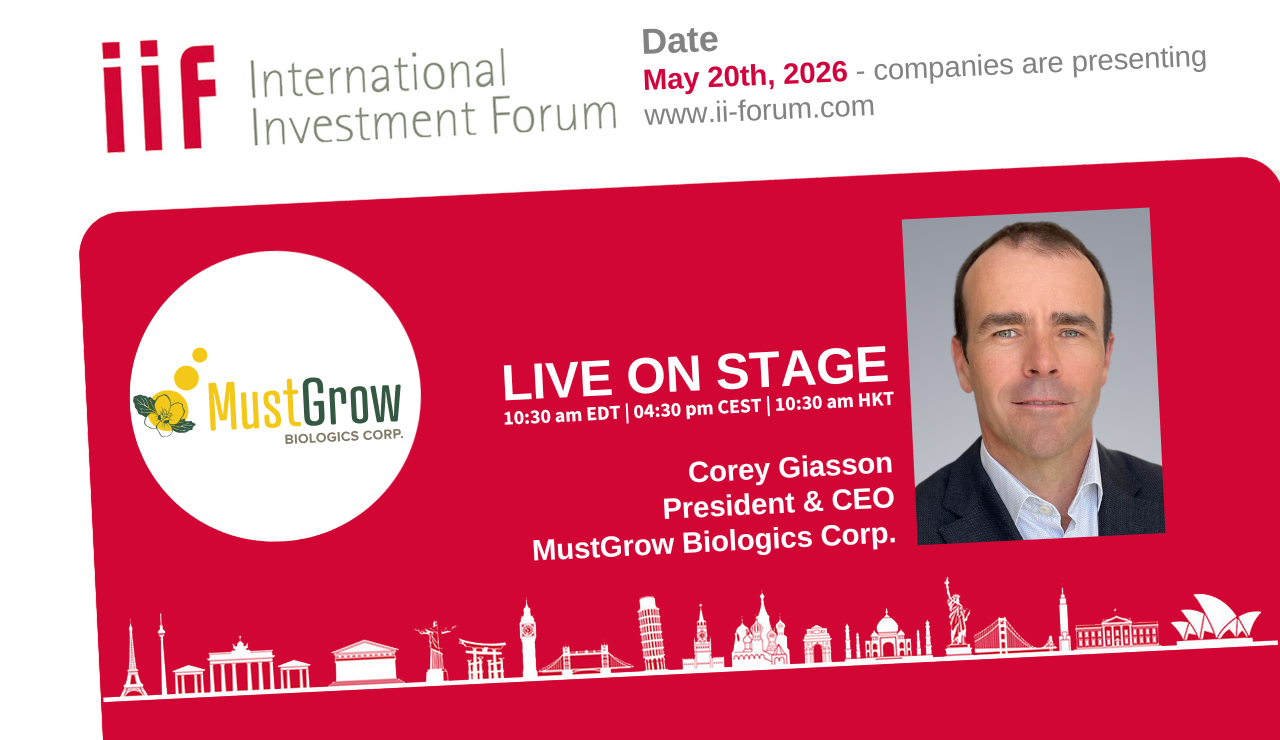
MustGrow Biologics has set the course for a more focused business model. With the closure of its Canadian sales division NexusBioAg in April 2026, management is ending a low-margin experiment with third-party products. This decisive move redirects all resources toward the company's own mustard-derived biofertility product, TerraSante™. Its US sales surged by 377% to CAD 0.6 million in 2025, and forecasts actually increased by nearly 600%. Repeat purchases by large farms prove that the product performs well in the field, not just in the lab. It is no surprise that the product sold out.
Thanks to a CAD 2 million capital increase in January 2026 and a government-guaranteed credit line in the tens of millions through CIBC, backed by Export Development Canada (EDC), the production scale is progressing. Instead of in-house facilities, MustGrow relies on Asian contract manufacturers that are now transitioning from discontinuous batch production to efficient large-scale production. This is expected to significantly improve gross margins. This is the key lever to finally meet strong demand. After all, forecasts worth approximately CAD 1 million remained unfilled in 2025. That is frustrating, but a positive problem from a business perspective.
The latest approval in Georgia, one of the largest US producers of peanuts, pecans, and blueberries, expands the US footprint to seven states. At the same time, Bayer is driving forward the registration of TerraMG™, a bio-pesticide against soil-borne diseases and pests, in the EMEA region and is investing tens of millions of dollars at its own risk to do so. MustGrow participates in milestone payments and future licensing revenues without incurring any costs of its own. With additional trials underway in Netherlands and Australia, it appears that the mustard technology could soon gain a foothold outside North America as well. The potential is there; now it is all about execution. The stock is currently trading at CAD 0.57.
Bayer – The Coming Weeks Will Be Decisive for Investors
At Bayer, the agricultural division remains the biggest risk. Over 60,000 pending glyphosate lawsuits weigh on the company, and the proposed USD 7.25 billion class-action settlement is not yet a done deal. Plaintiffs have until June 4 to decide whether to accept the offer or continue with individual lawsuits. Analysts accuse Bayer of deliberately using the deadline as leverage to secure as many settlements as possible before the Supreme Court ruling. If too little is achieved, the company will remain trapped in a cost spiral for years.
Now the Supreme Court enters the fray. On April 27, the justices heard arguments in the case "Monsanto v. Durnell" regarding whether federal law can override warning-label lawsuits filed by individual states. A ruling is expected in late June and could fundamentally turn the legal battle around. If Bayer wins, an estimated 80% of the pending cases would be affected. If the company loses, it faces further costs running into the billions. The justices appeared divided during the hearing, making it a true neck-and-neck race with enormous financial consequences for the Leverkusen-based company.
Bayer would have to pre-finance the settlement payments. A negative free cash flow of minus EUR 1.5–2.5 billion is expected for 2026. The dividend will therefore remain at the statutory minimum of EUR 0.11 per share for the first three years. At the same time, the group is pushing ahead with the restructuring of its agricultural division. Plenexos, an insecticide that spares beneficial insects, has been launched. The goal is a mid-20% margin by 2029. By then, the legal disputes involving the Crop Science division will hopefully be over. The stock is currently trading at EUR 38.28.
The two crises, the obesity epidemic and the looming disruptions in agricultural supply chains, require very different responses. Novo Nordisk is generating high cash flows despite margin pressure and is driving the next wave of innovation in obesity therapy with oral active ingredients and CagriSema. MustGrow Biologics is focusing on TerraSante™, a scalable biological crop protection product that can grow thanks to strong repeat purchases and a partnership with Bayer. Bayer, on the other hand, is struggling with glyphosate lawsuits and negative cash flow, while a Supreme Court ruling at the end of June will determine its future in agriculture.
Conflict of interest
Pursuant to §85 of the German Securities Trading Act (WpHG), we point out that Apaton Finance GmbH as well as partners, authors or employees of Apaton Finance GmbH (hereinafter referred to as "Relevant Persons") currently hold or hold shares or other financial instruments of the aforementioned companies and speculate on their price developments. In this respect, they intend to sell or acquire shares or other financial instruments of the companies (hereinafter each referred to as a "Transaction"). Transactions may thereby influence the respective price of the shares or other financial instruments of the Company.
In this respect, there is a concrete conflict of interest in the reporting on the companies.
In addition, Apaton Finance GmbH is active in the context of the preparation and publication of the reporting in paid contractual relationships.
For this reason, there is also a concrete conflict of interest.
The above information on existing conflicts of interest applies to all types and forms of publication used by Apaton Finance GmbH for publications on companies.
Risk notice
Apaton Finance GmbH offers editors, agencies and companies the opportunity to publish commentaries, interviews, summaries, news and the like on news.financial. These contents are exclusively for the information of the readers and do not represent any call to action or recommendations, neither explicitly nor implicitly they are to be understood as an assurance of possible price developments. The contents do not replace individual expert investment advice and do not constitute an offer to sell the discussed share(s) or other financial instruments, nor an invitation to buy or sell such.
The content is expressly not a financial analysis, but a journalistic or advertising text. Readers or users who make investment decisions or carry out transactions on the basis of the information provided here do so entirely at their own risk. No contractual relationship is established between Apaton Finance GmbH and its readers or the users of its offers, as our information only refers to the company and not to the investment decision of the reader or user.
The acquisition of financial instruments involves high risks, which can lead to the total loss of the invested capital. The information published by Apaton Finance GmbH and its authors is based on careful research. Nevertheless, no liability is assumed for financial losses or a content-related guarantee for the topicality, correctness, appropriateness and completeness of the content provided here. Please also note our Terms of use.