December 4th, 2025 | 06:55 CET
How suppliers like Aspermont, CATL, and Continental turn the world's complexity into profit
"During a gold rush, don't sell shovels - sell treasure maps." In a world driven by technological disruption, geopolitical tensions, and the trend toward decarbonization, investors need to think one step ahead. Often, it is not the end manufacturers who benefit most, but the specialized suppliers and service providers operating behind the scenes. They take the complexity off their customers' hands – whether it is building an electric vehicle, optimizing tyre compounds, or deciding where to build the next billion-dollar mine. Those who understand this principle will find exciting options on the stock market right now. We present three companies.
time to read: 4 minutes | Author: Nico Popp
ISIN: ASPERMONT LTD | AU000000ASP3 , CATL CONTEMPORARY AMPEREX TECHNOLOGY CO LTD | CNE100003662 , CONTINENTAL AG O.N. | DE0005439004
Table of contents:
Author

Nico Popp
At home in Southern Germany, the passionate stock exchange expert has been accompanying the capital markets for about twenty years. With a soft spot for smaller companies, he is constantly on the lookout for exciting investment stories.
Tag cloud
Shares cloud
CATL: The undisputed king of battery cells
Those who want to understand why suppliers are often the better investments must look to China. Contemporary Amperex Technology Co. Limited (CATL) is no longer just a manufacturer, but the technological heart of global electric mobility. While car manufacturers such as Ford and Volkswagen are struggling with falling margins and the challenging transition to electric motors, CATL simply provides the solution. CATL's products include high-performance batteries for electric vehicles and other applications. Produced in large quantities, the Chinese company is unrivalled.
The figures for the third quarter speak for themselves and prove all China skeptics wrong. Revenue climbed to RMB 104.2 billion (around USD 14.7 billion). But the real sensation lies in profitability: net profit jumped by over 41% to around USD 2.6 billion. CATL's secret lies in its scale and innovative strength. Despite a global price war on battery cells, the Chinese are managing to expand their margins. The Company now controls around 37% of the global market. For investors, the message is clear: no matter which car brand wins the race in the end, it will most likely be powered by CATL technology. In this case, the supplier is more powerful than the customer.
Continental is back on track for success
A similar picture, albeit under different circumstances, can be seen at the long-established German company Continental. For years, the stock suffered from its conglomerate penalty. But management has recognized that focus is everything in today's world. By spinning off its volatile automotive division, now operating as Aumovio, the group is once again focusing on what it does best: tyres and materials.
The figures for the third quarter of 2025 prove how right this radical cut was. Although the revenue of the remaining core businesses, at around EUR 5.0 billion, appears lower than in previous years at first glance, the quality of the revenues has improved massively. The tyre division in particular shines as a reliable cash cow. With an adjusted EBIT margin of 14.3%, Continental even exceeded analysts' expectations, whose consensus was only 13.0%. This fundamentally changes the investment story: Continental is no longer a cumbersome general store suffering from the problems of car manufacturers, but a highly profitable specialist in rubber and high-tech materials. In a world where electric vehicles need new tyres more often due to their weight, Continental is benefiting.
Aspermont: The "Bloomberg of mining" is emerging
While CATL and Continental supply hardware for industry, Aspermont supplies what is arguably the most valuable commodity of the 21st century: data. The Company is a media and technology house that has been archiving industry knowledge since its founding in 1835 as the "Mining Journal." Today, thanks to AI, this knowledge can be easily accessed and put into context. This is precisely where the imagination that more and more investors see in connection with Aspermont's stock lies.
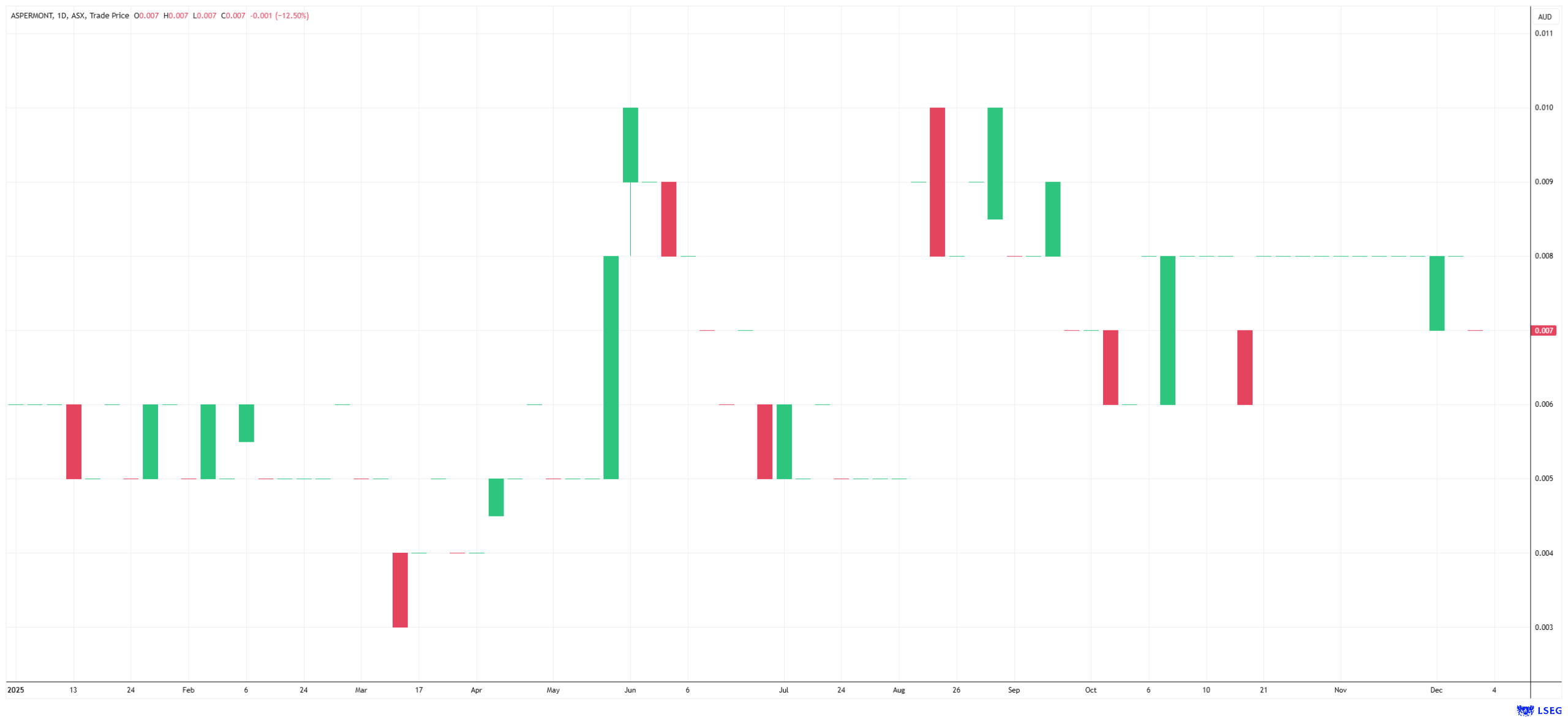
But why is this micro-cap with a market capitalization of less than AUD 25 million so interesting right now? Because Aspermont is making the leap from publishing house to "Data-as-a-Service provider"! Aspermont sits on a treasure trove of 190 years of project data, geological reports, and personal details. In the past, this treasure lay untapped. Today, in the age of AI, it is worth its weight in gold. AI models need clean, historical data to predict trends – and Aspermont is the exclusive provider of precisely this data.
The accolade from Rio Tinto
With the launch of the "Mining IQ" platform, the Company has begun to monetize this knowledge. The business model is shifting from one-time advertising revenue to recurring subscription revenue, which is traditionally rewarded with significantly higher valuation multiples on the stock market. The fact that this is not just a nice marketing story is proven by a deal that is unparalleled in the small-cap world: Aspermont signed an AI partnership with Rio Tinto in August 2025. When one of the world's largest mining companies decides to train its internal AI models with Aspermont's data, it is the ultimate proof of quality for the database. For Rio Tinto, the cost of this service is little more than a rounding error in the balance sheet – for Aspermont, it is a breakthrough.
Suppliers offer unique opportunities
Looking at the bare figures for the 2025 financial year, which ends in September at Aspermont, the picture that emerges is one of a company in transition. Revenue was a solid AUD 16.2 million. Although the Company still posted a loss of around AUD 2.4 million, this is primarily due to investments in the new data platform. These investments are likely to decrease in relation to scaling revenue in the future. In addition, digital products are easy to scale. As Aspermont solves the problem faced by many mining companies that are currently desperately searching for new projects in safe jurisdictions, the Company could follow in the footsteps of CATL or Continental. The stock would then also have massive catch-up potential. It is still a micro-cap with all the associated risks and opportunities.
Conflict of interest
Pursuant to §85 of the German Securities Trading Act (WpHG), we point out that Apaton Finance GmbH as well as partners, authors or employees of Apaton Finance GmbH (hereinafter referred to as "Relevant Persons") may hold shares or other financial instruments of the aforementioned companies in the future or may bet on rising or falling prices and thus a conflict of interest may arise in the future. The Relevant Persons reserve the right to buy or sell shares or other financial instruments of the Company at any time (hereinafter each a "Transaction"). Transactions may, under certain circumstances, influence the respective price of the shares or other financial instruments of the Company.
In addition, Apaton Finance GmbH is active in the context of the preparation and publication of the reporting in paid contractual relationships.
For this reason, there is a concrete conflict of interest.
The above information on existing conflicts of interest applies to all types and forms of publication used by Apaton Finance GmbH for publications on companies.
Risk notice
Apaton Finance GmbH offers editors, agencies and companies the opportunity to publish commentaries, interviews, summaries, news and the like on news.financial. These contents are exclusively for the information of the readers and do not represent any call to action or recommendations, neither explicitly nor implicitly they are to be understood as an assurance of possible price developments. The contents do not replace individual expert investment advice and do not constitute an offer to sell the discussed share(s) or other financial instruments, nor an invitation to buy or sell such.
The content is expressly not a financial analysis, but a journalistic or advertising text. Readers or users who make investment decisions or carry out transactions on the basis of the information provided here do so entirely at their own risk. No contractual relationship is established between Apaton Finance GmbH and its readers or the users of its offers, as our information only refers to the company and not to the investment decision of the reader or user.
The acquisition of financial instruments involves high risks, which can lead to the total loss of the invested capital. The information published by Apaton Finance GmbH and its authors is based on careful research. Nevertheless, no liability is assumed for financial losses or a content-related guarantee for the topicality, correctness, appropriateness and completeness of the content provided here. Please also note our Terms of use.