February 26th, 2026 | 07:40 CET
From penny stock to tech pioneer: How Aspermont is transforming the commodity data market with Rio Tinto – Informa as a role model
Data is the raw material for tomorrow's decisions. In an economy where algorithms and large language models (LLMs) rely on verified and structured information, access to high-quality archives determines competitiveness. Aspermont has recognized this need and is transforming itself from a traditional media company into a technology company in the field of data intelligence. With a cumulative brand archive covering over 200 years of mining history, the company has a comprehensive data set on the global commodities industry. With its Mining IQ platform, Aspermont is digitizing this historical knowledge and structuring it for AI applications. This realignment completes the company's fourth phase of technological development, which builds on 180 years of print publications and the digital media and content-as-a-service models. The quality of the data is ensured by more than 100 specialist journalists and analysts who provide qualitative input for the platform.
time to read: 4 minutes
|
Author:
Nico Popp
ISIN:
ASPERMONT LTD | AU000000ASP3 , RIO TINTO LTD | AU000000RIO1 , RIO TINTO PLC LS-_10 | GB0007188757
Table of contents:
Author

Nico Popp
At home in Southern Germany, the passionate stock exchange expert has been accompanying the capital markets for about twenty years. With a soft spot for smaller companies, he is constantly on the lookout for exciting investment stories.
Tag cloud
Shares cloud
Rio Tinto validates Aspermont's business model
The viability of this business model is demonstrated by a collaboration with a heavyweight in the mining industry. In August 2025, Aspermont entered into a partnership with mining group Rio Tinto, which invested approximately AUD 550,000 in the digitization and AI-supported processing of its 190-year-old archive of publications such as the Mining Journal. Rio Tinto secured exclusive access to this processed database for a period of six months before the system is opened up to the broader market as a subscription-based product. The fact that an international corporation is spending substantial funds to access this historical data validates the platform's value for strategic project and risk analysis. By creating customized AI platforms, Aspermont is positioning itself as a service provider for digital transformation. Such deals serve as a reference for future contracts with other Tier 1 mining operators and financial institutions.
Informa as a blueprint for margin growth
The media group Informa serves as a reference point for this strategic development, demonstrating how a focus on specialized B2B data and recurring revenues increases profitability. Informa, a specialist in B2B events and intelligence, achieved adjusted revenue growth of 7.8% and an adjusted operating margin of 28.4% in the first half of 2025 through its Growth Acceleration Plans. Aspermont is aiming for a 70% share of recurring revenue from subscriptions in its sector in the medium term. A relevant aspect of this success is the monetization of data for training AI models, which generated one-time revenues of over USD 75 million for Informa in 2024. Aspermont is pursuing an identical approach with the Rio Tinto project to leverage its structured assets for the AI economy and achieve operating margins of over 30% in the long term. CEO Alex Kent confirmed at the International Investment Forum (IIF) on February 25, 2026, that the model is based on converting high-quality content into decision-relevant data.
Another element of Aspermont's growth strategy is its in-house marketing agency, Nexus, which acts as the link between data and strategic communication. Within two years, Nexus has won mandates from governments such as Saudi Arabia, Australia, and Timor-Leste, as well as from companies such as Rio Tinto, BHP, and thyssenkrupp. For example, Nexus is helping the state of Timor-Leste position itself internationally as an attractive mining region. In the first quarter of fiscal year 2026, this division already exceeded the total revenue of the previous year. The agency's services are often linked to long-term marketing budgets, which measurably improve revenue quality through higher gross margins. Amid the current commodities boom, the agency is benefiting from the growing need among all industry players to position themselves professionally and stand out in terms of communication in the competition for investment capital.
Aspermont: Reverse split as a capital market liberation move
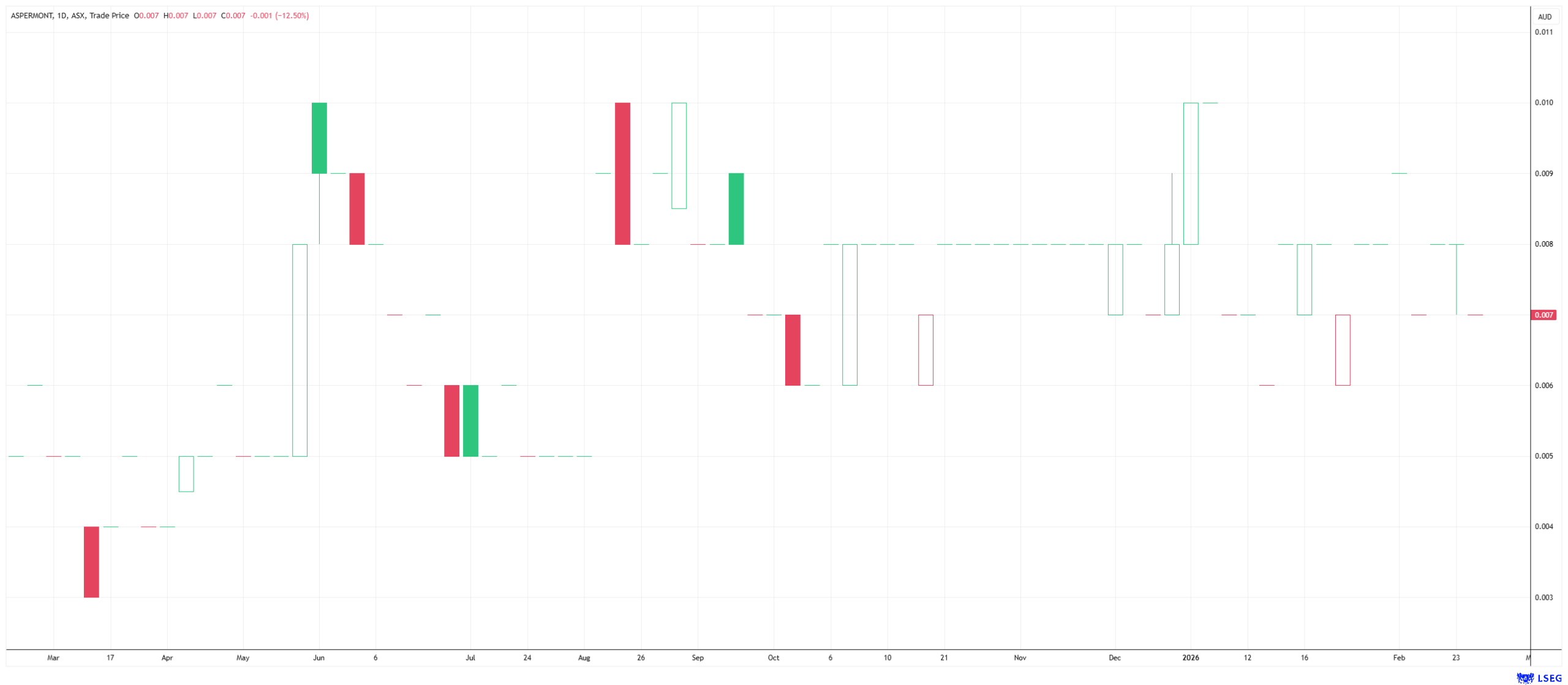
Despite this operational progress, Aspermont was difficult for institutional investors to access for a long time due to an unfavorable capital structure. With around 2.91 billion shares outstanding and a share price in the range of AUD 0.008, the company was considered a classic penny stock on paper. To remove this formal hurdle, shareholders at the Annual General Meeting on February 23, 2026, approved a reverse split at a ratio of 250 to 1. As a result of this measure, the number of shares is reduced to around 11.64 million, while the calculated price rises to approximately AUD 2.00 at an unchanged market capitalization of AUD 23 million, meeting the minimum price requirements of numerous funds.
Although this step is primarily cosmetic, it should make the stock more attractive to investors. Observers view the consolidation of the number of shares positively. The price target of AUD 0.03 issued prior to the split now corresponds to a value of AUD 7.50 and illustrates the calculated upside potential of over 275%. The adjusted structure enables management to present itself differently at international investor conferences in Europe and the US and to showcase its positioning as a tech player to a broader investor base. The transformation from a penny stock to a tech company that is investable for many market participants is likely to lay the foundation for higher institutional trading volume.
Consistency and scaling of customer value
CEO Alex Kent underscored the robustness of the company's business model at yesterday's IIF with concrete figures on business development. The company has recorded 37 consecutive quarters of subscription growth, regardless of macroeconomic fluctuations in the commodity markets. Information and verified data serve to minimize risk in volatile periods and retain their value for customers. A key objective is to increase revenue per customer (ARPU), as demonstrated by the example of a top-3 mining company whose annual spending with Aspermont rose from AUD 8,000 in 2016 to over AUD 210,000. Aspermont's goal is to play a significant role in its customers' decision-making processes with tools such as Mining IQ.
The upselling from pure news to data-as-a-service products illustrates the leverage that Aspermont's platform offers. Modules such as World Risk Analytics for assessing project risks, the ESG Mining Company Index for verified sustainability benchmarking, and the Project Pipeline Index, which analyzes over 24 different criteria per project, provide decision-makers in the mining industry with valuable tools for complex evaluations. The combination of structuring the historical data corpus and integrating modern LLM-based search functions enables Aspermont to develop future products at minimal cost and scale globally. The company operates at the intersection of commodity expertise and artificial intelligence, offering a platform that delivers added value. The stock is particularly exciting in the short term, given the share price consolidation planned for early March.
Conflict of interest
Pursuant to §85 of the German Securities Trading Act (WpHG), we point out that Apaton Finance GmbH as well as partners, authors or employees of Apaton Finance GmbH (hereinafter referred to as "Relevant Persons") currently hold or hold shares or other financial instruments of the aforementioned companies and speculate on their price developments. In this respect, they intend to sell or acquire shares or other financial instruments of the companies (hereinafter each referred to as a "Transaction"). Transactions may thereby influence the respective price of the shares or other financial instruments of the Company.
In this respect, there is a concrete conflict of interest in the reporting on the companies.
In addition, Apaton Finance GmbH is active in the context of the preparation and publication of the reporting in paid contractual relationships.
For this reason, there is also a concrete conflict of interest.
The above information on existing conflicts of interest applies to all types and forms of publication used by Apaton Finance GmbH for publications on companies.
Risk notice
Apaton Finance GmbH offers editors, agencies and companies the opportunity to publish commentaries, interviews, summaries, news and the like on news.financial. These contents are exclusively for the information of the readers and do not represent any call to action or recommendations, neither explicitly nor implicitly they are to be understood as an assurance of possible price developments. The contents do not replace individual expert investment advice and do not constitute an offer to sell the discussed share(s) or other financial instruments, nor an invitation to buy or sell such.
The content is expressly not a financial analysis, but a journalistic or advertising text. Readers or users who make investment decisions or carry out transactions on the basis of the information provided here do so entirely at their own risk. No contractual relationship is established between Apaton Finance GmbH and its readers or the users of its offers, as our information only refers to the company and not to the investment decision of the reader or user.
The acquisition of financial instruments involves high risks, which can lead to the total loss of the invested capital. The information published by Apaton Finance GmbH and its authors is based on careful research. Nevertheless, no liability is assumed for financial losses or a content-related guarantee for the topicality, correctness, appropriateness and completeness of the content provided here. Please also note our Terms of use.