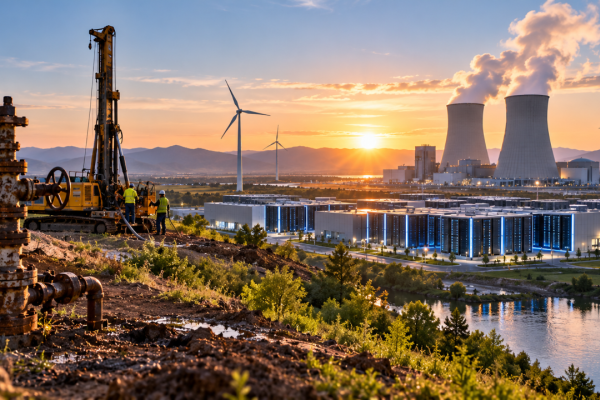
The insatiable appetite of AI data centers, electric vehicles, and digital networks is driving global electricity demand to record levels. Suddenly, it is not just the carbon footprint that matters, but above all, round-the-clock power availability. The return of nuclear power as a reliable baseload is being discussed again—and is giving savvy investors a second chance. While some are betting on stable grids, others are searching for tomorrow's raw materials or are already controlling the supply chains. Three completely different companies are positioned right at this intersection: RWE, Standard Uranium, and Cameco.
time to read: 4 minutes
|
Author:
Armin Schulz
ISIN:
STANDARD URANIUM LTD. | CA85422Q8487 | TSXV: STND , OTCQB: STTDF , RWE AG INH O.N. | DE0007037129 , CAMECO CORP. | CA13321L1085
Table of contents:
Author

Armin Schulz
Born in Mönchengladbach, he studied business administration in the Netherlands. In the course of his studies he came into contact with the stock exchange for the first time. He has more than 25 years of experience in stock market business.
Tag cloud
Shares cloud
RWE – From Nuclear Power Plant to Wind Farm
What began in 1898 as a coal supplier in the Ruhr region became, over the decades, a symbol of German nuclear power. RWE relied on large nuclear power plants, secure baseload power, and centralized generation. But the nuclear phase-out forced the company to rethink its strategy. Today, hardly anything remains of the old nuclear giant. Instead, RWE defines itself through offshore wind farms, onshore solar fields, and massive battery storage facilities. The transformation from a traditional utility to a global energy transition company is no longer a future scenario; it is in full swing.
In the first quarter of 2026, the operating business picked up noticeably. Adjusted EBITDA rose by 25% to EUR 1.6 billion, and earnings per share to EUR 0.85. In addition to improved conditions in Europe, newly built plants with a capacity of 2.3 gigawatts (GW) contributed to the growth. A real windfall was the Dutch compensation of EUR 332 million for a power plant that was only allowed to operate at limited capacity in 2022. Energy trading, however, posted a loss. Nevertheless, management confirmed the annual targets.
For 2026, EBITDA is expected to range between EUR 5.2 and 5.8 billion, and the dividend is set to rise to EUR 1.32 per share. By 2031, a total of EUR 35 billion will be invested to expand generation capacity to 65 GW. The focus is on the US and flexible gas-fired power plants in Germany. At the same time, the EUR 1.5 billion share buyback program is winding down as planned. Anyone familiar with the old RWE sees a company in transition today. It is no longer a defensive utility but a growth-oriented stock with a clear strategy. The stock is currently trading at EUR 55.38.
Standard Uranium – Neighbour to the Billion-Dollar Giants
Anyone exploring uranium in the Athabasca Basin finds themselves in elite company. Nestled among NexGen, Cameco, and Orano, a small explorer has quietly established itself: Standard Uranium, which is operating in a surprisingly strategic and savvy manner. The company holds a land position right next to NexGen's Arrow deposit, a mining project soon to be worth billions. While the major players advance infrastructure development, the neighbouring company stands to benefit indirectly. A recent collaboration with Fleet Space Technologies introduced a novel multiphysics survey method that helps filter out geological noise and deliver clearer gravity data. The result is a set of precise drill targets along three conductive corridors. Two drill rigs are scheduled to begin operations at the end of May.
The company has evolved into a project generator, which significantly reduces the risk for shareholders. Several joint venture deals have been concluded. Partners such as Collective Metals and Aventis are financing drilling on projects like Corvo and Rocas, while Standard Uranium retains operational control and collects fees in return. When a contract expires, the project reverts 100% to the company, including all collected data. This ensures a steady stream of news without constant capital raises. Funding has been secured for the upcoming Davidson season, and there are reportedly interested parties in a capital raise.
The upcoming campaign is the first on the flagship property since 2022. Drilling will take place on multiple corridors simultaneously. Priorities are based on the new multiphysics data plus a machine-learning model trained on public data from neighbouring properties. The management team is experienced. President Sean Hillacre was with NexGen when Arrow was discovered. Drilling permits have been obtained, and First Nations agreements have been signed. Over the next 6–12 months, there are several potential catalysts, including drill results, pending assays, and additional partnership agreements. At this scale, there are not many companies with a comparable opportunity profile. The stock is currently trading at CAD 0.10, giving it a small market capitalization of around CAD 14 million.
Cameco - Solid Quarter and Logistical Setback
Cameco closed the first quarter of 2026 with a net profit of CAD 131 million; adjusted EBITDA stood at CAD 509 million. Sales volumes in the uranium segment picked up, and the average realized price improved. Management confirmed the full-year forecast for uranium production of 19.5–21.5 million pounds and for Fuel Services of 13–14 million kg of uranium. Those familiar with the company know that Cameco prioritizes operational discipline over short-term maximization. This approach is paying off, as structural demand for nuclear fuel remains high.
In mid-May, flooding in northern Saskatchewan caused the main access bridge to the McArthur River and Key Lake mines to collapse. The mining sites themselves remained dry, but the delivery of critical supplies was disrupted. Cameco subsequently temporarily halted production at the Key Lake mill and scaled back operations at McArthur River. The Cigar Lake mine continues to operate. As long as the road closure persists, it remains unclear whether the annual forecast for this site will hold. This is a risk that investors should keep an eye on.
Despite the operational setback, the strategic direction remains intact. A nine-year contract with India secures deliveries of nearly 22 million pounds of uranium, worth approximately CAD 2.6 billion, starting in 2027. The Westinghouse investment improved its contribution to earnings, and the balance sheet shows CAD 1.1 billion in cash and cash equivalents. Those betting on the long-term recovery of the nuclear sector will find in Cameco a disciplined company with clear growth paths, despite temporary logistical disruptions. Currently, one share costs USD 107.51.
The AI boom is reigniting the debate over secure base load. RWE is capitalizing on this trend not as a nuclear power operator, but as an adaptable green energy giant with billions in investments. Standard Uranium, as a savvy exploration partner in the Athabasca Basin, is betting on rising uranium prices and financially strong partnerships. Cameco, despite temporary flooding issues, delivers the crucial resource as an established uranium supplier with a disciplined balance sheet and long-term off-take agreements. Three very different business models are united by one conviction: reliable energy around the clock is becoming a competitive advantage.
Conflict of interest
Pursuant to §85 of the German Securities Trading Act (WpHG), we point out that Apaton Finance GmbH as well as partners, authors or employees of Apaton Finance GmbH (hereinafter referred to as "Relevant Persons") currently hold or hold shares or other financial instruments of the aforementioned companies and speculate on their price developments. In this respect, they intend to sell or acquire shares or other financial instruments of the companies (hereinafter each referred to as a "Transaction"). Transactions may thereby influence the respective price of the shares or other financial instruments of the Company.
In this respect, there is a concrete conflict of interest in the reporting on the companies.
In addition, Apaton Finance GmbH is active in the context of the preparation and publication of the reporting in paid contractual relationships.
For this reason, there is also a concrete conflict of interest.
The above information on existing conflicts of interest applies to all types and forms of publication used by Apaton Finance GmbH for publications on companies.
Risk notice
Apaton Finance GmbH offers editors, agencies and companies the opportunity to publish commentaries, interviews, summaries, news and the like on news.financial. These contents are exclusively for the information of the readers and do not represent any call to action or recommendations, neither explicitly nor implicitly they are to be understood as an assurance of possible price developments. The contents do not replace individual expert investment advice and do not constitute an offer to sell the discussed share(s) or other financial instruments, nor an invitation to buy or sell such.
The content is expressly not a financial analysis, but a journalistic or advertising text. Readers or users who make investment decisions or carry out transactions on the basis of the information provided here do so entirely at their own risk. No contractual relationship is established between Apaton Finance GmbH and its readers or the users of its offers, as our information only refers to the company and not to the investment decision of the reader or user.
The acquisition of financial instruments involves high risks, which can lead to the total loss of the invested capital. The information published by Apaton Finance GmbH and its authors is based on careful research. Nevertheless, no liability is assumed for financial losses or a content-related guarantee for the topicality, correctness, appropriateness and completeness of the content provided here. Please also note our Terms of use.