February 26th, 2026 | 07:05 CET
Hydrogen transition: How dynaCERT, Plug Power, and Ballard Power Systems are decarbonizing the transportation sector
The market for hydrogen-powered logistics is set to reach a volume of USD 32.47 billion in 2026 and is expected to grow to USD 204.9 billion by the end of the decade. The International Energy Agency (IEA) reports that global demand for hydrogen was nearly 100 million tons last year, but less than 1% of that came from low-emission sources. In the US, tariffs on electrolysers and fuel cells, ranging from 10% to 30%, are forcing the industry to build local supply chains. In Europe, the REPowerEU plan, together with the EU hydrogen strategy, creates a stable framework for investment in infrastructure. However, an immediate and comprehensive replacement of the global heavy-duty fleet with completely emission-free vehicles would be difficult to achieve and also economically nonsensical. Instead, companies are preparing to retrofit existing fleets or promote the hydrogen transition in other ways.
time to read: 4 minutes | Author: Nico Popp
ISIN: DYNACERT INC. | CA26780A1084 , PLUG POWER INC. DL-_01 | US72919P2020 , BALLARD PWR SYS | CA0585861085
Table of contents:
Author

Nico Popp
At home in Southern Germany, the passionate stock exchange expert has been accompanying the capital markets for about twenty years. With a soft spot for smaller companies, he is constantly on the lookout for exciting investment stories.
Tag cloud
Shares cloud
dynaCERT focuses on transition technology
The Canadian company dynaCERT targets the extended service life of diesel trucks and mining equipment, often exceeding ten years, by making them more climate-neutral. Its in-house HydraGEN™ technology is a retrofit solution for existing combustion engines and uses an electrolysis system to generate hydrogen and oxygen from distilled water as needed. Independent analyses by the PIT Group in Montreal and Continental EMITEC in Germany verify that using this system reduces fuel consumption by 6 to 19% and nitrogen oxides by up to 88%. The dynaCERT process feeds the generated gases into the engine's air intake tract, where they act as a catalyst to increase the combustion speed of the diesel and lower the combustion temperature. Fleet operators can thus operate their vehicles in a more environmentally friendly manner without compromising payload or range.
Telematics and scaling of carbon markets
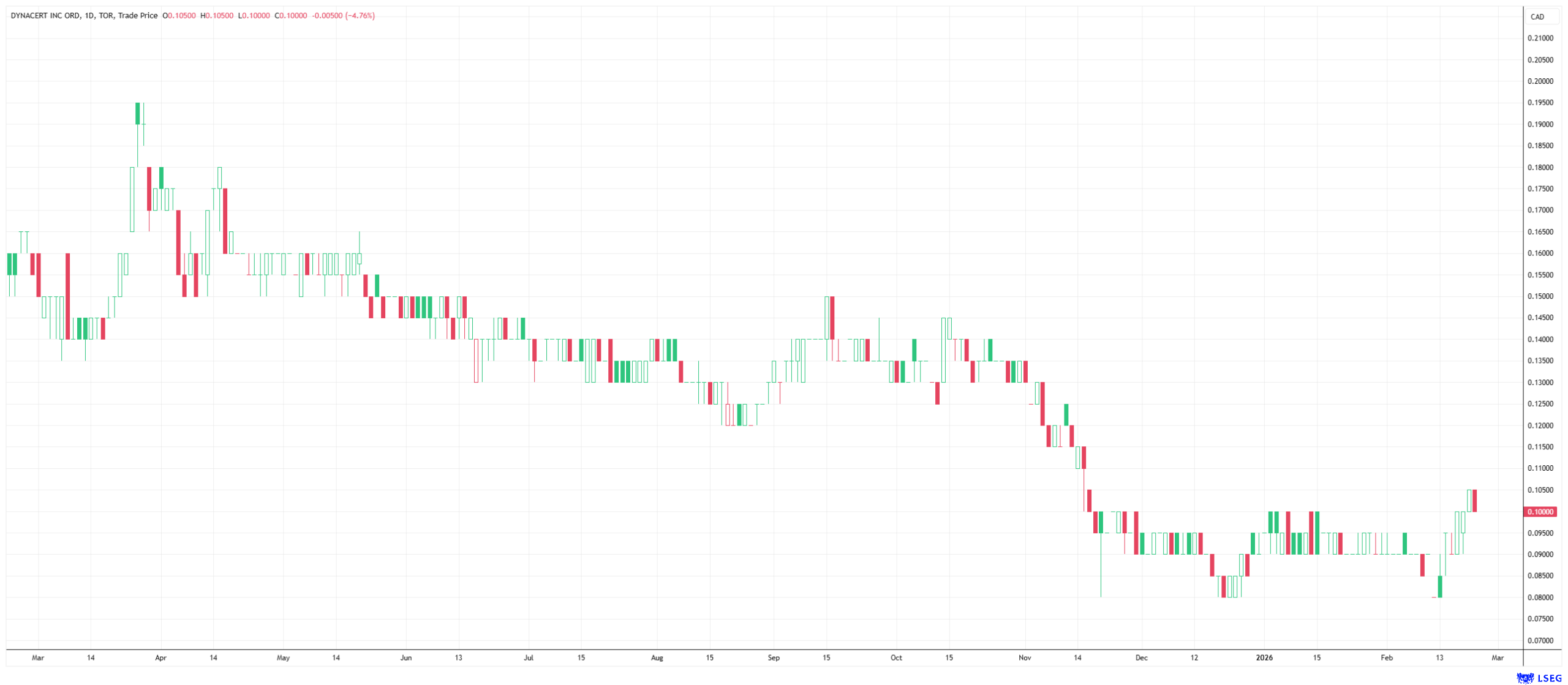
A key component of dynaCERT's business model is the connection of the hardware to the cloud-based HydraLytica telematics platform. This system records vehicle performance data in real time and calculates the emissions saved. Following successful certification by the Verra organization in 2025, dynaCERT and its customers will be able to monetize these savings as carbon credits. Analysts at GBC Research forecast that this recurring software and service business will increase the company's revenue to CAD 21.0 million in 2026, coupled with the achievement of profitability. With a commercial presence in over 50 countries, sales are currently focused on high-value markets such as mining in Australia and Brazil and port logistics in Europe.
While dynaCERT increases the efficiency of existing combustion engines, Plug Power is working on the infrastructure for the hydrogen transition. The business model spans the entire hydrogen value chain, from electrolysis to liquefaction and storage to the final refueling infrastructure. The company started 2026 with a focus on financial consolidation and initiated the so-called Project Quantum Leap to reduce operating costs. By the end of 2025, Plug Power had already reduced its operating cash burn by over 50% sequentially and, at the same time, delivered a 100 MW system for the Galp site in Portugal. More than 230 MW of GenEco electrolyser programs are currently being implemented worldwide. In the third quarter of 2025, the group generated revenue of USD 177.06 million and, with over 285 fueling stations installed, is positioning itself as a global player in the development of the necessary infrastructure.
Financing and leadership change at Plug Power
To ensure liquidity in this capital-intensive segment, Plug Power is focusing on new partnerships outside the traditional transportation sector. A strategic agreement to monetize electricity rights with a major US data center developer aims to release over USD 275 million in liquidity in the first quarter of 2026. The use of hydrogen fuel cells as a power source for the construction of data centers in the field of artificial intelligence opens up new sources of revenue for the company. The implementation of the USD 8 billion sales pipeline will fall under the responsibility of Jose Luis Crespo, who will take over as CEO from Andy Marsh in March 2026. This personnel realignment underscores the company's commitment to efficiently converting operational orders into profitable growth.
Ballard Power Systems is another well-known hydrogen stock. As a technology supplier, the company focuses on the development and production of PEM fuel cell stacks for heavy-duty equipment manufacturers. The company draws on comprehensive operational data, as vehicles with Ballard powertrains will have covered over 250 million km in real-world road use by early 2026. Under the leadership of CEO Marty Neese, who took office in 2025, the group is undergoing a phase of optimizing existing production sites in Canada, Denmark, and China, while plans for a gigafactory in Texas are on hold for the time being. Through this strategic focus, management is aiming to reduce annual operating costs by at least 30% in 2026. At the same time, Ballard launched the ninth generation of its modules under the name FCmove SC series. These systems offer 30% more power with 25% higher power density and reduce components by 40%, which should lower manufacturing costs and reduce the risk of errors for vehicle manufacturers.
Commercial momentum on rail and sea
The business models of dynaCERT, Plug Power, and Ballard Power Systems form a comprehensive value chain around the decarbonization of transportation. In their study on long-distance transport, analysts at McKinsey note that hydrogen filling station operators can break even at a utilization rate of 55%, which corresponds to approximately seven long-distance trucks. This industrial momentum is being supported by subsidy programs such as the 45V tax credit from the US Inflation Reduction Act, which subsidizes domestic hydrogen production with up to USD 3 per kilogram. In Europe, the European Hydrogen Backbone initiative is accelerating the expansion of a pipeline network that is expected to cover a length of over 58,000 km by 2040. Companies in the fields of retrofitting technology, infrastructure, and drive engineering are finally finding the structural conditions they need to grow competitively in this environment. While Plug Power and Ballard Power are heavyweights in industry, dynaCERT, which has made progress in the port business in recent quarters, remains the more speculative play given its market capitalization of approximately CAD 50 million. Opportunity-oriented investors may take advantage of this.
Conflict of interest
Pursuant to §85 of the German Securities Trading Act (WpHG), we point out that Apaton Finance GmbH as well as partners, authors or employees of Apaton Finance GmbH (hereinafter referred to as "Relevant Persons") may hold shares or other financial instruments of the aforementioned companies in the future or may bet on rising or falling prices and thus a conflict of interest may arise in the future. The Relevant Persons reserve the right to buy or sell shares or other financial instruments of the Company at any time (hereinafter each a "Transaction"). Transactions may, under certain circumstances, influence the respective price of the shares or other financial instruments of the Company.
In addition, Apaton Finance GmbH is active in the context of the preparation and publication of the reporting in paid contractual relationships.
For this reason, there is a concrete conflict of interest.
The above information on existing conflicts of interest applies to all types and forms of publication used by Apaton Finance GmbH for publications on companies.
Risk notice
Apaton Finance GmbH offers editors, agencies and companies the opportunity to publish commentaries, interviews, summaries, news and the like on news.financial. These contents are exclusively for the information of the readers and do not represent any call to action or recommendations, neither explicitly nor implicitly they are to be understood as an assurance of possible price developments. The contents do not replace individual expert investment advice and do not constitute an offer to sell the discussed share(s) or other financial instruments, nor an invitation to buy or sell such.
The content is expressly not a financial analysis, but a journalistic or advertising text. Readers or users who make investment decisions or carry out transactions on the basis of the information provided here do so entirely at their own risk. No contractual relationship is established between Apaton Finance GmbH and its readers or the users of its offers, as our information only refers to the company and not to the investment decision of the reader or user.
The acquisition of financial instruments involves high risks, which can lead to the total loss of the invested capital. The information published by Apaton Finance GmbH and its authors is based on careful research. Nevertheless, no liability is assumed for financial losses or a content-related guarantee for the topicality, correctness, appropriateness and completeness of the content provided here. Please also note our Terms of use.