August 11th, 2026 | 07:25 CEST
Germany in the Crosshairs: Regulations Slow Down Hensoldt and DroneShield – Is Volatus Aerospace Heading for a Boom in Orders?
A threat is increasingly looming over industrial facilities in Germany, keeping European security authorities on edge: drones. While unmanned aerial vehicles could still be dismissed as harmless toys just a few years ago, the targeted surveillance of critical infrastructure using professional drones paints a completely different picture today. In 2023 alone, authorities recorded at least 446 drone sightings over German military sites, while the number of incidents involving critical infrastructure rose to well over 1,000 by the end of 2025, according to the Federal Criminal Police Office. When unmanned systems spy on Bundeswehr facilities unnoticed or collect precise data on gas pipelines, caution is warranted—and this was true even before the incident involving a drone loaded with explosives at Leipzig Airport. We explore potential solutions and highlight exciting companies.
time to read: 3 minutes | Author: Nico Popp
ISIN: HENSOLDT AG INH O.N. | DE000HAG0005 , DRONESHIELD LTD | AU000000DRO2 , VOLATUS AEROSPACE INC | CA92865M1023 | TSXV: FLT , OTCQB: TAKOF
Table of contents:
Author

Nico Popp
At home in Southern Germany, the passionate stock exchange expert has been accompanying the capital markets for about twenty years. With a soft spot for smaller companies, he is constantly on the lookout for exciting investment stories.
Tag cloud
Shares cloud
Hensoldt's High-Frequency Sensing Pushing the Limits
Hensoldt plays a pivotal role in the European defence industry and supplies electronics for heavy military equipment. Among other things, the Munich-based company equips Rheinmetall's Skyranger 30 anti-aircraft gun tank with its radars. In addition, the Federal Police rely on the sensor specialist's mobile vehicle solutions for airspace surveillance. Through the ASUL defence system, Hensoldt integrates weapons from the manufacturer Kongsberg to neutralize missiles kinetically. While the passive Twinvis radar system operates in a way that makes it immune to anti-radiation weapons, defence systems in the civilian sector face bureaucratic headwinds. Although private port and power plant operators are permitted to collect radar data, they lack the legal authority to actively jam the frequencies of approaching drones or even shoot them down. The German Aviation Security Act currently restricts the use of active interception systems to such an extent that operators of critical infrastructure have little time to defend themselves against approaching drones.
DroneShield: Jammers vs. AI-Controlled Systems
DroneShield focuses on the development and distribution of portable and rapidly deployable defence devices for close-range use. The company, which uses high-frequency jammers, supplies security forces with portable handheld devices such as the DroneGun Mk4, which weighs just 3.2 kg including the battery and transmits targeted frequency interference. For stationary use, the company combines RfOne passive sensors with omnidirectional jammers from the DroneCannon series. DroneShield's frequency jamming disrupts the signals of common control devices on the 2.4 GHz and 5.8 GHz frequency bands and interferes with civilian satellite navigation systems such as GPS and Galileo. However, this approach is reaching its limits in an increasing number of operational scenarios. Autonomous drone systems that navigate using optical sensors and can operate without a continuous radio link to a ground station are largely immune to conventional signal jamming. In addition, such jamming can cause significant interference with cellular networks in densely populated metropolitan areas, further limiting its practical use.
Volatus Aerospace: Drone Platform for NATO Countries
As a platform provider, Volatus Aerospace offers a comprehensive suite of drone-related solutions, combining hardware with software and services. With its VIGIL-V300 unmanned platform, the Canadian company provides a flight system capable of a maximum flight duration of up to seven days, an altitude of 16,000 feet, and a range of 18,000 km. For battlefield logistics, the company provides the CONDOR XL unmanned heavy-lift helicopter, which can transport payloads of up to 180 kg over distances of 200 km. In addition, the company relies on the Peremoha and ReKam small systems—flexible, modular drones that can switch between reconnaissance optics and electronic warfare capabilities depending on their configuration. To develop its own Canadian interceptor drone, Volatus Aerospace signed a non-binding memorandum of understanding (MoU) with Sentinel R&D.
Services and SaaS Platform as Additional Pillars
But Volatus offers far more than just hardware. Through its Remote Operations Center in Vaughan, Canada, Volatus can conduct reconnaissance missions worldwide as a service for its customers. The in-house Volatus Academy also trains drone pilots for unmanned missions and accommodates even extreme environmental conditions. With the launch of the SKYDRA SaaS platform, Volatus expanded its portfolio to include a digital simulation environment. This enables government agencies and operators of critical infrastructure to simulate specific threat scenarios to ensure they are prepared in the event of an emergency. With the expansion of its own manufacturing capabilities in Québec and its foray into the US defence market, Volatus Aerospace continues to grow.
Volatus Aerospace on the Radar of Defence Experts
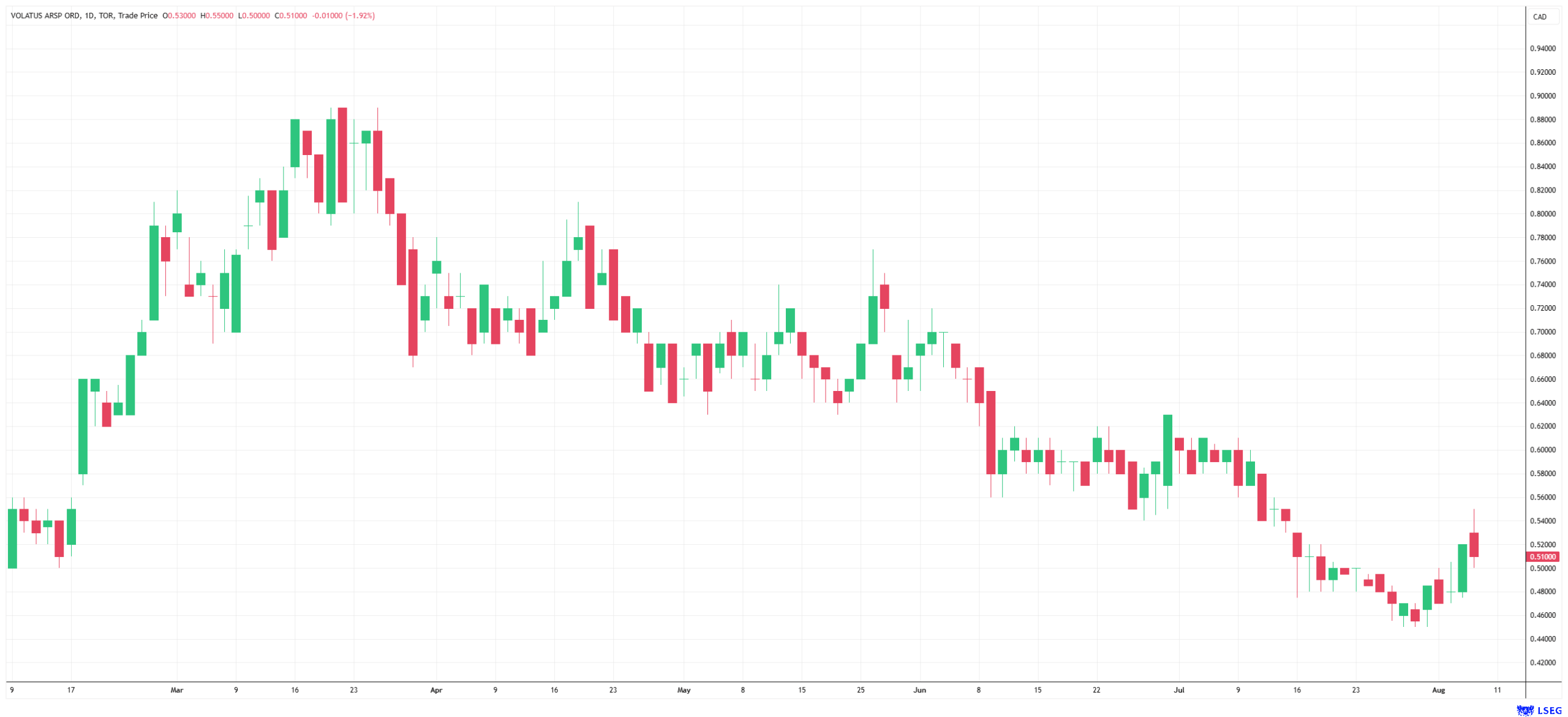
In recent quarters, Volatus Aerospace has repeatedly received orders from NATO countries. Follow-on orders in this area are likely to serve as catalysts for the share price, as are those in the services and training segments or via the SKYDRA software platform. As asymmetric threats are on the rise, particularly in Europe, and this increases pressure to remove regulatory barriers for drones, Volatus Aerospace could benefit. Things have quieted down somewhat around the stock in recent months. This can be an advantage for investors who want to act countercyclically. Drones are a pressing issue in Germany, and Volatus has relevant solutions in its portfolio.
Watch YouTube videoConflict of interest
Pursuant to §85 of the German Securities Trading Act (WpHG), we point out that Apaton Finance GmbH as well as partners, authors or employees of Apaton Finance GmbH (hereinafter referred to as "Relevant Persons") currently hold or hold shares or other financial instruments of the aforementioned companies and speculate on their price developments. In this respect, they intend to sell or acquire shares or other financial instruments of the companies (hereinafter each referred to as a "Transaction"). Transactions may thereby influence the respective price of the shares or other financial instruments of the Company.
In this respect, there is a concrete conflict of interest in the reporting on the companies.
In addition, Apaton Finance GmbH is active in the context of the preparation and publication of the reporting in paid contractual relationships.
For this reason, there is also a concrete conflict of interest.
The above information on existing conflicts of interest applies to all types and forms of publication used by Apaton Finance GmbH for publications on companies.
Risk notice
Apaton Finance GmbH offers editors, agencies and companies the opportunity to publish commentaries, interviews, summaries, news and the like on news.financial. These contents are exclusively for the information of the readers and do not represent any call to action or recommendations, neither explicitly nor implicitly they are to be understood as an assurance of possible price developments. The contents do not replace individual expert investment advice and do not constitute an offer to sell the discussed share(s) or other financial instruments, nor an invitation to buy or sell such.
The content is expressly not a financial analysis, but a journalistic or advertising text. Readers or users who make investment decisions or carry out transactions on the basis of the information provided here do so entirely at their own risk. No contractual relationship is established between Apaton Finance GmbH and its readers or the users of its offers, as our information only refers to the company and not to the investment decision of the reader or user.
The acquisition of financial instruments involves high risks, which can lead to the total loss of the invested capital. The information published by Apaton Finance GmbH and its authors is based on careful research. Nevertheless, no liability is assumed for financial losses or a content-related guarantee for the topicality, correctness, appropriateness and completeness of the content provided here. Please also note our Terms of use.