November 5th, 2026 | 05:34 CET
How First Hydrogen, Schaeffler and SpaceX Are Targeting the Trillion-Dollar Humanoid Robot Market
Artificial intelligence is learning to walk, but to do so it needs muscles made of steel and high-precision gearboxes. While aerospace company Space Exploration Technologies (SpaceX) is investing billions in new AI infrastructure and automotive supplier Schaeffler already operates a factory where robots assemble robot components, Canadian hydrogen pioneer First Hydrogen is now also venturing into robotics. The race to develop the joints for these machines has begun, and the roles in this emerging industry are being reshuffled.
time to read: 4 minutes | Author: Nico Popp
ISIN: First Hydrogen Corp | CA32057N1042 , DE000SHA0100 , SPACE EXPLORATION TECHNOLOGIES CORP | US84615Q1031
Table of contents:
Author

Nico Popp
At home in Southern Germany, the passionate stock exchange expert has been accompanying the capital markets for about twenty years. With a soft spot for smaller companies, he is constantly on the lookout for exciting investment stories.
Tag cloud
Shares cloud
Schaeffler: Robots build robots
Franconian automotive supplier Schaeffler is resisting the foreseeable end of the internal combustion engine. The announcement in early November shows how tough the restructuring is: a net 3,460 jobs in Europe are being cut, including around 2,660 in Germany, and several sites are being closed. At the same time, the group is expanding robotics as a new business pillar. In October, it opened a 7,500 sqm showcase factory in Taicang, China, where six humanoid robots assemble joint actuators for the next generation of humanoid robots at five stations. Schaeffler now records order intake of around EUR 400 million in this segment and has positioned itself early with supply contracts, including with Neura Robotics and Hexagon Robotics. According to the group, products within Schaeffler's core expertise, namely joint actuators and precision gearboxes, account for at least half the material costs of a humanoid robot. The company tests the processes in Taicang in advance on a digital twin of the production line. With technology partner NVIDIA, it also models its actuators in simulations so robots can be tested virtually before real-world deployment.
SpaceX: AI factories on the Moon
Elon Musk, meanwhile, is thinking on an interplanetary scale. SpaceX now generates more revenue from artificial intelligence than from rocket launches and satellite internet combined. In the third quarter, revenue rose 161% to USD 14.6 billion, of which USD 7.56 billion came from the "Super Intelligence" AI division. This is being driven, among other things, by new cloud contracts for computing capacity, with the Starlink satellite network following at USD 5.25 billion. The hunger for computing power comes at a price: of USD 19.6 billion in investment during the quarter, USD 16.4 billion went into AI infrastructure – and data centres of this size consume enormous amounts of electricity. Musk is therefore planning beyond Earth. In early August, during the first conference call as a listed company, he reaffirmed plans to build factories on the Moon for AI computing satellites, which would subsequently operate as data centres in space. Humanoid robots are to process aluminium, titanium and silicon from lunar rock there, with only the chips still coming from Earth.
First Hydrogen reaches for the patent treasure trove
Amid this industrial transformation, Canadian developer First Hydrogen is now positioning itself to take advantage. Until now, the Canadians were best known for their two hydrogen-powered vans approved for road use in the UK. Now, intellectual property is taking centre stage. On November 2, the TSX Venture Exchange approved the definitive agreement to acquire a 60% majority stake in Exodus Actuation Solutions Inc. for 2 million common shares and a staged investment of USD 2 million. Both components are tied to agreed budgets, with a further 523,475 shares payable as a finder's fee. This gives First Hydrogen access to 26 granted and 10 pending patents covering actuators, gearboxes and high-performance motors, which Exodus owns or licenses. The company is consolidating its robotics activities in its wholly owned subsidiary, First Humanoid. The drive systems are designed to reduce friction, increase efficiency and make robot movements smoother and more natural. Exodus is not merely a concept-stage start-up: according to the company, it has already manufactured and delivered more than 500 motors and gearboxes to customers in the robotics, automotive and packaging industries.
Unmanned ground vehicles for extreme operations
Alongside joints for humanoids, First Hydrogen is targeting military and logistics niches. A separate agreement with Exodus secures the company exclusive worldwide rights to a patented mobile ground-drone platform. The robust vehicle with shape-changing wheels is designed to keep moving even after sustaining damage. It is intended, among other things, for military support, transport and use as a launch and refuelling platform for aerial drones. At the end of September, First Hydrogen reported that construction was complete. The company has therefore reached the agreed development milestone and holds the exclusive rights for the remaining term of the patent, in exchange for a royalty of 1% of gross revenue. First Hydrogen bears the development costs, and the resulting intellectual property belongs entirely to the company. This brings things full circle back to the hydrogen business, as autonomous logistics vehicles and drones can benefit from quiet fuel cells far from any charging infrastructure.
Conclusion: A multibillion-dollar market for mechanical muscles
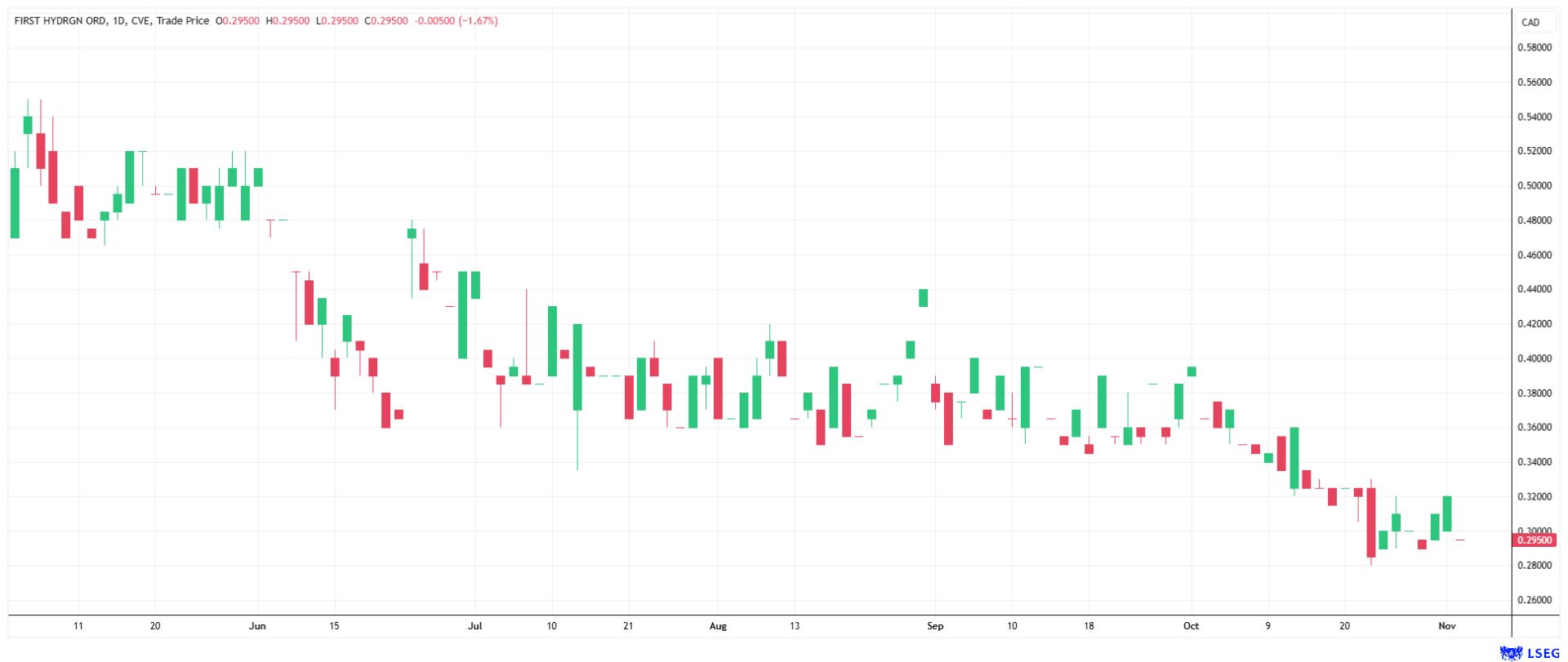
The figures show how large this market could become. Analysts at RBC Capital Markets estimate that the global market for humanoid robotics could reach around USD 9 trillion by 2050. According to The Business Research Company, the market for robot actuators alone is expected to grow to almost USD 68 billion by 2030. While Schaeffler focuses on industrial series production and SpaceX invests billions in AI infrastructure, First Hydrogen is taking the intellectual property route and targeting power transmission, a key area of robotics. Without precise joints, even the best neural networks remain rigid, and factories on the Moon remain pure fiction. Nevertheless, First Hydrogen's financial requirements are considerable given its ongoing operating losses, especially as shares trade around CAD 0.30, well below previous highs. This makes the stock a speculative investment despite its potential.
Conflict of interest
Pursuant to §85 of the German Securities Trading Act (WpHG), we point out that Apaton Finance GmbH as well as partners, authors or employees of Apaton Finance GmbH (hereinafter referred to as "Relevant Persons") may hold shares or other financial instruments of the aforementioned companies in the future or may bet on rising or falling prices and thus a conflict of interest may arise in the future. The Relevant Persons reserve the right to buy or sell shares or other financial instruments of the Company at any time (hereinafter each a "Transaction"). Transactions may, under certain circumstances, influence the respective price of the shares or other financial instruments of the Company.
In addition, Apaton Finance GmbH is active in the context of the preparation and publication of the reporting in paid contractual relationships.
For this reason, there is a concrete conflict of interest.
The above information on existing conflicts of interest applies to all types and forms of publication used by Apaton Finance GmbH for publications on companies.
Risk notice
Apaton Finance GmbH offers editors, agencies and companies the opportunity to publish commentaries, interviews, summaries, news and the like on news.financial. These contents are exclusively for the information of the readers and do not represent any call to action or recommendations, neither explicitly nor implicitly they are to be understood as an assurance of possible price developments. The contents do not replace individual expert investment advice and do not constitute an offer to sell the discussed share(s) or other financial instruments, nor an invitation to buy or sell such.
The content is expressly not a financial analysis, but a journalistic or advertising text. Readers or users who make investment decisions or carry out transactions on the basis of the information provided here do so entirely at their own risk. No contractual relationship is established between Apaton Finance GmbH and its readers or the users of its offers, as our information only refers to the company and not to the investment decision of the reader or user.
The acquisition of financial instruments involves high risks, which can lead to the total loss of the invested capital. The information published by Apaton Finance GmbH and its authors is based on careful research. Nevertheless, no liability is assumed for financial losses or a content-related guarantee for the topicality, correctness, appropriateness and completeness of the content provided here. Please also note our Terms of use.