October 2nd, 2026 | 09:50 CEST
Formycon and the Patent Cliff: Why Expiring Patents at Novartis and Merck Present an Opportunity for the German Biotech Industry
Even pharmaceutical giants are coming under pressure. The key term here is the patent cliff. According to industry estimates, between 2025 and 2030, active pharmaceutical ingredients with a global sales volume of approximately USD 300 billion will lose their exclusive patent protection. This turning point is forcing even pharmaceutical giants to rethink their strategies. Specialized developers will then bring biosimilars to market—equivalent and more affordable alternatives for healthcare systems. One well-known biosimilar provider is the German company Formycon. We examine the market and outline what makes Formycon's investment story compelling. But first, we look at two international pharmaceutical companies.
time to read: 4 minutes | Author: Nico Popp
ISIN: FORMYCON AG | DE000A1EWVY8 , NOVARTIS NAM. SF 0_50 | CH0012005267 , MERCK KGAA O.N. | DE0006599905
Table of contents:
Author

Nico Popp
At home in Southern Germany, the passionate stock exchange expert has been accompanying the capital markets for about twenty years. With a soft spot for smaller companies, he is constantly on the lookout for exciting investment stories.
Tag cloud
Shares cloud
Merck: Keytruda's Patent Cliff Looms Larger
The American pharmaceutical company Merck & Co. relies heavily on a single product: The cancer drug Keytruda, along with its new subcutaneous formulation, generated sales of USD 31.7 billion in 2025. This accounted for just under half of the company's total revenue of USD 65.0 billion. Market analysts expect the PD-1 inhibitor to reach peak sales of USD 33 to 34 billion by 2028. However, the key US substance patent expires at the end of 2028, while two other patents in the same family remain in effect until 2029. As soon as cheaper biosimilars enter the market, market observers expect significant revenue declines.
Novartis: A Case Study in Ophthalmology
The speed at which a market changes after a patent expires is evident in the case of Novartis and Roche in ophthalmology. For years, the two companies dominated the severe retinal disease segment with the high-priced drug Lucentis—Novartis outside the US and Roche in the US. But when the exclusive rights expired, biosimilars entered the market, including Formycon's. In the United Kingdom, Formycon's Lucentis biosimilar, FYB201, which Teva markets there as Ongavia, captured over 80% market share by indication-specific market volume. Novartis's global Lucentis sales fell by 29% in 2024 to approximately USD 1.0 billion. While this represents only a small portion of the group's total revenue, it is a massive slump for the product, as healthcare payers prefer the significantly cheaper alternatives. This example illustrates how quickly healthcare systems switch to cheaper alternatives after a patent expires.
Formycon: The Technological Breakthrough Behind the Billion-Dollar Alternative
Formycon AG is one such provider. With 200 employees at its headquarters in Martinsried, one of Europe's leading life sciences hubs just outside Munich, the company focuses exclusively on the development of biosimilars. Its most important project is known internally as FYB206 and targets the billion-dollar market surrounding Merck's Keytruda. Formycon is benefiting from a regulatory paradigm shift. The US Food and Drug Administration (FDA) and the European Medicines Agency (EMA) are increasingly foregoing lengthy Phase III efficacy studies, provided that comprehensive analytical testing and a comparative pharmacokinetic study demonstrate a high degree of similarity to the reference product. As early as 2024, Formycon had published the results of a comparative analytical study in the journal Drugs in R&D, which demonstrated a very high structural and functional similarity between FYB206 and Keytruda. In September 2026, the company also published its concept for an optimized clinical development approach focused on pharmacokinetics in the journal BioDrugs.
Formycon had embarked on this path early on. Following intensive discussions with the FDA, the company completed the Phase III Lotus trial in lung cancer patients as early as February 2025. Comparability with Keytruda was instead to be demonstrated through analytical testing and the parallel Dahlia pharmacokinetic study. In the Dahlia study, patients who had undergone surgical removal of melanoma (malignant melanoma) received the drug over 17 treatment cycles. The study was designed to show that the body absorbs and metabolises FYB206 the same way as the reference product.
The strategy paid off: Dahlia demonstrated pharmacokinetic equivalence to Keytruda, and Formycon completed clinical development in July 2026. According to the company, foregoing the Phase III trial saves a high double-digit million-euro amount and significantly shortens the path to approval. As early as December 2025, Formycon had also secured Zydus Lifesciences as its exclusive marketing partner for the US and Canada. Upon signing the agreement, the parties agreed on upfront and milestone payments in the low double-digit millions of euros. In addition, the agreement includes further development and approval milestones in the mid-double-digit millions of euros. Following the market launch, Formycon will also receive a share of gross profit in the mid-double-digit percentage range. Formycon is responsible for approval and delivery, while Zydus handles marketing.
Formycon: Global Scaling, Optimistic Analysts
Beyond its flagship oncology project, Formycon is demonstrating that its business model also works across a broad spectrum. Through partnerships, such as those with MS Pharma and Megalabs, the company is tapping into developing markets in the Middle East and Latin America. At the same time, Formycon is securing additional production capacity through an alliance with contract manufacturer OneSource Specialty Pharma. The ophthalmology portfolio is also delivering results. The Eylea biosimilar FYB203 has been on the market in Europe since mid-May 2026, and the US launch is scheduled for the fourth quarter of 2026. Eylea treats retinal diseases and can halt, and in some cases even reverse, vision loss.
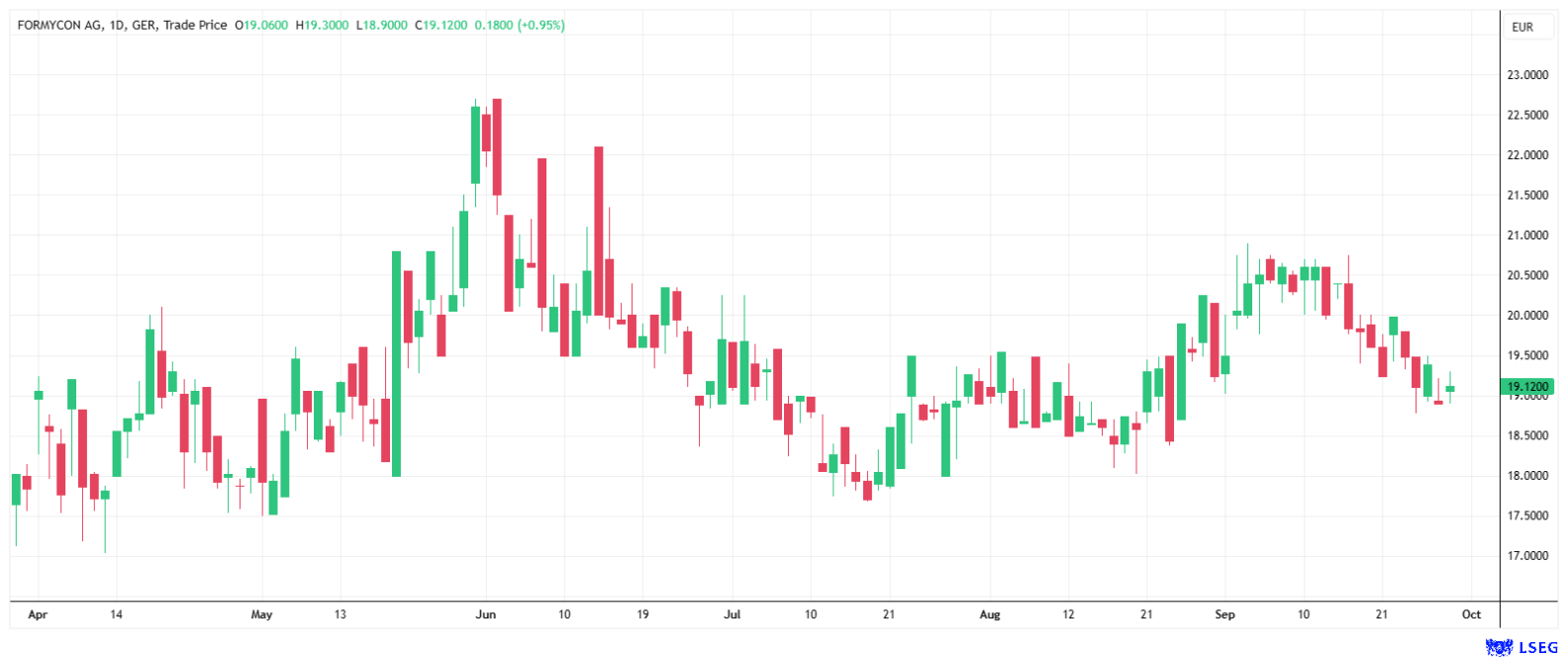
The figures show that Formycon is making progress with its multi-pronged strategy. In the first half of 2026, revenue rose from EUR 9.0 to 25.8 million, while EBITDA improved from minus EUR 17.9 to minus EUR 3.4 million. The drivers were milestone payments for FYB206 (EUR 11.3 million) and EUR 8.3 million from the immunology biosimilar FYB202, which is being marketed in a challenging, price-sensitive market environment. For the full year, Formycon expects revenue of EUR 60 to 70 million and EBITDA between EUR 0 and 10 million. Current analyst estimates for Formycon are predominantly positive. Six analysts recommend a "Buy", including Berenberg with a price target of EUR 30 and H.C. Wainwright with EUR 36; Oddo BHF is "Neutral". Price targets range from EUR 30 to 51, well above the current share price of around EUR 19. Catalysts include the US approval process for FYB206, with submission and review by the FDA, as well as additional milestone and licensing payments.
Conflict of interest
Pursuant to §85 of the German Securities Trading Act (WpHG), we point out that Apaton Finance GmbH as well as partners, authors or employees of Apaton Finance GmbH (hereinafter referred to as "Relevant Persons") may hold shares or other financial instruments of the aforementioned companies in the future or may bet on rising or falling prices and thus a conflict of interest may arise in the future. The Relevant Persons reserve the right to buy or sell shares or other financial instruments of the Company at any time (hereinafter each a "Transaction"). Transactions may, under certain circumstances, influence the respective price of the shares or other financial instruments of the Company.
In addition, Apaton Finance GmbH is active in the context of the preparation and publication of the reporting in paid contractual relationships.
For this reason, there is a concrete conflict of interest.
The above information on existing conflicts of interest applies to all types and forms of publication used by Apaton Finance GmbH for publications on companies.
Risk notice
Apaton Finance GmbH offers editors, agencies and companies the opportunity to publish commentaries, interviews, summaries, news and the like on news.financial. These contents are exclusively for the information of the readers and do not represent any call to action or recommendations, neither explicitly nor implicitly they are to be understood as an assurance of possible price developments. The contents do not replace individual expert investment advice and do not constitute an offer to sell the discussed share(s) or other financial instruments, nor an invitation to buy or sell such.
The content is expressly not a financial analysis, but a journalistic or advertising text. Readers or users who make investment decisions or carry out transactions on the basis of the information provided here do so entirely at their own risk. No contractual relationship is established between Apaton Finance GmbH and its readers or the users of its offers, as our information only refers to the company and not to the investment decision of the reader or user.
The acquisition of financial instruments involves high risks, which can lead to the total loss of the invested capital. The information published by Apaton Finance GmbH and its authors is based on careful research. Nevertheless, no liability is assumed for financial losses or a content-related guarantee for the topicality, correctness, appropriateness and completeness of the content provided here. Please also note our Terms of use.