January 19th, 2024 | 08:00 CET
dynaCERT, Mercedes-Benz, RWE - Future Technologies in Focus
The icy winter is causing snow chaos at Europe's airports, leading to numerous missed appointments. However, logistics companies show no mercy and deliver their goods punctually by road and rail. Entrepreneurs like Jim Payne from dynaCERT are attracting attention with innovative solutions for logisticians, construction companies, and waste management firms, offering cost savings for diesel drives while increasing fuel efficiency. Given the CO₂ tax on fossil fuels, this is music to investors' ears. Top Dog Mercedes-Benz uses its sales figures to show how the mobility market is changing in terms of alternative drive systems to diesel, petrol and the like. Change is also on the horizon for a company within the RWE Group. Find out what it is all about here.
time to read: 5 minutes
|
Author:
Juliane Zielonka
ISIN:
DYNACERT INC. | CA26780A1084 , MERCEDES-BENZ GROUP AG | DE0007100000 , RWE AG INH O.N. | DE0007037129
Table of contents:
Author

Juliane Zielonka
Born in Bielefeld, she studied German, English and psychology. The emergence of the Internet in the early '90s led her from university to training in graphic design and marketing communications. After years of agency work in corporate branding, she switched to publishing and learned her editorial craft at Hubert Burda Media.
Tag cloud
Shares cloud
Innovative bridging technology: HydraGEN™ from dynaCERT lowers fuel costs and reduces CO₂ emissions
Winter's icy touch covers Europe, causing flight cancellations, delays and snow chaos. However, logistics companies continue to run their delivery routes to keep business going. Political elites cavort in snowy Davos and dream of a global world order. Only Argentina's libertarian Prime Minister Javier Milei, in his speech on-site, calls for less state intervention and more courage for the private sector.
It is private-sector entrepreneurs like Jim Payne who are using their inventive spirit to create new solutions to solve current problems. His company dynaCERT (ISIN CA26780A1084) presents the latest generation of technology for reducing carbon dioxide emissions in diesel engines on the global market. The innovative HydraGEN™ technology uses the process of electrolysis to produce H2 and O2 gases from distilled water, on demand. It is a bridging technology that enables logistics operators to reduce their fuel costs and CO₂ emissions significantly.
In addition to transportation and logistics, the HydraGEN™ technology is beneficial for other sectors that rely on diesel: Agriculture, waste management, oil and mining industries. Construction vehicles and heavy machinery in the construction industry, such as excavators, bulldozers and dump trucks, often use diesel engines.
The reliability of dynaCERT's bridging technology is demonstrated this week at the prestigious Paris-Dakar Rally. dynaCERT is sponsoring the truck with the starting number 915 with its technology, and the team led by Alexandre Lemeray is performing confidently thanks to the reliable fuel supply in the Man model LL90. Here is an interactive map.
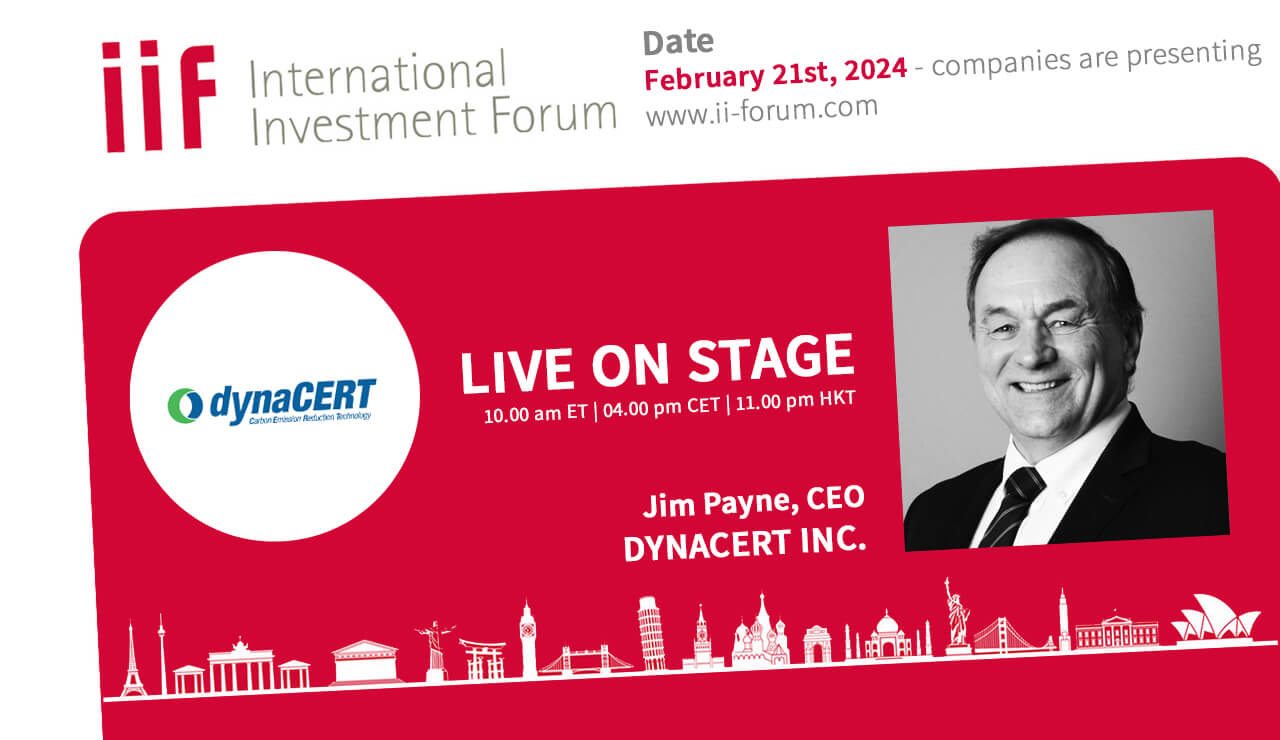
Technology tests to date have shown an improved fuel efficiency of 8 to 13%. Given the oil price and the efforts of various countries to reduce CO₂, Payne can look forward to increasing demand for dynaCERT's technology. He will report on what investors can expect in 2024 at the 10th International Investment Forum on February 21, 2024. You can register here.
Mercedes-Benz 2023 Passenger Cars sales figures at previous year's level, delivery bottlenecks in Q4
Daimler Truck sold 526,053 trucks and buses worldwide in 2023, compared to 520,291 in 2022, which is just 5,762 units more. Sales of battery-powered models rose by 277% to 3,443 units from 914. In North America, sales increased by 4% to 195,014 units, while at Mercedes-Benz, they fell by 5% to 158,511 units, mainly due to weak market development in Brazil. Sales figures for the Asia Unit rose by 3% to 161,171 units, while bus sales increased by 9% to 26,168 units.
CEO Martin Daum comments: "Our sales of battery electric vehicles have more than tripled compared to the previous year. We have expanded our product portfolio of battery electric vehicles for our customers to 10 different models in 2023."
On the consumer car side, the Stuttgart-based company reports that sales figures in 2023 are forecast to be on par with the previous year. In the fourth quarter, however, sales fell below those of the previous year due to delivery bottlenecks and a slowdown caused by the model changeover to the new E-Class, which was launched in China in December.
The sales of battery-electric passenger cars from Mercedes-Benz rose by 73% to 222,600 units over the year, while battery-electric sales of the Smart Fortwo and Smart Forfour models fell by 12%.
Given the inadequate charging infrastructure, relying solely on batteries is not working well. Even Hamburg's mayor Peter Tschentscher has recognized this and swapped his all-electric Mercedes-Benz for a hybrid vehicle. Since the third quarter, the car manufacturer has been struggling with a bottleneck in the 48-volt systems supplied by Bosch, which is limiting the availability of the new GLC and E-Class. The Company will announce its financial results for the full year 2023 on February 22. The share currently stands at EUR 59.47.
RWE ahead of planned Ørsted cooperation - Danish government blocks deal
The global energy group RWE (ISIN DE0007037129) is making a somewhat more mixed start to the new year. According to a report in Manager Magazin, at the end of 2023, the Company had planned a cooperation with the Danish developer of offshore wind projects, Ørsted.
However, the Germans made the cooperation without the Danish government. As the main shareholder of Ørsted, with a 50.1% stake, the Danes said "nej". Neither Ørsted nor the Danish government can be reached for comment at this time. In the wake of this announcement, RWE shares fell by 4.6 %.
There will be personnel changes within the RWE Group at the beginning of the 2nd quarter. Roger Miesen (59), the current CEO of RWE Generation SE, plans to end his career at RWE at the end of March and retire. Miesen has been with RWE since 2009 and, as a proven energy expert, has headed various power plant departments. He has headed the Executive Board of RWE Generation since 2018.
RWE Generation operates one of the largest flexible power plant fleets in Germany, the UK and the Netherlands and bundles the hydrogen activities within the RWE Group with gas, hard coal, hydrogen, hydropower and biomass as part of its energy mix.
Nikolaus Valerius (53), currently Chief Operating Officer (COO), is to replace Miesen as CEO of RWE Generation. Dutch-born Marinus Tabak (40) will take over the position of COO. The personnel changes must still be approved by the Supervisory Board meeting at the end of February. The share price is currently EUR 36.61.
With its HydraGEN™ technology, dynaCERT has created a pioneering solution for the reduction of carbon dioxide emissions in diesel engines. It enables fuel savings, increases the efficiency of the diesel used and provides a reliable alternative for logistics operators and other vertical industries that rely on diesel engines. With increasing demand and positive tests, dynaCERT is facing promising prospects. CEO Jim Payne will explain his strategy to interested investors at the 10th digital International Investment Forum on February 21, 2024. Register here. Mercedes-Benz reports a successful 2023 with over 526,000 trucks and buses sold worldwide in the Daimler Truck division. While battery-electric vehicle sales rose sharply, Mercedes-Benz struggled with delivery bottlenecks and a model change in the fourth quarter, which affected overall sales. The latest figures will be announced on February 22. RWE started the year with a planned cooperation with Ørsted, but the Danish government is blocking the deal. At the same time, personnel changes are pending at RWE while the global energy group continues to expand its flexible power plant portfolio and hydrogen activities.
Conflict of interest
Pursuant to §85 of the German Securities Trading Act (WpHG), we point out that Apaton Finance GmbH as well as partners, authors or employees of Apaton Finance GmbH (hereinafter referred to as "Relevant Persons") may hold shares or other financial instruments of the aforementioned companies in the future or may bet on rising or falling prices and thus a conflict of interest may arise in the future. The Relevant Persons reserve the right to buy or sell shares or other financial instruments of the Company at any time (hereinafter each a "Transaction"). Transactions may, under certain circumstances, influence the respective price of the shares or other financial instruments of the Company.
In addition, Apaton Finance GmbH is active in the context of the preparation and publication of the reporting in paid contractual relationships.
For this reason, there is a concrete conflict of interest.
The above information on existing conflicts of interest applies to all types and forms of publication used by Apaton Finance GmbH for publications on companies.
Risk notice
Apaton Finance GmbH offers editors, agencies and companies the opportunity to publish commentaries, interviews, summaries, news and the like on news.financial. These contents are exclusively for the information of the readers and do not represent any call to action or recommendations, neither explicitly nor implicitly they are to be understood as an assurance of possible price developments. The contents do not replace individual expert investment advice and do not constitute an offer to sell the discussed share(s) or other financial instruments, nor an invitation to buy or sell such.
The content is expressly not a financial analysis, but a journalistic or advertising text. Readers or users who make investment decisions or carry out transactions on the basis of the information provided here do so entirely at their own risk. No contractual relationship is established between Apaton Finance GmbH and its readers or the users of its offers, as our information only refers to the company and not to the investment decision of the reader or user.
The acquisition of financial instruments involves high risks, which can lead to the total loss of the invested capital. The information published by Apaton Finance GmbH and its authors is based on careful research. Nevertheless, no liability is assumed for financial losses or a content-related guarantee for the topicality, correctness, appropriateness and completeness of the content provided here. Please also note our Terms of use.