April 29th, 2026 | 07:35 CEST
DRONE STRATEGY: AEROVIRONMENT, VOLATUS AEROSPACE, OR DRONESHIELD – WHICH ONE WILL TAKE OFF AGAIN?
The stock market has not failed to notice that drones play a key role in modern warfare. At one point, anything related to unmanned aviation was being snapped up as if there were no tomorrow. But since fall 2025, the high-flying days are over. Even good news barely moves stock prices anymore—a consequence of high valuations. Will stocks like AeroVironment, Volatus Aerospace, and DroneShield take off again? And, if so, does it make more sense to invest in companies that manufacture drones, or in those that shoot them down?
time to read: 6 minutes | Author: Jens Castner
ISIN: VOLATUS AEROSPACE INC | CA92865M1023 | TSXV: FLT , OTCQB: TAKOF , AEROVIRONMENT DL -_0001 | US0080731088 , DRONESHIELD LTD | AU000000DRO2
Table of contents:
Author

Jens Castner
The Nuremberg native brings over three decades of capital markets experience, backed by a career shaped by deep market insight and a genuine passion for investing. His journey began in 1994 through an investment club among colleagues – a formative experience that sparked a lifelong dedication to identifying compelling investment opportunities.
Following senior editorial roles at Nürnberger Nachrichten, €uro am Sonntag, and €uro, he went on to serve as Editor-in-Chief of the renowned investor magazine Börse Online from 2014, where he played a key role in shaping high-quality financial journalism for a broad investor audience.
Tag cloud
Shares cloud
AEROVIRONMENT: THE PRECISE ATTACKER
In this tactical match, the offensive is led by combat drone manufacturers like AeroVironment—though in this specific case, perhaps not entirely justifiably. After all, the US company's portfolio is by no means limited to offensive weapons designed to fly precisely toward targets and destroy them upon impact. But it is precisely for this so-called loitering munition—commonly known as kamikaze drones—that the Arlington, Virginia-based company is world-renowned.
A recent USD 17.6 million contract awarded by the US military in March to procure the new Red Dragon system caused quite a stir. Unlike the company's previous Switchblade drones, the Red Dragons are designed for fully autonomous missions without a GPS signal and without a constant radio link to the pilot. With an operational range of over 400 km, they surpass some models in the Switchblade series by nearly a factor of ten and use AI-based image processing to independently identify, classify, and attack targets, even when GPS and radio communications are disrupted by electronic warfare. But interceptor defense systems like Freedom Eagle are equally uncompromising. They employ so-called hard-kill methods, in which the enemy drone is physically neutralized—that is, destroyed.
AeroVironment grew to its current size through the acquisition of the defense technology provider BlueHalo in a stock swap worth USD 4.1 billion in May 2025. As a result, the company is now a diversified defense conglomerate with core competencies in aerospace, laser weapons, satellite technology, cybersecurity, electronic warfare, and artificial intelligence. Its market capitalization currently stands at just under USD 8.4 billion, more than four times this year's expected revenue. The price-to-earnings (P/E) ratio of 68, based on 2026 estimates, is also not insignificant. If analysts are correct, net income is expected to nearly double by 2028, which would reduce the P/E ratio to 36—though this would still not make the stock a bargain. Nevertheless, the analyst consensus believes that this jumbo among drone manufacturers, thanks to its bulging order book, will one day return to the now-distant USD 300 mark. That would correspond to a 50% price increase.** Since the stock has been in a downtrend since the start of the year, patience will likely be required.
VOLATUS AEROSPACE: THE VERSATILE MIDFIELDER
The stock of Volatus Aerospace, which is currently hovering around CAD 0.70 (EUR 0.44), shows a significantly more stable chart pattern. The Montréal-based company also builds military drones, though not for attack missions. At Volatus, the focus is on Intelligence, Surveillance, and Reconnaissance (ISR)—systems for reconnaissance and surveillance, as well as military logistics applications. Under the model designation Condor XL, the mid-sized company is also developing heavy-lift drones for resupply in contested areas. Since the Canadian government gives domestic companies priority in defense contracts, Volatus benefits from its classification as a systemically important player in the critical infrastructure and defense sectors.** Its proximity to what may become its most important client in the future is also evident in its board of directors, which includes numerous former high-ranking military officers. Most recently, retired Major General Peter M. Fesler was appointed to the board; he is a former US fighter jet pilot who previously served as deputy director at the North American Aerospace Defense Command, where he was jointly responsible for airspace control across North America.
Although the focus is shifting more toward military applications, the civilian business is by no means being neglected. Here, public safety, as well as agriculture and forestry, are at the forefront, but so is monitoring critical infrastructure, such as power lines and gas pipelines. Data evaluation, AI-supported analyses, and training programs for drone pilots round out the business model, which covers nearly the entire value chain of unmanned aviation. A recently announced training contract worth CAD 2.1 million from a NATO member state was not of a military nature, but is tailored to security and law enforcement officials. Last year, Volatus had already secured a major defense contract worth CAD 9 million. Revenue rose 26% to CAD 34.2 million in 2025.
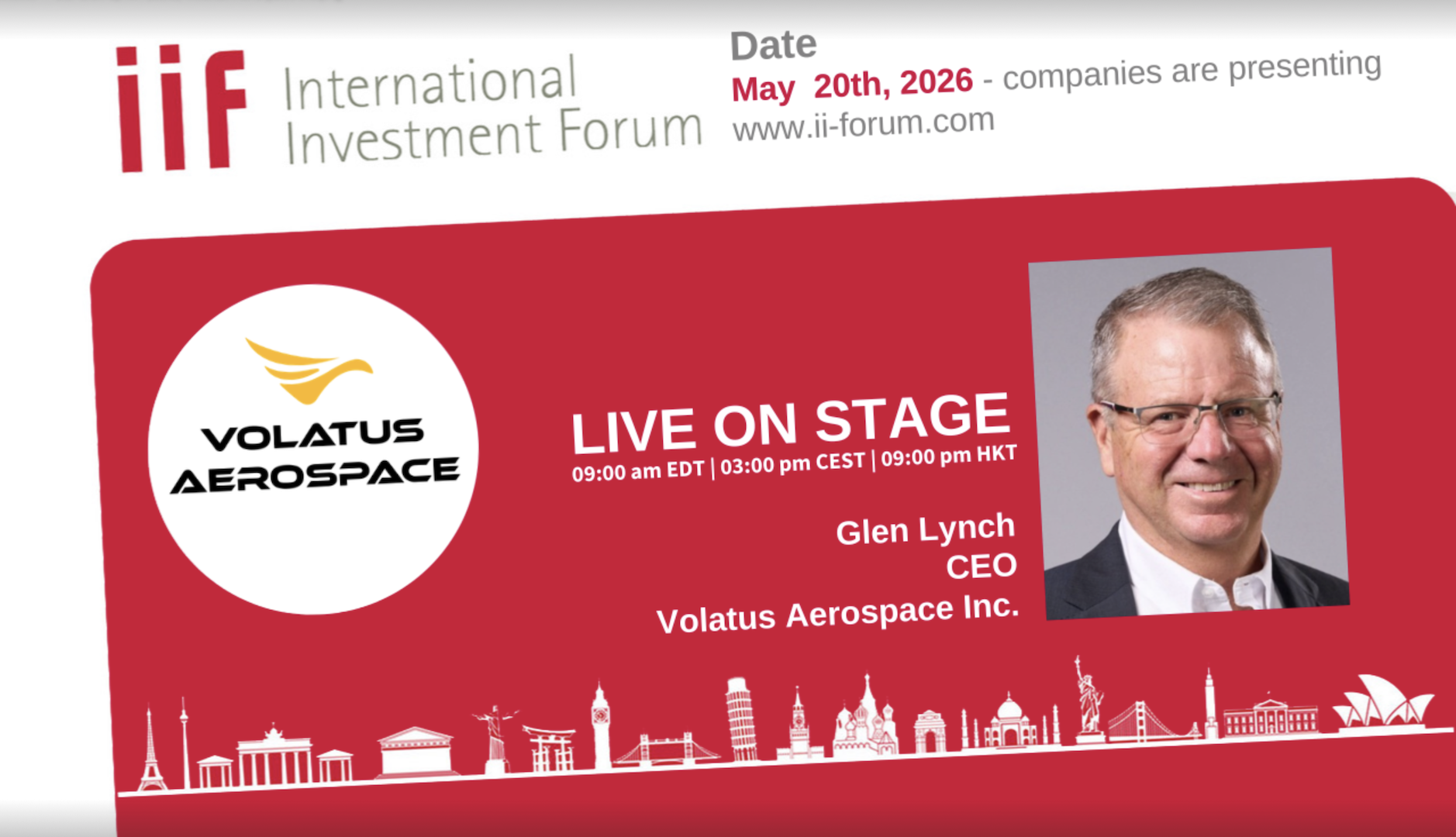
Through capital measures, the company has also strengthened its balance sheet. At the turn of the year, cash on hand stood at over CAD 40 million. For this year, analysts expect revenue growth to accelerate by 45% to CAD 49.5 million; by 2028, the company is likely to set its sights on the CAD 100 million mark. This contrasts with a market capitalization of around CAD 470 million. Consequently, the valuation of Volatus shares, currently trading at a price-to-sales (P/S) ratio of nearly 10, is ambitious, especially given the company's heavy investments in the defence sector, which make it unclear when it will turn a profit. A P/E ratio is therefore not measurable. However, because the company is a minnow compared to AeroVironment, it offers significantly more upside. Further major contracts could drive revenue growth even faster than expected, bringing the breakeven point within sight. CEO Glen Lynch will present details of the strategy on Wednesday, May 20, at 3 pm CET at the International Investment Forum (IIF). Click here to register.
DRONESHIELD: THE STRONG DEFENDER
The example of DroneShield shows just how quickly a mid-sized drone specialist can become a billion-dollar corporation. The Australian defense strategist's business model is based on developing and selling AI systems to detect and defend against unmanned aerial vehicles. The focus is on jamming rather than destruction, which is intended to prevent collateral damage. The product portfolio includes both stationary and vehicle-mounted as well as portable defense systems called DroneGun. Major customers include the military, government agencies, border protection, airports, and all sectors related to critical infrastructure. The company operates globally and considers Europe a large and important market.
The Australians even have solutions in their lineup for autonomous attacking drones like Red Dragon. These range from net cannons for capturing enemy drones to targeted energy weapons. These emit an extremely powerful microwave pulse that literally fries the attacker's onboard electronics. Without functioning computer chips, the autonomous drone crashes. Air combat thus becomes a war of algorithms.
Consequently, DroneShield is transforming from a hardware manufacturer into a SaaS (Software-as-a-Service) provider with recurring revenue from maintenance and licenses. The fact that artificial intelligence for drone identification—such as friend-or-foe recognition—forms the foundation of the technology is also reflected in the valuation. The current market capitalization of AUD 3.4 billion (EUR 2.1 billion) is more than 15 times the expected 2025 revenue of AUD 217 million. Analysts forecast a rapid rise to AUD 345 million for the current year, which is expected to continue seamlessly through 2028. But even based on the then-expected revenue of AUD 572 million, this results in a P/S ratio of 6. The P/E ratio, at 47 for the current year and 32 for 2028, is also on par with those of highly traded AI stocks in the high-tech sector. Analysts are divided on whether the share price, currently EUR 2.25 in Germany, already reflects too much premature optimism. While some analysts are setting price targets as high as AUD 5.00 (EUR 3.06), experts at the investment firm Jefferies remain cautious and view the stock as having peaked for now.
Even the impressive first-quarter figures presented last week by the Sydney-based defense giant—121% revenue growth and a project pipeline worth AUD 2.2 billion—do nothing to change this assessment.
WHO IS BOLDLY STEPPING FORWARD AS A LEADER?
Drones remain one of the most exciting investment themes of our time. Now that the euphoria has subsided, the stocks are currently, at best, in no-man's-land from a technical analysis perspective, with the highly traded player AeroVironment even trending downward despite positive analyst sentiment and optimistic price targets. Even strong earnings and news of major contracts are currently failing to provide fresh momentum in the sector, as the high valuations already factor in significant future potential. While experts are debating the future outlook for defensive specialist DroneShield, analysts at firms like Maxim Group and Ventum Capital Markets believe that mid-tier strategist Volatus Aerospace, at least on a CAD basis, has the potential to leave the penny stock level and break out of its sideways trend. Whether this succeeds will depend to a certain extent on whether CEO Glen Lynch can convince investors at the International Investment Forum (IIF) on May 20.
Conflict of interest
Pursuant to §85 of the German Securities Trading Act (WpHG), we point out that Apaton Finance GmbH as well as partners, authors or employees of Apaton Finance GmbH (hereinafter referred to as "Relevant Persons") may hold shares or other financial instruments of the aforementioned companies in the future or may bet on rising or falling prices and thus a conflict of interest may arise in the future. The Relevant Persons reserve the right to buy or sell shares or other financial instruments of the Company at any time (hereinafter each a "Transaction"). Transactions may, under certain circumstances, influence the respective price of the shares or other financial instruments of the Company.
In addition, Apaton Finance GmbH is active in the context of the preparation and publication of the reporting in paid contractual relationships.
For this reason, there is a concrete conflict of interest.
The above information on existing conflicts of interest applies to all types and forms of publication used by Apaton Finance GmbH for publications on companies.
Risk notice
Apaton Finance GmbH offers editors, agencies and companies the opportunity to publish commentaries, interviews, summaries, news and the like on news.financial. These contents are exclusively for the information of the readers and do not represent any call to action or recommendations, neither explicitly nor implicitly they are to be understood as an assurance of possible price developments. The contents do not replace individual expert investment advice and do not constitute an offer to sell the discussed share(s) or other financial instruments, nor an invitation to buy or sell such.
The content is expressly not a financial analysis, but a journalistic or advertising text. Readers or users who make investment decisions or carry out transactions on the basis of the information provided here do so entirely at their own risk. No contractual relationship is established between Apaton Finance GmbH and its readers or the users of its offers, as our information only refers to the company and not to the investment decision of the reader or user.
The acquisition of financial instruments involves high risks, which can lead to the total loss of the invested capital. The information published by Apaton Finance GmbH and its authors is based on careful research. Nevertheless, no liability is assumed for financial losses or a content-related guarantee for the topicality, correctness, appropriateness and completeness of the content provided here. Please also note our Terms of use.