April 10th, 2026 | 07:20 CEST
Drone Market Set to Exceed USD 100 Billion: Volatus Aerospace Positioned to Benefit from Dual-Use Strategy
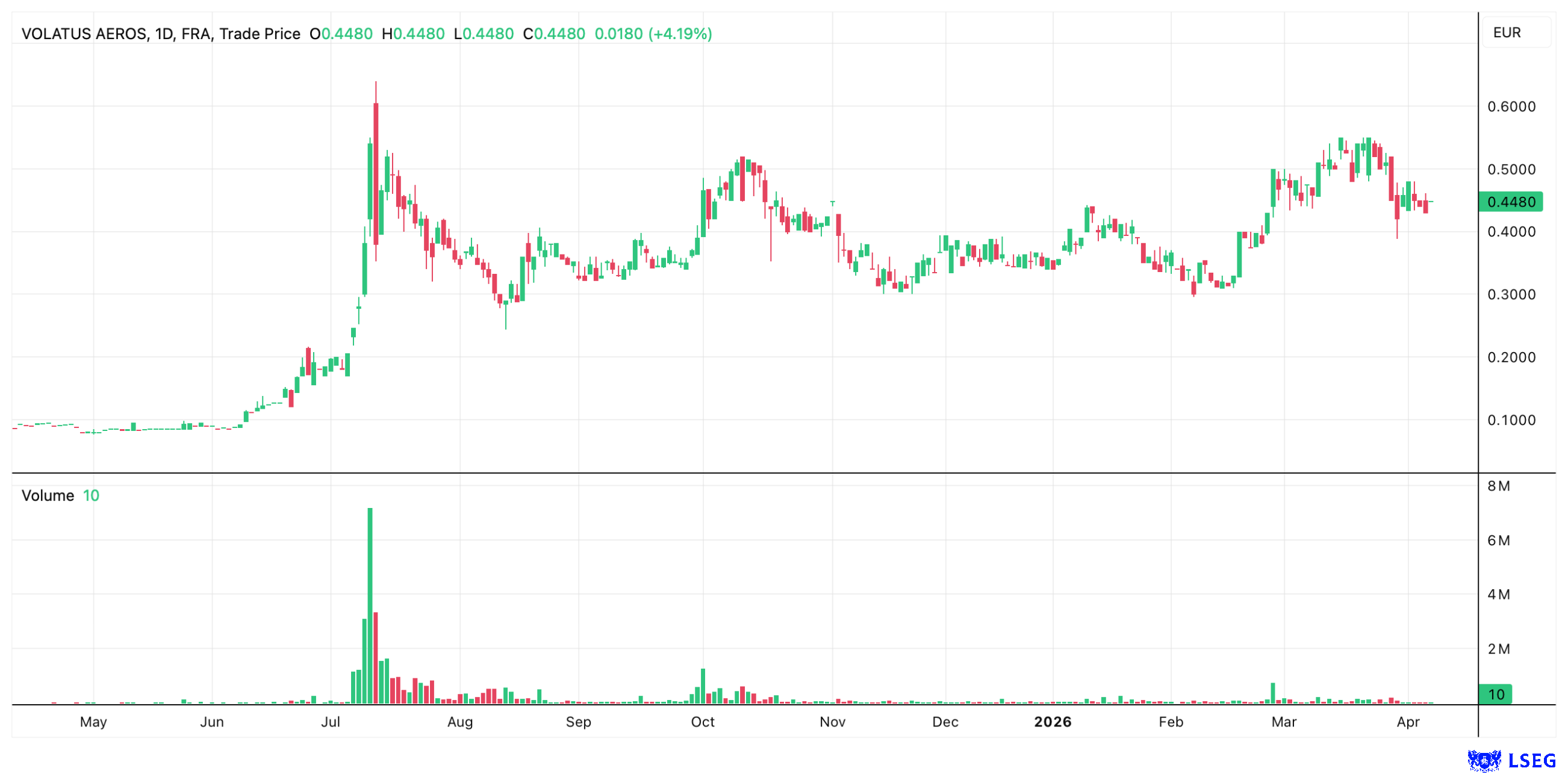
Drones have evolved from a niche application into a rapidly expanding multi-billion-dollar market. Industry estimates point to a global market volume exceeding USD 100 billion by 2032. The military sector in particular is booming, driven by geopolitical tensions and new forms of conflict. But the civilian market is also growing at double-digit rates and opening up enormous opportunities in infrastructure, logistics, and agriculture. Against this backdrop, Volatus Aerospace is positioning itself with a dual-use strategy that targets both military and commercial applications. The company reports an order pipeline exceeding CAD 600 million, highlighting strong operational momentum. Analyst price targets currently reach up to CAD 1.25, compared to a current share price of around CAD 0.70. The stock is also actively traded on German exchanges.
time to read: 3 minutes | Author: Fabian Lorenz
ISIN: VOLATUS AEROSPACE INC | CA92865M1023 | TSXV: FLT , OTCQB: TAKOF
Table of contents:
Author

Fabian Lorenz
For more than twenty years, the Cologne native has been intensively involved with the stock market, both professionally and privately. He is particularly passionate about national and international small and micro caps.
Tag cloud
Shares cloud
A Billion-Dollar Market – Civil and Military
Drones have evolved from a niche application into a key growth driver of the global economy. Billions are already being generated in both the military and civil sectors. According to experts at Global Market Insights, the industry will easily surpass the USD 100 billion mark by 2032.
While the market volume for unmanned aerial vehicles in the defense sector is still around USD 20.7 billion for 2026, experts expect it to jump to an impressive USD 66.5 billion by 2032. Given current global events, this estimate is anything but optimistic. In the war between Ukraine and Russia, drones and their defense have been a decisive factor for years. And in the ongoing conflict in the Middle East, which does not appear to have ended despite the ceasefire, drones have demonstrated their strengths in combating modern air defense systems.
While the opportunities for drones in the military sector are well-known, their civilian applications are often overlooked. Yet the success of drones in this sector is equally impressive. Global Market Insights forecasts that the commercial drone market will grow by an average of 10% annually through 2032, reaching a volume of USD 78.5 billion. In 2023, the market volume stood at USD 32.5 billion. The main drivers here are increasing affordability and the diverse range of applications in agriculture, logistics, and the construction industry. Whether for automated crop monitoring or efficient site inspections, the combination of falling production costs and increasingly intelligent data insights makes drones an indispensable tool. Volatus Aerospace is active in both of these areas.
Significant Potential In Civilian Applications
Civilian drone solutions are the foundation of Volatus and are being consistently expanded. The business with inspection and monitoring solutions for critical infrastructure is developing particularly dynamically. In 2025, for example, the company secured a multi-year major contract with one of North America's largest energy providers. For this client, Volatus monitors approximately 100,000 miles of power lines—clear evidence of the rising demand for automated, scalable drone solutions. At the same time, pipeline monitoring is growing, having now reached over 75,000 flight hours and securing Volatus a leading role in long-range missions. Technologically, the company also gains a competitive advantage through approval for nighttime BVLOS (Beyond Visual Line of Sight) flights across Canada, which opens up new fields of application. With the launch of the heavy-lift drone system "Condor XL" and initial commercial applications starting in 2026, such as in reforestation, offshore energy, and logistics, Volatus is targeting future markets. Partnerships such as the one with Ki Reforestation as part of large-scale reforestation programs underscore the strategic focus on sustainable, civilian drone applications.
Military Drones As Growth Drivers
Unsurprisingly for Volatus, the military sector was the growth driver in 2025, with revenue doubling. The Canadian company has thus established itself as a serious provider of drone systems for NATO-affiliated customers. Multiple deliveries of tactical ISR (Intelligence, Surveillance, Reconnaissance) drones, as well as recurring orders, underscore the operational reliability of Volatus systems in field deployment. A particularly significant milestone is a defense contract worth up to CAD 9 million for the delivery of a modern ISR training system to a NATO organization, with the first deliveries scheduled for the first half of 2026. At the same time, Volatus is strengthening its technological foundation through the acquisition of the V100/V200/V300 platforms—long-range fixed-wing drones capable of operating for up to seven days. By establishing its own production and innovation facility in Quebec, the company is also securing strategic autonomy in manufacturing and positioning itself long-term as an integrated provider in the growing market for military drone solutions.
Production in Canada has created the conditions to tap into a substantial revenue potential. This is based on Canada's new defense strategy. Over the next 10 years, more than half a trillion CAD is set to flow into national defense. When awarding contracts, preference will be given to companies manufacturing in Canada. In addition, CAD 6.6 billion will be made available under the new Defence Industrial Strategy to specifically promote the relevant industry.
https://youtu.be/Ss7fxhBQ16c?si=fdVdwsugFeUTgd8i
Volatus is also making its mark in drone defense. The SKYDRA system was recently unveiled. The Software-as-a-Service (SaaS) platform supports the operational planning and simulation of systems for defending against unmanned aerial vehicles. SKYDRA is offered as a subscription-based licensing model, enabling Volatus to generate recurring revenue.
Conclusion: A Drone Stock With Potential
Volatus Aerospace has a compelling investment case. Within its focus on the drone market, the company addresses several structural growth trends, from the surveillance of critical infrastructure to drone defense. The combination of civilian applications, a defense business with strong momentum, and a full order pipeline points to sustained high growth. The stock should also benefit from this.
Conflict of interest
Pursuant to §85 of the German Securities Trading Act (WpHG), we point out that Apaton Finance GmbH as well as partners, authors or employees of Apaton Finance GmbH (hereinafter referred to as "Relevant Persons") may hold shares or other financial instruments of the aforementioned companies in the future or may bet on rising or falling prices and thus a conflict of interest may arise in the future. The Relevant Persons reserve the right to buy or sell shares or other financial instruments of the Company at any time (hereinafter each a "Transaction"). Transactions may, under certain circumstances, influence the respective price of the shares or other financial instruments of the Company.
In addition, Apaton Finance GmbH is active in the context of the preparation and publication of the reporting in paid contractual relationships.
For this reason, there is a concrete conflict of interest.
The above information on existing conflicts of interest applies to all types and forms of publication used by Apaton Finance GmbH for publications on companies.
Risk notice
Apaton Finance GmbH offers editors, agencies and companies the opportunity to publish commentaries, interviews, summaries, news and the like on news.financial. These contents are exclusively for the information of the readers and do not represent any call to action or recommendations, neither explicitly nor implicitly they are to be understood as an assurance of possible price developments. The contents do not replace individual expert investment advice and do not constitute an offer to sell the discussed share(s) or other financial instruments, nor an invitation to buy or sell such.
The content is expressly not a financial analysis, but a journalistic or advertising text. Readers or users who make investment decisions or carry out transactions on the basis of the information provided here do so entirely at their own risk. No contractual relationship is established between Apaton Finance GmbH and its readers or the users of its offers, as our information only refers to the company and not to the investment decision of the reader or user.
The acquisition of financial instruments involves high risks, which can lead to the total loss of the invested capital. The information published by Apaton Finance GmbH and its authors is based on careful research. Nevertheless, no liability is assumed for financial losses or a content-related guarantee for the topicality, correctness, appropriateness and completeness of the content provided here. Please also note our Terms of use.