July 14th, 2026 | 07:25 CEST
Dividend Gem Vonovia, Sell-Off Warning for Siemens Energy, and Almonty Industries on the Verge of a Technical Breakout!
Over the weekend, international financial markets were shaken by a dramatic military escalation in the Middle East that could abruptly paralyze global supply chains and energy corridors. Following attacks by the Iranian Revolutionary Guard in the Strait of Hormuz, US President Donald Trump declared the ceasefire over. In retaliation, the US military struck well over 140 military targets along Iran's southern coast, prompting Tehran to respond with missile and drone attacks on US bases in the Gulf states of Kuwait, Bahrain, and the UAE, and to declare the key sea lane closed. This latest disruption to shipping traffic on the "lifeline of global oil and gas trade" threatens to drive global inflation skyward at a rapid pace. On the stock markets, this shock could trigger a fundamental flight to tangible assets and a reassessment of strategic independence. While the interest-rate-sensitive German real estate giant Vonovia is facing new headwinds due to the looming inflationary and interest-rate consequences of this conflict, despite its high dividend yield, the need for a self-sufficient and secure energy infrastructure provided by Siemens Energy is coming into focus, even though the company is currently struggling with share price declines. However, the spotlight may ultimately fall on Almonty Industries. As a leading Western supplier of tungsten, a metal critical to defence and advanced technologies, the Canadian-American resource company occupies a strategically important position. At the same time, its shares may be on the verge of a technical breakout.
time to read: 7 minutes | Author: Matthias Schomber
ISIN: VONOVIA SE NA O.N. | DE000A1ML7J1 , SIEMENS ENERGY AG NA O.N. | DE000ENER6Y0 , ALMONTY INDUSTRIES INC. | CA0203987072 | TSX: AII , NASDAQ: ALM , ASX: AII
Table of contents:
Author

Matthias Schomber
Raised in Giessen, Hesse, Matthias Schomber discovered his passion for the financial markets as early as the 1990s—at a time when stock trading was still largely the domain of true, die-hard traders. After completing his banking apprenticeship, he worked for a private bank there and witnessed the rise and fall of the Neuer Markt firsthand on the trading floor of the Frankfurt Stock Exchange, drawing lessons from the experience that continue to shape his thinking as a trader, author, and trading system developer to this day.
Tag cloud
Shares cloud
Vonovia with a High Dividend Yield and Siemens Energy with a Dangerous Chart Formation
Regardless of geopolitical influences, the German stock market is currently driven by several forces affecting share prices.
For housing giant Vonovia, its recent stock market recovery from just under EUR 20.00 to EUR 22.50 suffered a setback over the past trading week. Dividend-focused investors, in particular, are likely to have been hit by this setback, as the Bochum-based company is traditionally known for its high dividend yield and is therefore a popular choice for income-focused portfolios. The primary cause of this sudden headwind is interest rates, which are once again creating significant obstacles for the real estate sector as loans must be refinanced. The escalation of the conflict in Iran, particularly around the Strait of Hormuz, is driving up crude oil prices, and supply chains could also face disruptions, thereby fueling inflation and raising prices for certain products. Central banks could then respond with interest rate hikes. This would weigh on real estate companies, including Vonovia. Nevertheless, the group's fundamental strength remains remarkably stable with respect to its dividend policy.
Current analyst forecasts underscore the stock's long-term appeal for dividend seekers. For the current fiscal year, the average expectation is a dividend of EUR 1.28 per share, which, at the current share price, corresponds to a substantial dividend yield of just under 6.0%. The medium-term outlook also suggests this high level will persist, with an increase to EUR 1.30 per share expected in 2028. For the following years, 2029 and 2030, market observers forecast a steady EUR 1.32 per share, which could allow the dividend yield to settle at just over 6.0%. When these four upcoming dividend years are considered cumulatively, the expected total payout amounts to an impressive EUR 5.22 per share, which, based on the current share price, implies a total return of nearly 25%. Admittedly, the short-term chart picture has been somewhat dampened by recent interest rate pressure. Falling below the 50-day SMA is also not exactly favourable. But a rise above EUR 22, or even EUR 22.50, would certainly brighten the overall picture.
While the real estate sector remains highly sensitive to interest rates, Siemens Energy operates in a different, yet equally challenging, environment shaped by the ongoing industrial transformation. The company's key challenge is to translate the immense global demand for energy infrastructure and clean energy solutions into sustainably profitable margins. Although Siemens Energy is currently benefiting significantly from full order books in the power grid sector and the transformation of the global energy supply, partly driven by AI, it remains highly susceptible to volatility stemming from ongoing operational risks and project timelines. Above all, following the recent price slide in Siemens Energy, there is a latent risk that an SKS pattern could form on the chart, which, in turn, could imply a derived price target in the EUR 100 range. Orders are not yet revenue, and certainly not profit. Amid all the euphoria surrounding Siemens Energy, this should not be forgotten—even as analysts tout price targets that, in some cases, are well above EUR 200.
Both stocks, Vonovia and Siemens Energy, currently reflect the challenges facing the market. While both are primarily focused on navigating the complexities of potential interest rate shifts and energy transition processes, our attention turns across the Atlantic to a commodities company that has worked hard to carve out a unique global position in recent years.
Almonty Industries on the Verge of a Technical Breakout?
The Canadian-American company Almonty Industries operates at the intersection of geopolitics, cutting-edge technology, and military defense.
As a global producer of tungsten concentrate, the company has positioned itself well at a time when Western governments are vehemently trying to free themselves from their crushing dependence on Chinese supply chains. China continues to control about 80% of the global tungsten market and has drastically tightened its export controls on critical metals, leading to market fragmentation.
Buyers outside China are paying premiums to secure physical material for strategic applications such as semiconductors, defense equipment, and aerospace. In this market environment, Almonty Industries announced on July 1, 2026, the official start of processing operations at its flagship Sangdong mine in South Korea's Gangwon Province. This milestone marks the transition from years of development and commissioning to active, revenue-generating operations.
As early as June, the company began processing the extensive ore stockpile through the newly constructed processing plant to produce marketable tungsten concentrate. The company had closed out the first quarter of the year with a substantial inventory of approximately 120,000 metric tons of ore with an average grade of 0.24% tungsten trioxide. In the following quarter, an additional 19,700 metric tons with an even higher grade of 0.35% were mined, while underground excavation was also advanced primarily along the main vein.
In total, a mixed ore reserve of approximately 139,700 metric tons is now available, which, at current price levels, corresponds to a potential gross value of about USD 68 million and secures the initial ramp-up process for the coming months.
The Group's operational development and already significant level of maturity have also been recognized at the institutional level of the financial markets, as on June 29, 2026, Almonty Industries was officially added to the Russell 1000 Large-Cap Index and the broad-based Russell 3000 Index.
Since inclusion in these prestigious US indices is based exclusively on objective market capitalization criteria, this step underscores that the company has crossed the critical size threshold on a purely fundamental basis. For the stock, this membership means access to a large universe of index-tracking funds and institutional investors who were previously barred from investing, possibly for regulatory reasons.
This development is accompanied by an expansion strategy in North America. As early as June 23, 2026, the company provided deeper insights into the Gentung project in the US state of Montana, which was fully acquired in October of the previous year for USD 9.75 million and represents one of the largest known tungsten deposits in the country. Although the permitting processes there are considered lengthy, Almonty is rapidly advancing the development of local infrastructure to be ready for production starting in the second half of the year.
These operational advances are complemented by the successful completion of an oversubscribed offering of USD 800 million in convertible senior notes.
Financial risk is further minimized by long-term offtake agreements with strong partners such as the Plansee Group, which guarantee a reliable price floor without capping potential profit growth. The planned vertical integration through a downstream tungsten oxide plant to supply the semiconductor sector underscores the well-thought-out business model.
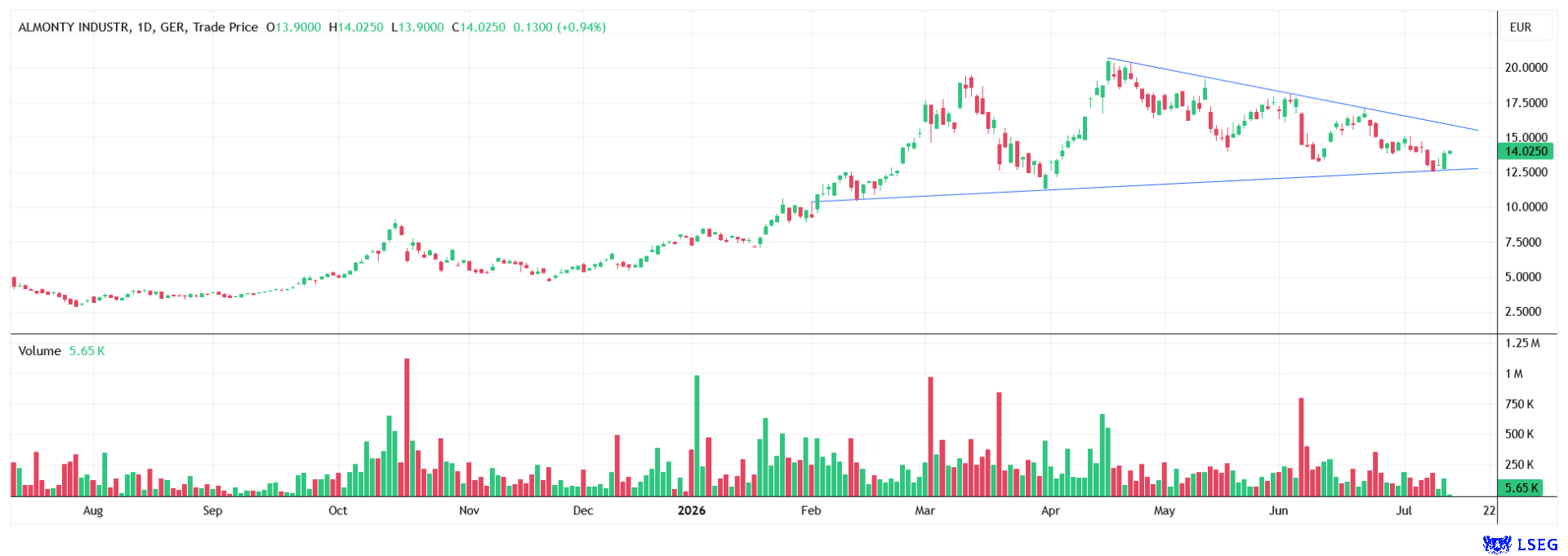
From a technical analysis perspective, Almonty Industries' stock is currently in a healthy consolidation phase after reaching its high of just over EUR 20.62. The stock is currently trading within a wedge pattern, with its upper boundary at just under EUR 16. Should the price sustainably break above EUR 16.50, the breakout would likely be considered successful. Based on this chart pattern, a successful breakout could trigger a dynamic upward move with potential to reach as high as EUR 24 or 26. This represents a significant upside opportunity compared to both the current level and the breakout price. At the same time, the stock appears to be quite well-supported on the downside, as a robust support zone is forming around the current range of EUR 12 to 12.50; this zone is further reinforced by several underlying horizontal support lines and should limit the downside risk.
Conclusion: It Is All About the Mix
In summary, all three stocks present specific advantages and disadvantages for different investor profiles.
Despite recent headwinds from rising interest rates, Vonovia remains a rock-solid value share with a reliable, highly attractive dividend yield of around 6% in the medium term.
Siemens Energy represents the classic bet on the success of the global infrastructure transition, but naturally struggles with higher operational volatility in project execution. A drawback is the potential formation of an SKS pattern and the fact that it remains to be proven that orders will actually translate into profits.
A look at Almonty Industries reveals a company that is in an extremely promising operational position. The successful start of production at the Sangdong mine, strategic expansion in its home market of the United States, and inclusion in the Russell indices form a stable foundation. Since the stock is currently in the midst of a technical consolidation above strong support levels, the current price level offers a potentially attractive entry point with considerable upside potential once the breakout from the wedge formation is complete.
Conflict of interest
Pursuant to §85 of the German Securities Trading Act (WpHG), we point out that Apaton Finance GmbH as well as partners, authors or employees of Apaton Finance GmbH (hereinafter referred to as "Relevant Persons") may hold shares or other financial instruments of the aforementioned companies in the future or may bet on rising or falling prices and thus a conflict of interest may arise in the future. The Relevant Persons reserve the right to buy or sell shares or other financial instruments of the Company at any time (hereinafter each a "Transaction"). Transactions may, under certain circumstances, influence the respective price of the shares or other financial instruments of the Company.
In addition, Apaton Finance GmbH is active in the context of the preparation and publication of the reporting in paid contractual relationships.
For this reason, there is a concrete conflict of interest.
The above information on existing conflicts of interest applies to all types and forms of publication used by Apaton Finance GmbH for publications on companies.
Risk notice
Apaton Finance GmbH offers editors, agencies and companies the opportunity to publish commentaries, interviews, summaries, news and the like on news.financial. These contents are exclusively for the information of the readers and do not represent any call to action or recommendations, neither explicitly nor implicitly they are to be understood as an assurance of possible price developments. The contents do not replace individual expert investment advice and do not constitute an offer to sell the discussed share(s) or other financial instruments, nor an invitation to buy or sell such.
The content is expressly not a financial analysis, but a journalistic or advertising text. Readers or users who make investment decisions or carry out transactions on the basis of the information provided here do so entirely at their own risk. No contractual relationship is established between Apaton Finance GmbH and its readers or the users of its offers, as our information only refers to the company and not to the investment decision of the reader or user.
The acquisition of financial instruments involves high risks, which can lead to the total loss of the invested capital. The information published by Apaton Finance GmbH and its authors is based on careful research. Nevertheless, no liability is assumed for financial losses or a content-related guarantee for the topicality, correctness, appropriateness and completeness of the content provided here. Please also note our Terms of use.