March 20th, 2026 | 08:30 CET
DAX and NASDAQ Plunge, but Drones Are on the Order List: How Is Volatus Aerospace Faring?
The escalation surrounding Iran is currently starkly illustrating just how much modern conflicts are shaped by unmanned systems. Drone attacks on storage and energy infrastructure in the Gulf region are driving not only geopolitical uncertainty but also oil prices skyward, putting global markets under pressure. At the same time, we are witnessing a broad sell-off in the stock markets, triggered by fears of inflation, supply bottlenecks, and a further escalation of the conflict. What is striking here is that while traditional markets come under pressure, the strategic importance of technologies for reconnaissance, surveillance, and the protection of critical infrastructure is rapidly increasing. This is precisely where new demand cycles are emerging, not only in the military sector but also in energy, security, and industry. It is at this striking intersection that the true investment story of Volatus Aerospace begins.
time to read: 5 minutes | Author: André Will-Laudien
ISIN: VOLATUS AEROSPACE INC | CA92865M1023 | TSXV: FLT , OTCQB: TAKOF
Table of contents:
Author

André Will-Laudien
Born in Munich, he first studied economics and graduated in business administration at the Ludwig-Maximilians-University in 1995. As he was involved with the stock market at a very early stage, he now has more than 30 years of experience in the capital markets.
Tag cloud
Shares cloud
Drones Are Becoming the Critical Infrastructure of Our Time
The global security landscape and technological progress are giving unmanned aerial systems a completely new significance today. What was once considered experimental technology is increasingly becoming an integral part of modern infrastructure. The range of applications extends far beyond traditional defense uses and encompasses areas such as energy supply, industrial inspection, disaster response, and border security. Volatus Aerospace positions itself precisely at this intersection with a clear focus on so-called dual-use technologies that can be deployed in both civilian and government settings. This strategic orientation aligns with the current policy objectives of many Western industrialized nations and creates a stable, long-term sustainable demand base.
Made in Canada as a Strategic Competitive Advantage
A key success factor lies in the company's strong integration into Canada's industrial and defense strategy. Canada is investing heavily in expanding its technological sovereignty and is specifically relying on domestic suppliers to build an independent value chain. The West would do well to take this to heart in other sectors as well. Volatus Aerospace benefits from this development in several ways. The expansion of the Mirabel Manufacturing Hub in Québec is creating a central production site, while the Operations Control Center in Toronto forms the foundation for globally scalable missions. This combination of local production and international operational capability precisely meets the requirements of strategic system delivery and modern procurement strategies, which increasingly rely on resilient supply chains and national technological expertise.
CEO Glen Lynch outlined his medium-term strategy at the 18th International Investment Forum.
Platform Strategy Instead of Pure Drone Production
Unlike many competitors who focus primarily on the development and sale of hardware, Volatus Aerospace pursues an integrated platform approach. The business model combines services, system solutions, and training within a closed ecosystem. This creates an end-to-end value chain that ranges from training drone pilots to providing systems, executing complex missions, and subsequent data analysis. Of particular note is the Operations Control Center, which enables remote operations over long distances and thus lays the foundation for scalability. At the same time, the training segment, with over 114,000 trained operators worldwide, ensures recurring revenue and strong customer loyalty.
Dynamic Growth Signals the Transition to Scaling
The latest financial results clearly show that the company is entering a new phase. With revenue growth of 60% in the third quarter of 2025 and a significant shift in the revenue mix toward system sales, it is evident that demand for integrated drone solutions is growing significantly. At the same time, the financial foundation has been strengthened through successful capital measures, ensuring sufficient funds are now available for further expansion of production capacity and international growth. Operational progress is also evident, as losses at the EBITDA level have been significantly reduced. This development indicates that economies of scale are increasingly taking effect and that the foundation for sustainable growth has been laid. Despite high investments, net profitability can already be expected in the coming years.
Software and Data as the Key to Profitability
While the hardware sector forms an important foundation, the actual value-added potential lies in the overarching technology layer. Volatus Aerospace develops solutions in the fields of artificial intelligence, data analysis, and automated mission control that enable significantly higher scalability than traditional aviation activities. Platforms such as SKYDRA for simulating defense scenarios or proprietary systems for data processing and mission planning open up new margin potential and are increasingly shifting the business model toward that of a technology-driven platform company. In these areas, gross margins of well over 80% are possible, which is likely to have a significant impact on profitability in the long term. Looking ahead, Volatus Aerospace's service portfolio is a good fit for the growth-oriented NASDAQ exchange.
Valuation Gap and New Capital Market Phase as an Opportunity
Despite the positive operational performance, the company continues to be valued at a significant discount compared to international competitors. While comparable companies sometimes achieve revenue multiples several times higher, Volatus Aerospace currently remains at a moderate level. This discrepancy opens up room for a revaluation, particularly against the backdrop of rising defense budgets and growing demand for autonomous systems. A key milestone in this regard is the move to the Toronto Stock Exchange (TSX), which significantly increases visibility among institutional investors. With increasing scale and rising revenue, perceptions of the company could shift permanently and usher in a new phase of capital market development.
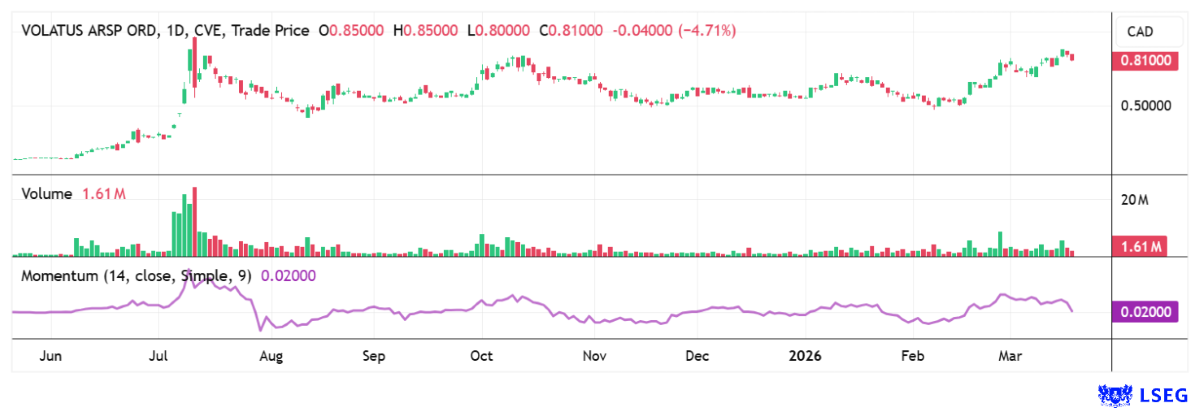
Volatus Aerospace is currently at a strategic turning point where years of groundwork are, for the first time, clearly shifting toward scaling and market penetration. The company has created an integrated ecosystem of technology, services, and operational execution and is now beginning to roll out this model on a larger scale. Accordingly, interest in the capital market is also growing; the first analysts are already actively tracking the company's development and pointing to the valuation gap that still exists in an international comparison. For fiscal year 2026, revenue multiples in the range of approximately 7 to 15 are being discussed, depending on how quickly existing orders can be converted into realized revenue. From a valuation perspective, this implies a price range of between CAD 0.85 and CAD 1.25 over a 12-month horizon, with a decisive trigger likely to lie in the next growth phase. Following the upgrade to the main TSX and rising revenues, Volatus could now very quickly come into the focus of institutional investors and experience a new market perception. Against the backdrop of massive growth in investments in autonomous systems and government-funded technology programs, this development could unfold dynamically. The market for unmanned aerial solutions is still in the early stages of a long-term supercycle - and Volatus is strategically well-positioned with its platform of hardware, software, and data-driven services. Jump on board before the train leaves the station!
Conflict of interest
Pursuant to §85 of the German Securities Trading Act (WpHG), we point out that Apaton Finance GmbH as well as partners, authors or employees of Apaton Finance GmbH (hereinafter referred to as "Relevant Persons") currently hold or hold shares or other financial instruments of the aforementioned companies and speculate on their price developments. In this respect, they intend to sell or acquire shares or other financial instruments of the companies (hereinafter each referred to as a "Transaction"). Transactions may thereby influence the respective price of the shares or other financial instruments of the Company.
In this respect, there is a concrete conflict of interest in the reporting on the companies.
In addition, Apaton Finance GmbH is active in the context of the preparation and publication of the reporting in paid contractual relationships.
For this reason, there is also a concrete conflict of interest.
The above information on existing conflicts of interest applies to all types and forms of publication used by Apaton Finance GmbH for publications on companies.
Risk notice
Apaton Finance GmbH offers editors, agencies and companies the opportunity to publish commentaries, interviews, summaries, news and the like on news.financial. These contents are exclusively for the information of the readers and do not represent any call to action or recommendations, neither explicitly nor implicitly they are to be understood as an assurance of possible price developments. The contents do not replace individual expert investment advice and do not constitute an offer to sell the discussed share(s) or other financial instruments, nor an invitation to buy or sell such.
The content is expressly not a financial analysis, but a journalistic or advertising text. Readers or users who make investment decisions or carry out transactions on the basis of the information provided here do so entirely at their own risk. No contractual relationship is established between Apaton Finance GmbH and its readers or the users of its offers, as our information only refers to the company and not to the investment decision of the reader or user.
The acquisition of financial instruments involves high risks, which can lead to the total loss of the invested capital. The information published by Apaton Finance GmbH and its authors is based on careful research. Nevertheless, no liability is assumed for financial losses or a content-related guarantee for the topicality, correctness, appropriateness and completeness of the content provided here. Please also note our Terms of use.