June 22nd, 2026 | 07:30 CEST
Data Centers and the Uranium Shortage: The Solution Lies with Standard Uranium, SAP, ServiceNow, and Oracle
The past trading week was dominated by the SpaceX IPO. Elon Musk's masterpiece caused quite a stir after its market value soared from USD 1.8 to 2.7 trillion shortly after the initial listing. The first profit-taking did not occur until the end of the week, yet the stock is still trading 30% above its offering price. Analysts are puzzling over this debut, given the harsh criticism in the run-up to the IPO over its high pricing. A fourfold oversubscription ultimately silenced all critics, and now the real valuation process can begin. AI and software stocks remain perennial topics on the US growth exchange, NASDAQ. While semiconductor stocks are stringing one rally after another, software stocks are taking a beating almost daily. Doubts about their role in the next AI era persist among analysts, which is weighing on stock prices. Uranium stocks, however, have reason to celebrate, as they represent the raw material solution for the trillion-dollar investments in modern data centers. After all, the consensus—and Donald Trump—is that electricity will be supplied by nuclear power in the long run. We do the math!
time to read: 5 minutes | Author: André Will-Laudien
ISIN: STANDARD URANIUM LTD. | CA85422Q8487 | TSXV: STND , OTCQB: STTDF , SAP SE O.N. | DE0007164600 , SERVICENOW INC. DL-_001 | US81762P1021
Table of contents:
Author

André Will-Laudien
Born in Munich, he first studied economics and graduated in business administration at the Ludwig-Maximilians-University in 1995. As he was involved with the stock market at a very early stage, he now has more than 30 years of experience in the capital markets.
Tag cloud
Shares cloud
Standard Uranium: Scalable Land Position and Valuation Potential in the Global Uranium Cycle
Global electricity demand is skyrocketing, as the need for computing power is rising rapidly, driven primarily by increasingly sophisticated applications in the field of artificial intelligence. According to current IEA forecasts, the power required by data centers is expected to rise from the current level of about 120 gigawatts to around 290 gigawatts by the end of the decade. As a result, energy supply is increasingly becoming a limiting factor, as electricity availability is placing ever greater constraints on the expansion of new AI capacities. The Trump administration, under the slogan "Drill, Baby, Drill," is currently touting nuclear energy as its preferred long-term plan. While officials are well aware that doubling reactor capacity will take 15 to 20 years and cost billions, they are primarily relying on investment from the major tech conglomerates themselves.
One of the future problem-solvers in the uranium sector could come from Saskatchewan: Standard Uranium. The Canadians position themselves as a traditional project generator whose business model is based on identifying, consolidating, and further developing early-stage exploration targets in the Athabasca Basin across a total area of 220,000 acres. Capital expenditures are systematically outsourced through earn-in structures with partners, allowing the company to keep its balance sheet lean and partially externalize exploration risks. A current example is the Rocas project, where a five-week campaign is planned to drill approximately 1,200 to 1,500 m of diamond drilling across 6 to 8 drill holes. It is particularly noteworthy that a 7.5 km long electromagnetic structural corridor has not yet been tested at all, indicating a typical greenfield approach. This program is financed through an earn-in agreement with an exploration budget of up to CAD 4.5 million; in return, the partner can acquire up to 75% of the project interests.
At the same time, the company is strengthening its social license through local partnerships with Indigenous communities to ensure operational stability in Saskatchewan. At the flagship Davidson River project, the latest report detailed an ongoing drilling campaign covering approximately 900 m across two drill holes, during which elevated radioactivity of up to 1,650 cps was detected in individual intervals. The overall program is designed to cover several thousand meters and is scheduled to continue into late summer, with three main trends being systematically tested. The region itself is considered one of the world's most significant uranium districts, where over 400 million pounds of uranium have already been discovered. Investors are eager to see what else will be unearthed there in the coming months. Investors who want to get in on this should subscribe to the current placement at CAD 0.10 or buy shares in Canada or Germany at similar prices. With a market capitalization of just CAD 15 million, the upside potential in the event of good drilling results is enormous. Snap it up!
IIF host Lyndsay Malchuk talks with CEO Jon Bey about the progress of the drilling program in the Athabasca Basin.
SAP and ServiceNow: Enterprise Software Put to the AI Test
Skepticism prevails in the software sector. Analysts see the AI-powered enterprise software sector entering an early monetization phase—one that has not yet been fully priced into the market—for major platforms such as SAP and ServiceNow. At SAP, the focus is on the AI layer "Joule," which is increasingly being integrated into the company's own cloud and, according to management, enables sector growth of at least 20 to 28%. ServiceNow is driving "Now Assist" forward and benefiting from a subscription growth rate of about 20% per year, coupled with a high contract renewal rate.
Following the sharp valuation correction from 2022 to 2023, several analysts are now referring to a gradual re-rating phase. SAP's structural strengths include its ERP dominance, a very broad installed base in the enterprise segment, and deeply integrated business processes with major clients. ServiceNow, on the other hand, stands out primarily for its platform-based approach to workflow management, high scalability, and a strong position in IT service management beyond traditional ERP systems. Both companies exhibit robust margin profiles, with SAP operating at approximately 27%-30% and ServiceNow posting free cash flow margins of over 30%.
Experts generally do not anticipate a rapid fundamental recovery; rather, the majority expect it will take 12 to 24 months for sustainable revaluation to occur. Risks exist in particular from Microsoft's Copilot ecosystem, which addresses both ERP and workflow use cases and could create price pressure. At the same time, the structural tailwind from enterprise digitization and AI automation remains intact, which stabilizes the demand base in the long term. Overall, this results in a selectively positive setup for both stocks; the 12-month price targets on the LSEG platform average EUR 218 for SAP and USD 144 for ServiceNow. 50% each for bold turnaround speculators!
Oracle: Billions in Investments in High-Tech Infrastructure
Oracle has rebounded strongly following its sell-off to a low of USD 134 in April. Beyond short-covering, a closer look even reveals a fundamental rebound scenario, after the stock had previously come under significant pressure amid AI consolidation. The catalyst was a series of new AI and cloud updates—including developments related to Aconex—which the market interpreted as a sign that Oracle is advancing its platform strategy more aggressively than had been priced in recently. To finance the costly expansion of Oracle's AI data centers, CEO Larry Ellison is pumping in additional capital at a record pace. For the Oracle EU Sovereign Cloud alone, billions have recently been invested in the expansion of the Frankfurt region, among other projects. The debt mountain is growing, but it is offset by a record order backlog of more than USD 600 billion.
The spending appears to be paying off already. Cloud revenues are growing rapidly, and the company has entered into long-term partnerships with heavyweights such as OpenAI. Leading up to the release of the fourth-quarter results, the stock surged to the USD 250 mark. Following the earnings announcement, the stock pulled back and is currently consolidating again around the USD 185 mark. The new AI era is fast-paced—stock prices in the tech sector swing wildly from one extreme to the other—only flexible investors can weather the volatility!
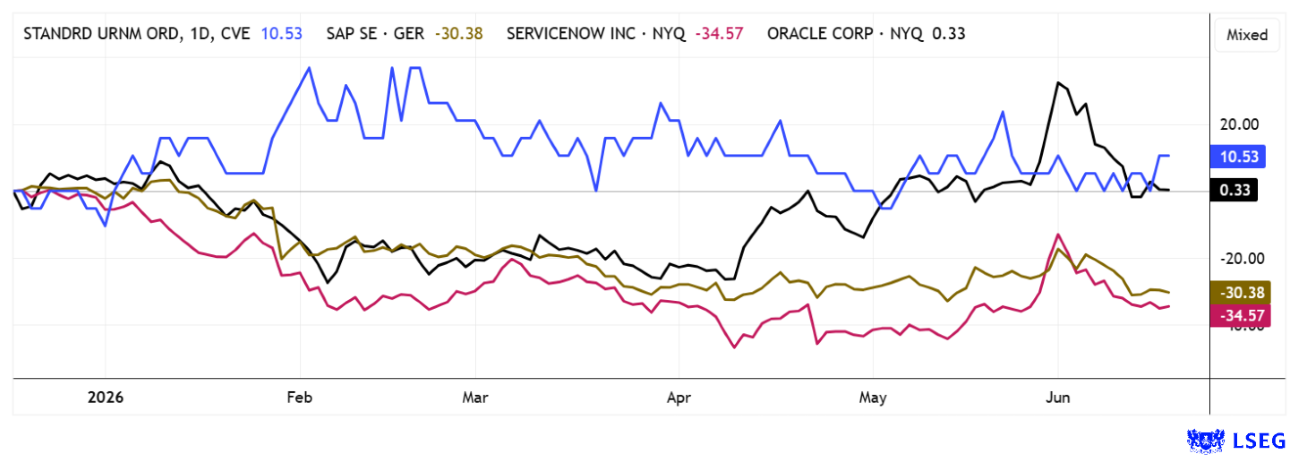
Growth markets have regained momentum following SpaceX's successful IPO. In early June, it looked like a correction was underway, but the upward trend has now resumed. While the outlook has brightened somewhat for software stocks SAP, ServiceNow, and Oracle, investors are still not particularly enthusiastic about these battered shares. Standard Uranium, a player in the critical metals sector, is being buoyed by the ongoing scarcity scenario.
Conflict of interest
Pursuant to §85 of the German Securities Trading Act (WpHG), we point out that Apaton Finance GmbH as well as partners, authors or employees of Apaton Finance GmbH (hereinafter referred to as "Relevant Persons") currently hold or hold shares or other financial instruments of the aforementioned companies and speculate on their price developments. In this respect, they intend to sell or acquire shares or other financial instruments of the companies (hereinafter each referred to as a "Transaction"). Transactions may thereby influence the respective price of the shares or other financial instruments of the Company.
In this respect, there is a concrete conflict of interest in the reporting on the companies.
In addition, Apaton Finance GmbH is active in the context of the preparation and publication of the reporting in paid contractual relationships.
For this reason, there is also a concrete conflict of interest.
The above information on existing conflicts of interest applies to all types and forms of publication used by Apaton Finance GmbH for publications on companies.
Risk notice
Apaton Finance GmbH offers editors, agencies and companies the opportunity to publish commentaries, interviews, summaries, news and the like on news.financial. These contents are exclusively for the information of the readers and do not represent any call to action or recommendations, neither explicitly nor implicitly they are to be understood as an assurance of possible price developments. The contents do not replace individual expert investment advice and do not constitute an offer to sell the discussed share(s) or other financial instruments, nor an invitation to buy or sell such.
The content is expressly not a financial analysis, but a journalistic or advertising text. Readers or users who make investment decisions or carry out transactions on the basis of the information provided here do so entirely at their own risk. No contractual relationship is established between Apaton Finance GmbH and its readers or the users of its offers, as our information only refers to the company and not to the investment decision of the reader or user.
The acquisition of financial instruments involves high risks, which can lead to the total loss of the invested capital. The information published by Apaton Finance GmbH and its authors is based on careful research. Nevertheless, no liability is assumed for financial losses or a content-related guarantee for the topicality, correctness, appropriateness and completeness of the content provided here. Please also note our Terms of use.