April 2nd, 2026 | 08:00 CEST
Back to the Debasement Trade: Gold Stocks Like Kinross Gold, Lahontan Gold, and Newmont Poised to Benefit
Over the past year, the debasement trade has come into focus for many investors. The idea behind it is an investment strategy designed to protect one's assets from the creeping devaluation of currencies like the US dollar or the euro. As global debt continues to rise and central banks in countries like the US or Japan are massively buying up their own government debt, their currencies are being weakened. Creeping inflation, which is likely to be exacerbated by the war in the Persian Gulf, will then effectively result in taxpayers being expropriated. Economists have long realized that these countries will never repay their debts but will instead resort to massive inflation. This is what emperors and kings did in earlier times, and this is what heads of state and prime ministers will do today. Investors can protect themselves from these developments by investing in the gold sector while simultaneously generating returns.
time to read: 9 minutes
|
Author:
Tarik Dede
ISIN:
KINROSS GOLD CORP. | CA4969024047 , LAHONTAN GOLD CORP | CA50732M1014 | TSXV: LG , OTCQB: LGCXF , NEWMONT CORP. DL 1_60 | US6516391066
Table of contents:
Author

Tarik Dede
Even as a high school student in northern Germany, he developed a strong interest in the “Neuer Markt” and the dynamics of the equity markets. Small- and mid-cap companies were at the center of his focus from the very beginning. After completing his training as a certified bank clerk, he deepened his economic expertise through formal studies in economics as well as through various positions within Frankfurt’s financial sector. Today, he has been actively involved in the capital markets for more than 25 years, both professionally and as a private investor.
Tag cloud
Shares cloud
Gold, Silver, and Cash-Flow-Rich Stocks!
For investors, debasement leads to a simple strategy: metals such as gold and silver, as well as cash-flow-rich stocks from companies with a strong competitive moat, increase the value of one's portfolio and will remain in demand even as paper money becomes increasingly worthless. This explains why, among other things, gold, silver, and especially gold stocks performed so well last year. The war in the Middle East has somewhat overshadowed this stock market trend. Even the price of gold suffered a sharp setback because professional investors, such as funds and asset managers, faced liquidity problems. In the long term, however, the war is likely to reinforce the shift away from the dollar. Meanwhile, the debt spiral will continue to turn. The US alone has likely shouldered USD 50 billion or even more in direct costs from the war so far. Higher energy prices are placing an additional burden on it, as on other nations. Many countries, such as South Korea and Thailand, have already begun subsidizing companies. That costs money, too!
Away from the Dollar, Toward Gold
The trend toward debasement is likely to come back into sharper focus as a result of the war; perhaps not quite as loudly as last year. Nevertheless, the trend persists. At the forefront of this movement are central banks such as the People's Bank of China and many other Asian and Eastern European countries, which are reducing their dollar holdings and instead increasing the gold share in their reserves. The greenback is likely to be under increasing pressure anyway. After all, its foundation, the petrodollar, is being shaken by the war. The Iranians have begun allowing only ships through the Strait of Hormuz that pay a fee in Chinese yuan.
Those who want to protect themselves from inflation and the world's debt can bet on cash-flow-rich gold stocks. Industry is currently producing gold at a cost of under USD 2,000 per ounce and is still generating profit margins of more than 50%. As early as the fourth quarter of 2025, many companies had therefore already posted record cash flows. Analysts remain optimistic despite the recent dip in the gold price. Goldman Sachs is maintaining its price target of USD 5,400 per ounce.
Competitor Wells Fargo is aiming even higher, considering prices of more than USD 6,000 by year-end to be realistic. That would represent an increase of more than a third from current levels.
Kinross Gold: From Mid-Tier Producer to the Top Tier
For investors, getting in on gold producers could be worthwhile if this trend continues. Kinross Gold is among the established gold miners. Founded in Toronto in 1993, the company now has a market capitalization of USD 36 billion and thus ranks among the industry's giants. With six active mines currently in the US, Brazil, Chile, and Mauritania, the company can look back on a record year in 2025. All targets were met, and record cash flows were generated. Production stood at 2.01 million ounces of gold equivalent. This year, it is expected to rise to between 2 and 2.3 million ounces. The management team is among the best in the world when it comes to cost management. Costs stood at USD 1,289 per ounce and are expected to rise to a maximum of USD 1,480 in 2026. Free cash flow reached a historic high of USD 2.5 billion. The company uses this money to finance expansion on the one hand, and to reward shareholders directly and indirectly on the other.
Dividends and Share Buybacks
The company raised its dividend by 17% in November 2025, followed by another increase in February. Kinross plans to pay out USD 0.04 cents per share per quarter this year, or USD 0.16 annually. In addition, a total of 40% of free cash flow is to be returned to shareholders in the form of dividends and share buybacks in 2026. This continues the strategy from the previous year. USD 1.5 billion had already been allocated to debt reduction and capital returns. The balance sheet looks strong: Kinross had net debt of USD 800 million at the end of 2024; one year later, it holds just over USD 1 billion in net cash. Furthermore, the company has only long-term debt. Kinross Gold's stock had fallen by about 20% in the wake of the war in the Gulf. Analysts, however, remain largely bullish and praise the strong operating profit margin and the comparatively low valuation. Price targets range up to USD 62. The stock is currently trading at USD 30.50.
Kinross aims primarily to grow organically and has so far avoided costly acquisitions. As a result, the company plans to invest several hundred million USD in its own projects by 2026. The focus is on its crown jewel, the "Great Bear" project in Canada. Just last February, the company received approval from the Ontario government for an accelerated permitting process. Construction is set to begin next year, with gold production slated to start as early as 2029. At peak production, the mine is expected to produce 500,000 ounces of gold per year. Additionally, new growth drivers are expected to emerge through investments in the three US mines: Round Mountain (transition to underground mining), Bald Mountain (new open-pit mine and five satellite pits), and Kettle River-Curlew (reactivation of the existing mill).
Lahontan Gold: The Fast Track to Becoming a Gold Producer
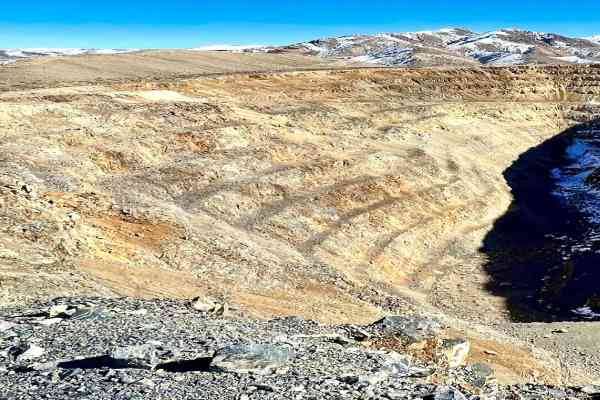
Lahontan Gold is not yet a gold producer, but is well on its way to becoming one. The company, also based in Canada, plans to bring its flagship Santa Fe project online in 2028. It is located in the famous Walker Lane district in Nevada. The state is one of the world's largest gold producers and stands out for its low costs. Santa Fe is a former gold mine that was already in production between 1988 and 1994. Production is now set to resume in 2028. Due to the region's long history of mining, the project benefits from good infrastructure, with roads, water, and power readily available.
Lahontan Gold has already published a resource estimate and a feasibility study for the project. According to the current resource estimate, the deposit contains 1.54 million ounces in the indicated category and 411,000 ounces in the inferred category, corresponding to a total resource of 1.95 million ounces of gold equivalent. The deposit is spread across five satellites. The average gold grade of 0.93 grams per ton of ore is at the high end for this region. The most recent drilling program also revealed significantly higher grades. For example, one drill hole returned 3.11 g/t AuEq over a 37-meter length starting directly from surface.
Heap Leaching Makes Processing More Cost-Effective
Importantly, the rock is oxidized. This allows it to be processed cost-effectively using heap leaching, a well-established mining process. The gold-bearing ore simply needs to be crushed (usually to gravel size) and can then be piled onto huge, waterproof tarps to form a heap. Similar to watering a garden, a weak sodium cyanide solution is then sprayed onto the heap, which extracts the gold particles from the rock. This is why even gold deposits with extremely low grades (as low as 0.3 g/t gold) can be mined very economically in Nevada.
Due to this geological advantage and the possibility of open-pit mining, production should also be cost-effective for Lahontan Gold. At the end of 2024, the company published a feasibility study on this. According to the study, Lahontan Gold plans annual production of 70,000 to 80,000 ounces of gold starting in 2027/2028 over eight years. Should further exploration prove successful, there is potential for even more. According to the PEA from December 2024, cash production costs are expected to be below USD 1,300 per ounce. While these costs are likely higher today, the calculations at that time assumed a gold price of only USD 1,950. Today, gold stands at more than USD 4,500.
Lahontan Gold currently has a market capitalization equivalent to approximately EUR 85 million. Cash flow from the first year of production alone, based on a conservative profit margin of USD 2,000 per ounce, would exceed USD 140 million. For investors, Lahontan Gold is therefore a bet on the start of production in 2028. Further potential comes from the expansion of the resource and a continuing rise in the gold price. This year, the stock is likely to benefit primarily from new drilling results, the updated resource estimate in Q3, and the subsequent new Preliminary Economic Assessment (PEA). Lahontan Gold raised approximately CAD 11.7 million from investors this past March, which means the 2026 plans are well-funded.
Newmont: When Will a Takeover Happen?
The very large producers benefit particularly strongly from high or rising gold prices. Just like its competitors, Agnico Eagle Mines and Barrick, global market leader Newmont also achieved record figures in the fourth quarter of 2025. As gold prices rise, the US company benefits directly from higher selling prices. For more conservative investors, Newmont stock is therefore worth a look at this time. The Denver-based company is the world's largest gold producer and mined approximately 5.9 million ounces of gold last year, bringing the company to the upper end of its own guidance. A transitional year is planned for 2026. Management anticipates a decline in production of around 10%, which is expected to mark the "low point in the production cycle." This is due to planned mine sequencing to optimize production. On the cost side, Newmont is also among the market leaders. This year, costs are expected to rise to about USD 1,680 per ounce (AISC) due to the lower planned production.
Operationally, therefore, everything is on the right track despite this dip. In addition, as is the case across the industry, shareholders play a more significant role at Newmont than they did a few years ago. The company has announced a Capital Allocation Framework under which USD 1.1 billion is to be distributed annually. This currently corresponds to a quarterly dividend of USD 0.26 per share. In addition, approximately USD 2.4 billion remains outstanding from the share buyback program approved in 2025. EPS should therefore continue to rise, if only due to the buybacks.
Newmont's expansion strategy remains a major unknown. Competitors such as Agnico have already announced that they are actively looking for acquisition targets. Newmont is also likely to want to take action. Like many gold miners, it had underinvested in new deposits during the period of low gold prices prior to 2022. External growth is therefore likely to be the order of the day. Most recently, in November 2023, Newmont acquired the Australian company Newcrest Mining, paying approximately USD 17.8 billion—though entirely in stock. After several sales to streamline the acquired portfolio, Newmont is ready to take another major step. Whether this will be good or bad for the stock will likely depend on the details of the deal. One thing is clear: Newmont wants mines with a higher copper content. And: only the very largest mines are in the running. These so-called Tier 1 assets must produce at least 500,000 gold equivalent ounces annually.
Conclusion: The debasement trade will continue, with investors and central banks turning their backs on the dollar. This benefits the gold price, and consequently, gold stocks as well. With Newmont, investors can bet on an industry leader, which is currently in a transitional year. One risk remains: an overpriced acquisition. Lahontan Gold plans to bring the historic Santa Fe Mine in Nevada online in 2028. The stock offers significant potential if management can successfully execute this plan. With Kinross, investors are betting on a producer that grows primarily through organic growth, has very low production costs, and should benefit from higher gold prices.
Conflict of interest
Pursuant to §85 of the German Securities Trading Act (WpHG), we point out that Apaton Finance GmbH as well as partners, authors or employees of Apaton Finance GmbH (hereinafter referred to as "Relevant Persons") may hold shares or other financial instruments of the aforementioned companies in the future or may bet on rising or falling prices and thus a conflict of interest may arise in the future. The Relevant Persons reserve the right to buy or sell shares or other financial instruments of the Company at any time (hereinafter each a "Transaction"). Transactions may, under certain circumstances, influence the respective price of the shares or other financial instruments of the Company.
In addition, Apaton Finance GmbH is active in the context of the preparation and publication of the reporting in paid contractual relationships.
For this reason, there is a concrete conflict of interest.
The above information on existing conflicts of interest applies to all types and forms of publication used by Apaton Finance GmbH for publications on companies.
Risk notice
Apaton Finance GmbH offers editors, agencies and companies the opportunity to publish commentaries, interviews, summaries, news and the like on news.financial. These contents are exclusively for the information of the readers and do not represent any call to action or recommendations, neither explicitly nor implicitly they are to be understood as an assurance of possible price developments. The contents do not replace individual expert investment advice and do not constitute an offer to sell the discussed share(s) or other financial instruments, nor an invitation to buy or sell such.
The content is expressly not a financial analysis, but a journalistic or advertising text. Readers or users who make investment decisions or carry out transactions on the basis of the information provided here do so entirely at their own risk. No contractual relationship is established between Apaton Finance GmbH and its readers or the users of its offers, as our information only refers to the company and not to the investment decision of the reader or user.
The acquisition of financial instruments involves high risks, which can lead to the total loss of the invested capital. The information published by Apaton Finance GmbH and its authors is based on careful research. Nevertheless, no liability is assumed for financial losses or a content-related guarantee for the topicality, correctness, appropriateness and completeness of the content provided here. Please also note our Terms of use.