April 1st, 2026 | 07:20 CEST
Antimony as a Bottleneck: Challenges for Northrop Grumman and First Solar – Top Opportunity for Antimony Resources
Created and published on behalf of Antimony Resources Corp.
In the spring of 2026, global supply chains for the semi-metal antimony will be under severe pressure. Escalating geopolitical tensions, particularly the war in the Middle East and the de facto blockade of the Strait of Hormuz, have left a deep mark. According to the International Energy Agency (IEA), this is one of the most severe disruptions in recent history. The situation is exacerbated by China's export controls, as China historically controls around 48% of global antimony production. While civilian use of this critical element is partially possible again for US entities, military exports remain strictly prohibited. In this context, the focus is shifting to the development of new Western deposits. The goal: to reliably supply defense contractors like Northrop Grumman and solar companies like First Solar. The exploration company Antimony Resources plays a key role in this effort, offering a readily available solution with its Bald Hill project in Canada.
time to read: 3 minutes | Author: Nico Popp
ISIN: ANTIMONY RESOURCES CORP | CA0369271014 | CSE: ATMY , OTCQB: ATMYF , NORTHROP GRUMMAN DL 1 | US6668071029 , FIRST SOLAR INC. D -_001 | US3364331070
Table of contents:
Author

Nico Popp
At home in Southern Germany, the passionate stock exchange expert has been accompanying the capital markets for about twenty years. With a soft spot for smaller companies, he is constantly on the lookout for exciting investment stories.
Tag cloud
Shares cloud
Northrop Grumman: Defense Capabilities at Risk
For the US defense contractor Northrop Grumman, the availability of antimony is essential. The material serves as an indispensable hardening agent in lead alloys for ammunition and as a component in fuses. In addition, antimony-based semiconductors are essential for infrared detectors and target acquisition systems to replenish NATO's dwindling stockpiles. In the fourth quarter of 2025, the company recorded a strong 10% increase in revenue to USD 11.7 billion and reported a record order backlog of USD 95.7 billion. However, since inventories in the defense industry typically last only six to twelve months, Chinese export restrictions threaten to disrupt production of precision munitions and sensors. Northrop CEO Kathy Warden recently highlighted the unprecedented demand in the sector. Industry experts estimate the cost of developing substitutes at up to USD 2 billion per military platform.
First Solar: Decarbonization at the Material Limit
The energy transition also faces major hurdles due to the antimony shortage, as the example of First Solar shows. The US company has successfully become independent of the Chinese silicon supply chain through its cadmium telluride thin-film technology. However, its Achilles' heel remains the highly transparent photovoltaic glass, which requires sodium antimonate as a clarifying agent to increase light transmittance. Although First Solar generated revenue of USD 5.22 billion in fiscal year 2025, the forecast for 2026 was disappointing for the market, with expected revenue of USD 4.9 to 5.2 billion. CEO Mark Widmar justified his revenue forecast by citing a deliberate strategic underutilization of Asian factories to hedge against trade risks, which caused the stock price to plummet by about 13% following the announcement. The risk of rising material costs for solar glass remains acute for the manufacturer, as approximately 40 grams of antimony are used per standard module, which adds up to a significant amount given an annual production of 18 gigawatts.
Antimony Resources: The Western Solution to the Bottleneck
In this critical market phase, Antimony Resources is positioning itself as a problem solver. The company is advancing exploration of the Bald Hill project in the Canadian province of New Brunswick, which, according to a technical report, is considered one of the highest-grade antimony deposits in the Western world. Estimates indicate enormous potential of approximately 2.7 million tons of ore with grades ranging from 3.0% to 4.0% antimony. To translate this potential into an initial resource estimate in accordance with North American standards, management is currently carrying out a 10,000-meter drilling program, of which over 6,500 m have already been successfully completed. The recent discovery of the so-called Marcus Zone in January, where massive stibnite was exposed directly at the earth's surface, further expands the geological scope.**
Antimony Resources: Geological Potential and Secured Financing
Another key success factor for Antimony Resources is the expansion of its geological potential, coupled with a strong financial position in a historically challenging market environment. Systematic trenching in the new Marcus Zone confirmed the extent of the high-grade mineralization, which is why current drilling is now targeting depths between 30 and 50 m to verify the surface findings. Financially, the company is operating from a position of strength. Thanks to an oversubscribed capital increase in December totaling CAD 8.7 million and the exercise of warrants worth over CAD 1.2 million in February, the entire exploration program is already fully funded.
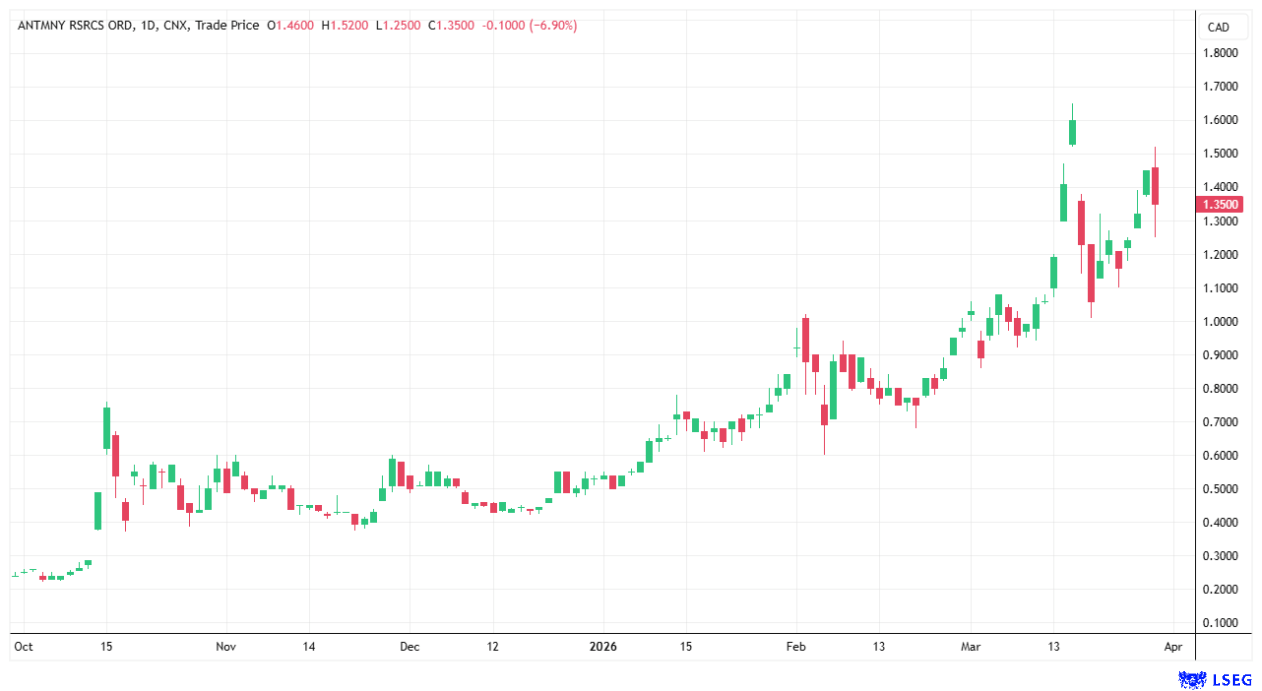
In a recent study, GBC analysts demonstrate that this newly raised capital, combined with the extreme upside potential from converting exploration targets into proven resources, offers promising leverage for investors. Consequently, the analysts issued a "Buy" recommendation with a price target of CAD 3.00. This corresponds to a potential of well over 100%. Since technology leaders such as Grumman and First Solar are critically dependent on high-quality, traceable antimony from secure jurisdictions, and the US Department of Defense is subsidizing the development of domestic supply chains, Antimony Resources' Canadian project is inevitably coming into focus. Investors can take advantage of this.
Watch YouTube videoConflict of interest
Pursuant to §85 of the German Securities Trading Act (WpHG), we point out that Apaton Finance GmbH as well as partners, authors or employees of Apaton Finance GmbH (hereinafter referred to as "Relevant Persons") currently hold or hold shares or other financial instruments of the aforementioned companies and speculate on their price developments. In this respect, they intend to sell or acquire shares or other financial instruments of the companies (hereinafter each referred to as a "Transaction"). Transactions may thereby influence the respective price of the shares or other financial instruments of the Company.
In this respect, there is a concrete conflict of interest in the reporting on the companies.
In addition, Apaton Finance GmbH is active in the context of the preparation and publication of the reporting in paid contractual relationships.
For this reason, there is also a concrete conflict of interest.
The above information on existing conflicts of interest applies to all types and forms of publication used by Apaton Finance GmbH for publications on companies.
Risk notice
Apaton Finance GmbH offers editors, agencies and companies the opportunity to publish commentaries, interviews, summaries, news and the like on news.financial. These contents are exclusively for the information of the readers and do not represent any call to action or recommendations, neither explicitly nor implicitly they are to be understood as an assurance of possible price developments. The contents do not replace individual expert investment advice and do not constitute an offer to sell the discussed share(s) or other financial instruments, nor an invitation to buy or sell such.
The content is expressly not a financial analysis, but a journalistic or advertising text. Readers or users who make investment decisions or carry out transactions on the basis of the information provided here do so entirely at their own risk. No contractual relationship is established between Apaton Finance GmbH and its readers or the users of its offers, as our information only refers to the company and not to the investment decision of the reader or user.
The acquisition of financial instruments involves high risks, which can lead to the total loss of the invested capital. The information published by Apaton Finance GmbH and its authors is based on careful research. Nevertheless, no liability is assumed for financial losses or a content-related guarantee for the topicality, correctness, appropriateness and completeness of the content provided here. Please also note our Terms of use.