March 16th, 2026 | 07:35 CET
Ammunition shortages pressure the defense industry: Opportunity for Almonty, challenges for General Dynamics and Rheinmetall
Our global security architecture has been undergoing significant disruptions for some time. The decades-long paradigm of the peace dividend, built on global supply chains and reduced stockpiles, has largely collapsed. The defense industry now faces the challenge of establishing reliable supply chains for critical raw materials in order to meet the growing demand for artillery ammunition and heavy weapon systems. Another driver is the war in Iran. According to a report by the Financial Times, the conflict has decimated US ammunition stockpiles to such an extent that the Pentagon is already warning of shortages of certain munitions. To replenish these inventories, the US government is planning a supplemental budget of around USD 50 billion. In this environment, the US defense contractor General Dynamics is helping maintain the operational readiness of NATO partners through production of ammunition, while Rheinmetall, as a European systems provider, is also expanding its capacities. However, the crucial foundation for this production is the critical metal tungsten. The only significant Western supplier, Almonty Industries, therefore plays a key role - potentially opening up unique opportunities for investors.
time to read: 3 minutes | Author: Nico Popp
ISIN: ALMONTY INDUSTRIES INC. | CA0203987072 | TSX: AII , NASDAQ: ALM , ASX: AII , GENERAL DYNAMICS CORPORATION | US3695501086 , RHEINMETALL AG | DE0007030009
Table of contents:
Author

Nico Popp
At home in Southern Germany, the passionate stock exchange expert has been accompanying the capital markets for about twenty years. With a soft spot for smaller companies, he is constantly on the lookout for exciting investment stories.
Tag cloud
Shares cloud
General Dynamics Supplies Urgently Needed Ammunition
The US company General Dynamics plays a crucial role in US ammunition production. In the current crisis environment, the Combat Systems division is proving to be a key growth driver. This division encompasses the production of main battle tanks and, through its subsidiary OTS, the manufacture of large-caliber ammunition and warheads. In the fourth quarter of 2025, this division closed with a book-to-bill ratio (order intake relative to revenue) of 4.3, while the order backlog increased by 60% to USD 27.2 billion. General Dynamics benefits from its position as a major supplier of NATO ammunition, as evidenced by orders from Germany worth over USD 4 billion, as well as orders from Canada and the United Kingdom. This business is further supported by the Marine Systems division, which recorded revenue growth of 16.6% last year and is preparing for the US Navy's planned fleet expansion with investments exceeding USD 2.1 billion in 2026. At the group level, the company generated revenue of more than USD 52 billion in the past fiscal year and reported operating cash flow of USD 5.1 billion.
Rheinmetall is Accelerating Capacity Expansion
In Germany, Rheinmetall has become a key player in the European defense industry. The Group benefits from Germany's special defense fund and structural rearmament in Europe. The figures for the Weapon and Ammunition division are strong. In a market environment where demand exceeds supply, Rheinmetall achieved an operating margin of 29.3% in this segment in 2025. The Group is expanding its capacities and is currently building 13 new plants in Europe or expanding existing facilities. One key component is the new plant in Unterlüß, where production of 155 mm artillery shells is set to rise from 25,000 units in 2025 to 140,000 in the current year. This development is supported by government purchase guarantees. For the 2025 fiscal year, Rheinmetall reported an operating profit of EUR 1.84 billion on revenue of EUR 9.93 billion. For 2026, management expects revenue to jump to as much as EUR 14.5 billion and the order backlog to grow to a staggering EUR 135 billion.
Almonty Industries as a Tungsten Monopolist
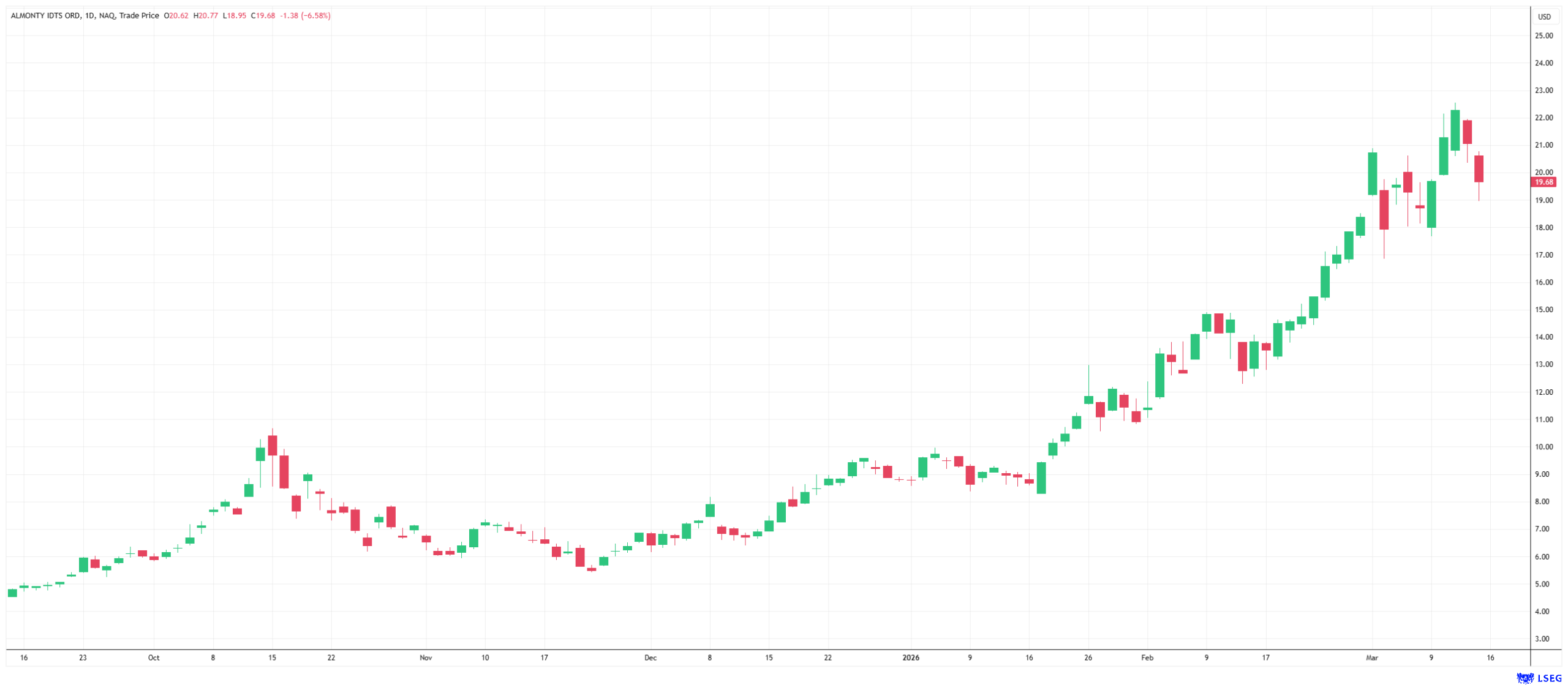
The operational capacity of companies such as Rheinmetall and General Dynamics is directly linked to the availability of critical raw materials. Due to its exceptional density and heat resistance, tungsten is essential for penetrators in artillery ammunition, armor systems, and rocket nozzles. China currently controls around 83% of global production and restricts exports through quotas, pushing the market into what many analysts describe as a supercycle. Prices for tungsten concentrates have risen sharply in recent months. While tungsten traded at around USD 340 at the beginning of 2025, the market price today is well above the USD 2,200 mark. In this environment, Almonty Industries is assuming a key role. Since the start of mining operations at the Sangdong mine in South Korea in December 2025, the company has become one of the largest tungsten producers outside China. At the same time, management is pushing ahead with the expansion of the Panasqueira mine in Portugal and developing the Gentung-Browns Lake project in the US to strengthen the Western supply base. Almonty's commercial structure also secures supply contracts spanning 15 years. These contracts guarantee a minimum price of USD 235 per MTU, but deliberately exclude a price cap. This allows the company to benefit directly from rising market prices, regardless of how far the price of the largely irreplaceable metal continues to increase.
Shift in Value Creation Creates Opportunities
For investors, the current environment marks a turning point within the defense industry. While defense contractors have historically captured the largest share of value creation, pricing power is increasingly shifting toward the beginning of the supply chain. A defense contractor cannot afford to halt production of critical systems due to a shortage of tungsten components. General Dynamics and Rheinmetall, therefore, remain key players in the current market environment, with large order backlogs providing strong revenue visibility. Almonty, however, positions itself as the supplier of what the entire industry urgently needs: tungsten. As the tungsten market continues to be defined by structural scarcity, Almonty's stock could offer investors a unique opportunity to benefit from the ongoing realignment of Western supply chains for critical metals.
Watch YouTube videoConflict of interest
Pursuant to §85 of the German Securities Trading Act (WpHG), we point out that Apaton Finance GmbH as well as partners, authors or employees of Apaton Finance GmbH (hereinafter referred to as "Relevant Persons") currently hold or hold shares or other financial instruments of the aforementioned companies and speculate on their price developments. In this respect, they intend to sell or acquire shares or other financial instruments of the companies (hereinafter each referred to as a "Transaction"). Transactions may thereby influence the respective price of the shares or other financial instruments of the Company.
In this respect, there is a concrete conflict of interest in the reporting on the companies.
In addition, Apaton Finance GmbH is active in the context of the preparation and publication of the reporting in paid contractual relationships.
For this reason, there is also a concrete conflict of interest.
The above information on existing conflicts of interest applies to all types and forms of publication used by Apaton Finance GmbH for publications on companies.
Risk notice
Apaton Finance GmbH offers editors, agencies and companies the opportunity to publish commentaries, interviews, summaries, news and the like on news.financial. These contents are exclusively for the information of the readers and do not represent any call to action or recommendations, neither explicitly nor implicitly they are to be understood as an assurance of possible price developments. The contents do not replace individual expert investment advice and do not constitute an offer to sell the discussed share(s) or other financial instruments, nor an invitation to buy or sell such.
The content is expressly not a financial analysis, but a journalistic or advertising text. Readers or users who make investment decisions or carry out transactions on the basis of the information provided here do so entirely at their own risk. No contractual relationship is established between Apaton Finance GmbH and its readers or the users of its offers, as our information only refers to the company and not to the investment decision of the reader or user.
The acquisition of financial instruments involves high risks, which can lead to the total loss of the invested capital. The information published by Apaton Finance GmbH and its authors is based on careful research. Nevertheless, no liability is assumed for financial losses or a content-related guarantee for the topicality, correctness, appropriateness and completeness of the content provided here. Please also note our Terms of use.