May 4th, 2026 | 07:35 CEST
Almonty Industries: Commodity Shock Escalates – Tungsten Becomes a Bottleneck
Geopolitical tensions, new trade barriers, and rapidly rising demand from key industries are currently fundamentally changing the dynamics of the commodities market. One metal in particular is increasingly coming into focus: tungsten. With prices now exceeding USD 3,200 per MTU, the market has reached a level that was barely imaginable just a few years ago. At the same time, demand from the defence industry, semiconductor manufacturing, and future technologies such as artificial intelligence or nuclear fusion is growing rapidly. While demand is expanding dynamically, supply remains limited, which represents a classic scenario for persistently high prices. The crucial question is therefore no longer whether tungsten is needed, but who can supply it in sufficient quantities. This is precisely where the greatest investment opportunities are currently emerging.
time to read: 3 minutes | Author: Stefan Feulner
ISIN: ALMONTY INDUSTRIES INC. | CA0203987072 | TSX: AII , NASDAQ: ALM , ASX: AII
Table of contents:
Author

Stefan Feulner
The native Franconian has more than 20 years of stock exchange experience and a broadly diversified network.
He is passionate about analyzing a wide variety of business models and investigating new trends.
Tag cloud
Shares cloud
China Loses Control – Structural Deficit Drives Prices
For decades, China dominated the global tungsten market, accounting for around 80% of production and processing. This one-sided dependence is now increasingly becoming a risk for Western industrialized nations. Export restrictions, political tensions, and targeted supply chain interventions are significantly exacerbating the situation. At the same time, the US and Europe are advancing their own raw materials strategies. Particularly explosive is the fact that, starting in 2027, the US will prohibit the use of Chinese tungsten in military applications.
The result is a structural supply deficit. Demand is growing across the board, from high-performance chips and AI infrastructure to state-of-the-art weapons systems. At the same time, there is a lack of new projects outside China that could provide short-term relief. The massive price surge to over USD 3,200 per MTU is therefore not a short-term outlier, but rather a reflection of a fundamental shift. Many market observers expect this price level to become established in the long term. Additionally, shortages of intermediate products such as tungsten hexafluoride are further exacerbating the situation, putting particular pressure on the semiconductor industry.
South Korea, the US, and Europe – A Compelling Strategic Trio
In this environment, Almonty Industries positioned itself early on as a key Western supplier and is benefiting from several structural trends. At the center is the Sangdong mine in South Korea, one of the most significant tungsten projects outside of China. The production ramp-up is proceeding according to plan, with initial output data confirming expectations. Significant volumes are already being processed in the current phase, while the second expansion phase, starting in 2027, is expected to significantly increase capacity. Looking ahead, the project alone could account for around 40% of global tungsten production outside of China.
Particularly noteworthy is the combination of high ore quality and low production costs. The project remains profitable even under conservative price assumptions. At current price levels, however, significant margin potential is emerging. Analysts are already projecting net margins of around 60% even at significantly lower tungsten prices. Given actual market prices, the profit potential is likely to be significantly higher. As a result, Sangdong is increasingly emerging as a potential cash flow engine capable of driving sustainable growth in enterprise value.
At the same time, the company is consistently expanding its strategic presence in the US. With a project in Montana, the relocation of its headquarters, and a stronger institutional foothold, the company is gaining direct access to the American market. This step is of great significance, as the US is making a concerted effort to reduce its dependence on China while simultaneously building its own supply chains. The planned commencement of production in the United States thus meets a politically driven demand. Furthermore, the US presence facilitates access to grants, loans, and institutional investors, thereby significantly improving financing for further growth.
This strategy is complemented by existing operations in Europe. The long-established Panasqueira mine in Portugal delivers stable cash flows and supports the financing of the expansion. At the same time, projects in Spain provide additional growth prospects. This geographic diversification reduces risk and strengthens the company's position as a reliable supplier to multiple industrialized nations. Added to this is a clear strategic approach to acquisitions. Instead of high-risk exploration projects, management is focusing specifically on existing properties with established infrastructure. This shortens development times and significantly reduces investment risks.
Another key factor is long-term off-take agreements, particularly with customers in the US and nearby regions. These not only secure stable revenue over many years but also provide planning certainty in a traditionally cyclical commodities market. At the same time, the company's geopolitical significance is further strengthened as it establishes itself as a reliable partner for critical supply chains. Overall, this creates a strategic triad of Asia, Europe, and North America that is virtually unique in the tungsten sector.
Revaluation Driven by Scarcity and Geopolitical Power
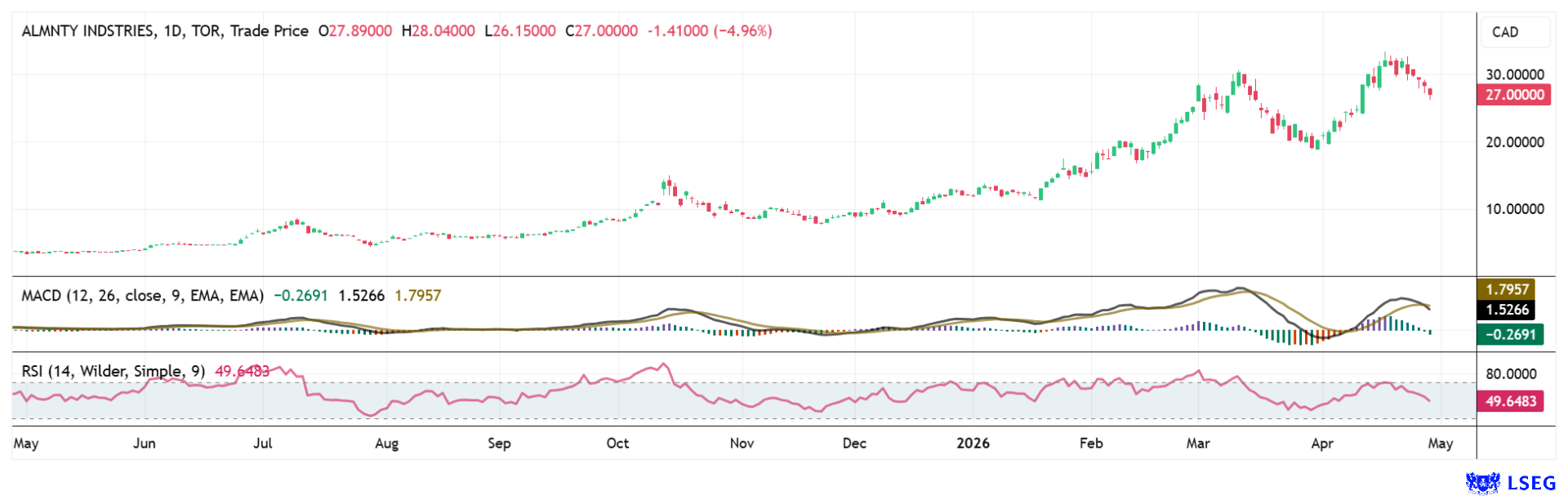
The tungsten story is just beginning. A structural supply deficit, rapidly rising demand from high-tech and defence sectors, and the geopolitical realignment of supply chains form a strong foundation for sustained high prices. Almonty Industries is one of the few players capable of closing this gap. With growing production capacity, strategic proximity to the US, long-term off-take agreements, and exceptional margin prospects, the company possesses significant revaluation potential. There are many indications that, despite recent price gains, the stock has not yet reached its peak.
Conflict of interest
Pursuant to §85 of the German Securities Trading Act (WpHG), we point out that Apaton Finance GmbH as well as partners, authors or employees of Apaton Finance GmbH (hereinafter referred to as "Relevant Persons") may hold shares or other financial instruments of the aforementioned companies in the future or may bet on rising or falling prices and thus a conflict of interest may arise in the future. The Relevant Persons reserve the right to buy or sell shares or other financial instruments of the Company at any time (hereinafter each a "Transaction"). Transactions may, under certain circumstances, influence the respective price of the shares or other financial instruments of the Company.
In addition, Apaton Finance GmbH is active in the context of the preparation and publication of the reporting in paid contractual relationships.
For this reason, there is a concrete conflict of interest.
The above information on existing conflicts of interest applies to all types and forms of publication used by Apaton Finance GmbH for publications on companies.
Risk notice
Apaton Finance GmbH offers editors, agencies and companies the opportunity to publish commentaries, interviews, summaries, news and the like on news.financial. These contents are exclusively for the information of the readers and do not represent any call to action or recommendations, neither explicitly nor implicitly they are to be understood as an assurance of possible price developments. The contents do not replace individual expert investment advice and do not constitute an offer to sell the discussed share(s) or other financial instruments, nor an invitation to buy or sell such.
The content is expressly not a financial analysis, but a journalistic or advertising text. Readers or users who make investment decisions or carry out transactions on the basis of the information provided here do so entirely at their own risk. No contractual relationship is established between Apaton Finance GmbH and its readers or the users of its offers, as our information only refers to the company and not to the investment decision of the reader or user.
The acquisition of financial instruments involves high risks, which can lead to the total loss of the invested capital. The information published by Apaton Finance GmbH and its authors is based on careful research. Nevertheless, no liability is assumed for financial losses or a content-related guarantee for the topicality, correctness, appropriateness and completeness of the content provided here. Please also note our Terms of use.