August 27th, 2020 | 09:00 CEST
AI Infrastructure and Batteries in Focus – Who Has the Edge? BASF, Heidelberger Druck, HPQ Silicon and VW in the Spotlight
After nearly three years in use, it has become impossible to imagine life without it: artificial intelligence. The unstoppable rise of this new knowledge-based world is not only revolutionizing the software industry but is also fueling an unprecedented boom in stationary energy storage and advanced battery systems behind the scenes. Gigantic AI data centers consume enormous amounts of energy and are driving up demand for high-performance network infrastructure and crisis-proof storage technologies. At the end of this rapid race, it will become clear that future technological leadership is inextricably linked to a seamless supply chain in the hardware sector. Only those who master the symbiosis of efficient raw material design, local production, and intelligent grid integration will lead this transformative supercycle. Investors should therefore focus on the players pulling the strings at this critical intersection of energy and digital infrastructure. We are here to help.
time to read: 6 minutes | Author: André Will-Laudien
ISIN: HPQ SILICON INC | CA40444L1031 | TSXV: HPQ , OTCQB: HPQFF , BASF SE NA O.N. | DE000BASF111 , VOLKSWAGEN AG VZO O.N. | DE0007664039 , HEIDELBERG.DRUCKMA.O.N. | DE0007314007
Table of contents:
Author

André Will-Laudien
Born in Munich, he first studied economics and graduated in business administration at the Ludwig-Maximilians-University in 1995. As he was involved with the stock market at a very early stage, he now has more than 30 years of experience in the capital markets.
Tag cloud
Shares cloud
Heidelberger Druckmaschinen: A High-Performance Drone Battery in the Spotlight
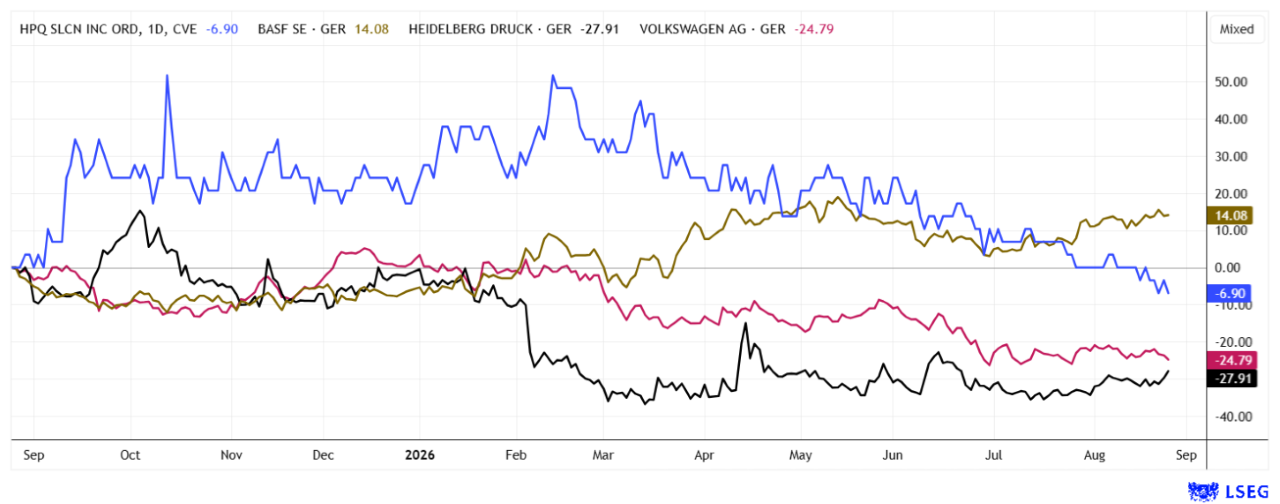
Companies looking to attract attention in the stock market today need to embrace the themes that are shaping the times. There is more news from Heidelberger Druckmaschinen AG in an exciting field. The mid-sized company is skillfully shifting its focus toward forward-looking cutting-edge technologies to tap into new growth markets beyond the traditional print business. It is succeeding in this endeavour thanks to its extensive expertise in industrial precision manufacturing, which enables the development of high-performance batteries suitable for use in modern drones. This technological initiative not only promises a significant increase in efficiency for the booming logistics and surveillance industries but also provides a lively boost to the stock. Investors and market observers are fascinated by the enormous potential of the company's in-house battery technology for unmanned aerial vehicles. Through this progressive diversification, the group is demonstrating remarkable adaptability and innovative strength in the dynamic high-tech sector. The share price has not benefited much from this yet; consequently, the price-to-sales (P/S) ratio for 2027, according to the LSEG Refinitiv platform, currently stands at a very low 0.2, and even a P/E ratio of 11.6 is not too expensive. Exciting!
HPQ Silicon: From Battery Testing to the First Order for Europe's Defense Sector
And the Canadians are also playing a major role! The innovative technology company HPQ Silicon is taking a decisive step forward in its transformation from a technology developer to a commercial provider, as a customer has, for the first time, ordered batteries featuring Novacium's silicon anode technology for a specific defense application. At the heart of this is an order from LN Innov for Gen3-6S1P battery packs with a capacity of 6,000 mAh, which are to be integrated into FPV drones for a regiment of the French Army. While the financial scale of this initial order is still modest, its strategic significance is considerable, as the technology has now crossed the crucial threshold from qualification to real-world application.
This was preceded by extensive testing at the end customer's site beginning in the second quarter; the results met the performance and reliability requirements, ultimately paving the way for the order. This marks the first time HPQ has secured a solid reference from the European defense sector. And it is precisely such references that can be far more valuable than a single order when it comes to acquiring additional customers. The timing is favourable, as the military drone market is projected, according to market data cited by HPQ, to grow from approximately USD 35 billion in 2026 to over USD 109 billion by 2031, while demand for more powerful and lighter energy storage systems is increasing in parallel.
Technologically, the strategy offers additional leverage because HPQ participates in the further expansion of silicon batteries through its 36.8% stake in Novacium and exclusive North American marketing rights. The now-certified Gen4 21700 cell achieves 6,500 mAh, an 8.3% increase in capacity over the Gen3 version, while UL 1642 and UN 38.3 certifications have removed key safety and transportation barriers. The combination of battery and propulsion system could become even more interesting, as HPQ, Novacium, and LN Innov are simultaneously exploring a Canadian platform that brings together batteries, electric motors, and electric propulsion systems for the North American drone and defense markets. A single battery module could thus potentially give rise to an integrated technology offering—a significantly more attractive business model because it addresses greater value creation per system. At the same time, the first French military reference opens the door to further qualification programs within LN Innov's network, with additional projects already under discussion.
HPQ is also establishing a second pillar for the future with HyDRAS™, through which Novacium aims to use industrial waste from the aluminum industry, such as black dross and bauxite residues, for hydrogen production. Tests have shown that bauxite residues can more than double the hydrogen yield while simultaneously addressing a waste problem that has been difficult to manage until now. According to the study cited by HPQ, approximately 175 million metric tons of bauxite residues are generated worldwide each year, meaning that what is currently a niche process could, in the long term, become an interesting building block of a circular hydrogen economy. HPQ remains a speculative technology investment for now, but recent developments are changing the nature of the story: technical promises are turning into initial customer references, certifications are leading to qualifications, and individual technologies are increasingly coming together to form a platform for batteries, drones, hydrogen, and industrial circular economy. The total company valuation of approximately CAD 68 million appears very reasonable given the diversity of ideas on display.
Chairman, President and CEO Bernard Tourillon explained his strategy at the 19th International Investment Forum.
VW: Power Generators Coming Soon from Valencia with Chinese Assistance
Things are stirring in the German automotive sector! Amid intense supervisory board meetings at Volkswagen, debates are primarily focused on far-reaching cost-cutting plans and the strategic realignment of the global production network, given the enormous cost pressures within the group. A central, much-discussed component of this long-term e-mobility strategy remains the new gigafactory of the group's battery subsidiary, PowerCo, in Sagunt, Spain, near Valencia. Originally slated for 2026, advanced planning indicates that, following the installation of production equipment, the state-of-the-art cell factory will be gradually prepared for its opening and the official start of series production. This plant is considered strategically indispensable, as it is intended to supply the Spanish vehicle plants in Martorell and Pamplona with the standardized unit cell for upcoming small electric cars. In light of the current billion-euro investments, Volkswagen is, according to industry reports, simultaneously and very intensively examining the strategic entry of the Chinese battery giant Gotion High-Tech via a possible joint venture directly at the Valencia site. Such a move could secure fresh capital and valuable technological know-how for the struggling automaker, while core control over the strategic project is officially set to remain with PowerCo. The stock came under pressure again following the final confirmation of 50,000 job cuts.
BASF: The Entire Value Chain Under Control
BASF is also pushing ahead full steam with its strategic realignment in the field of e-mobility and will focus heavily on advanced cathode materials in the future. At the heart of this ambitious growth strategy is the large-scale production facility in Schwarzheide, Brandenburg, which is considered the first fully automated plant of its kind in Europe. To sustainably strengthen its market position, the chemical company has signed a groundbreaking global framework agreement with the Chinese battery giant CATL to supply its worldwide cell manufacturing operations directly. At the same time, the company is committed to technological innovation and, through a joint venture, is already delivering the first batches of innovative cathode materials for next-generation semi-solid-state batteries. This materials initiative is complemented by a large-scale circular economy program right on site. A newly inaugurated recycling plant in Schwarzheide processes tons of used batteries into valuable black mass, returning critical raw materials such as nickel and cobalt directly to the production cycle. With this closed-loop value chain, BASF is increasingly establishing itself as an indispensable, strategic key partner for the European and global automotive industry. BASF shares are becoming interesting again: after three years of consolidation, it has once again surpassed the EUR 50 mark.
Conflict of interest
Pursuant to §85 of the German Securities Trading Act (WpHG), we point out that Apaton Finance GmbH as well as partners, authors or employees of Apaton Finance GmbH (hereinafter referred to as "Relevant Persons") currently hold or hold shares or other financial instruments of the aforementioned companies and speculate on their price developments. In this respect, they intend to sell or acquire shares or other financial instruments of the companies (hereinafter each referred to as a "Transaction"). Transactions may thereby influence the respective price of the shares or other financial instruments of the Company.
In this respect, there is a concrete conflict of interest in the reporting on the companies.
In addition, Apaton Finance GmbH is active in the context of the preparation and publication of the reporting in paid contractual relationships.
For this reason, there is also a concrete conflict of interest.
The above information on existing conflicts of interest applies to all types and forms of publication used by Apaton Finance GmbH for publications on companies.
Risk notice
Apaton Finance GmbH offers editors, agencies and companies the opportunity to publish commentaries, interviews, summaries, news and the like on news.financial. These contents are exclusively for the information of the readers and do not represent any call to action or recommendations, neither explicitly nor implicitly they are to be understood as an assurance of possible price developments. The contents do not replace individual expert investment advice and do not constitute an offer to sell the discussed share(s) or other financial instruments, nor an invitation to buy or sell such.
The content is expressly not a financial analysis, but a journalistic or advertising text. Readers or users who make investment decisions or carry out transactions on the basis of the information provided here do so entirely at their own risk. No contractual relationship is established between Apaton Finance GmbH and its readers or the users of its offers, as our information only refers to the company and not to the investment decision of the reader or user.
The acquisition of financial instruments involves high risks, which can lead to the total loss of the invested capital. The information published by Apaton Finance GmbH and its authors is based on careful research. Nevertheless, no liability is assumed for financial losses or a content-related guarantee for the topicality, correctness, appropriateness and completeness of the content provided here. Please also note our Terms of use.