October 7th, 2026 | 09:15 CEST
Aspermont, S&P Global and Alphabet: Specialized Data Poses a Challenge Even for Tech Giants
Generative artificial intelligence is fundamentally changing how information is obtained and siphoning organic web traffic away from traditional media platforms. As search engines utilize AI-generated answers, such as AI Overviews, the traditional advertising business of websites is losing its foundation. Publishers are becoming increasingly dependent on others, but specialized B2B information providers are carving out a lucrative niche. Deep industry knowledge built up over time still offers added value, as it is indispensable for reliable industrial applications and not easily replaceable. We shed light on this trend and highlight some exciting companies.
time to read: 4 minutes | Author: Nico Popp
ISIN: ASPERMONT LTD. | AU000000ASP3 | ASX: ASP , S&P GLOBAL INC | US78409V1044 | NASDAQ: SPGI , ALPHABET INC.CL.A DL-_001 | US02079K3059
Table of contents:
Author

Nico Popp
At home in Southern Germany, the passionate stock exchange expert has been accompanying the capital markets for about twenty years. With a soft spot for smaller companies, he is constantly on the lookout for exciting investment stories.
Tag cloud
Shares cloud
Alphabet: Only Crumbs Left for Content Creators
Google's parent company, Alphabet, is attempting to counter growing criticism of its generative response systems with compensation payments. As reported by industry publications The Information and Digiday, the company is testing the "AI Contribution Pilot" project, in which approximately 100 selected publishers are participating. The compensation range is extremely wide. While Alphabet compensates individual major media companies with over USD 1 million per year, the company pays smaller niche portals amounts of less than USD 1,000 for several months. Several renowned publishers are therefore refusing to participate in the pilot program. Legal pressure is also mounting: In late May, the Munich I Regional Court ruled in summary proceedings that the company is liable as a direct infringer for inaccurate AI summaries. Following Google's appeal, the parties settled the dispute with two Munich-based publishers, rendering the ruling moot. The court's reasoning is nonetheless being widely discussed in the legal literature. Competition regulators are also taking a closer look: The UK's CMA required Google to provide an opt-out option for the AI summaries. In an ongoing antitrust proceeding, the European Commission is examining whether publishers are thereby given a genuine choice regarding data scraping.
S&P Global: Data Worth Billions
The US company S&P Global shows how profitable systematic processing of industry knowledge can be, even outside volatile advertising markets. Its Market Intelligence division feeds verified metrics directly into the risk models of international banks, funds, and commodities companies via interfaces. In the second quarter of 2026, the division increased its adjusted revenue to USD 1.24 billion, with 97% of revenue coming from recurring contracts. The segment's adjusted operating profit climbed to USD 445 million, with an operating margin of 36%. A key component in the commodities sector is the Mine Economics module, which features mine-level cost and production models. The underlying dataset covers over 35,000 mines, projects, and processing facilities worldwide. Because of geopolitical decoupling of supply chains and the expansion of power-intensive AI data centres, analysts expect supply shortages of critical raw materials in the coming years. Consequently, there is high demand for reliable data on production costs and projects. Scalable data providers are valued significantly higher on the capital market than traditional publishers.
Aspermont: Historical Archive Transforms into AI Intelligence
Aspermont sits on a comparable treasure trove of data. The media company has published the long-established Mining Journal since 1835 and maintains an archive spanning about 190 years of the global raw materials industry. Together with other specialized brands such as Mining Magazine, the company draws on editorial analyses from 150 industry journalists and a network of 4,000 corporate clients. Rather than handing over its content unprotected to search engine operators, Aspermont enhances its database with knowledge graphs and domain-specific ontologies to create the AI platform Mining IQ. In 2025, the mining conglomerate Rio Tinto paid about AUD 550,000 to implement this AI-powered search and analysis platform. Mining IQ combines historical primary data with real-time parameters from over 12,000 projects worldwide to generate forecasts for mine life cycles and country risks. The platform is designed to validate answers using curated primary data, thereby significantly reducing the risk of technical errors. In this way, Aspermont provides precise interfaces for mining companies. This breakthrough clearly demonstrates that global commodity producers are willing to allocate substantial budgets for curated expert data. A pure AI startup simply cannot reconstruct 190 years of industry experience and primary data through web scraping.
Aspermont: Streamlined Capital Structure and Growth for 40 Quarters
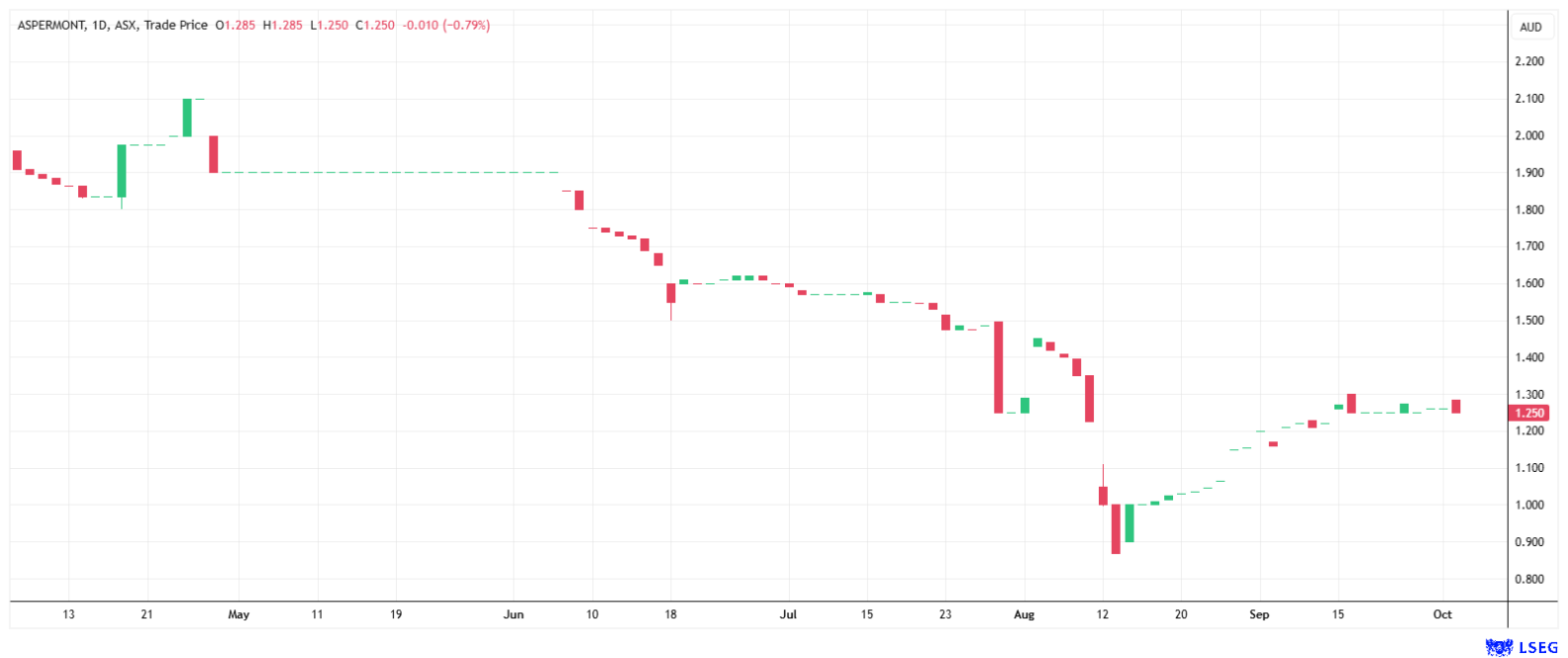
The operational transformation is clearly reflected in Aspermont's financial metrics. For the third quarter of fiscal year 2026 (April through June), the company reported record revenue of AUD 4.5 million, a 25% increase from the same period last year. The subscriptions segment contributed AUD 2.6 million and recorded its 40th consecutive quarter of growth. Annualized recurring revenue has grown by an average of 11% per year since 2016 and stood at approximately AUD 11 million as of the end of June 2026. With a net customer retention rate of 100%, revenue per customer grew by 17% per year over the same period. At the same time, management streamlined the capital structure. A 250-to-1 stock consolidation, which took effect in March 2026, reduced the number of shares from approximately 2.9 billion to approximately 11.6 million. As a result, the stock shed its penny stock stigma and opened itself up to funds specifically seeking scalable Data-as-a-Service providers.
Aspermont's investment story rests on growth in its data business and the continued rollout of Mining IQ to premium clients in the commodities industry. Key risks include the still-limited cash reserves of AUD 0.9 million as of the end of June and the challenge of quickly replicating the success achieved with Rio Tinto at other major players in the industry. Management now expects a sustainably positive operating cash flow only in the second half of fiscal year 2027. If the platform fails to scale or customer growth slows, delays are likely. If, on the other hand, Aspermont succeeds in firmly embedding the data platform into the planning processes of mine operators, the company stands to achieve a sustainable convergence with the high-margin valuation multiples of specialized data service providers such as S&P Global. Aspermont's stock is not without risks, but it is certainly a good fit for the current market environment.
Conflict of interest
Pursuant to §85 of the German Securities Trading Act (WpHG), we point out that Apaton Finance GmbH as well as partners, authors or employees of Apaton Finance GmbH (hereinafter referred to as "Relevant Persons") currently hold or hold shares or other financial instruments of the aforementioned companies and speculate on their price developments. In this respect, they intend to sell or acquire shares or other financial instruments of the companies (hereinafter each referred to as a "Transaction"). Transactions may thereby influence the respective price of the shares or other financial instruments of the Company.
In this respect, there is a concrete conflict of interest in the reporting on the companies.
In addition, Apaton Finance GmbH is active in the context of the preparation and publication of the reporting in paid contractual relationships.
For this reason, there is also a concrete conflict of interest.
The above information on existing conflicts of interest applies to all types and forms of publication used by Apaton Finance GmbH for publications on companies.
Risk notice
Apaton Finance GmbH offers editors, agencies and companies the opportunity to publish commentaries, interviews, summaries, news and the like on news.financial. These contents are exclusively for the information of the readers and do not represent any call to action or recommendations, neither explicitly nor implicitly they are to be understood as an assurance of possible price developments. The contents do not replace individual expert investment advice and do not constitute an offer to sell the discussed share(s) or other financial instruments, nor an invitation to buy or sell such.
The content is expressly not a financial analysis, but a journalistic or advertising text. Readers or users who make investment decisions or carry out transactions on the basis of the information provided here do so entirely at their own risk. No contractual relationship is established between Apaton Finance GmbH and its readers or the users of its offers, as our information only refers to the company and not to the investment decision of the reader or user.
The acquisition of financial instruments involves high risks, which can lead to the total loss of the invested capital. The information published by Apaton Finance GmbH and its authors is based on careful research. Nevertheless, no liability is assumed for financial losses or a content-related guarantee for the topicality, correctness, appropriateness and completeness of the content provided here. Please also note our Terms of use.