November 19th, 2026 | 05:21 CET
Zefiro Methane: Order Books Full for Orphaned Oil Well Plugging
Created and published on behalf of Zefiro Methane Corp.
In the US, almost 142,000 orphaned oil and gas wells are officially recorded, while state authorities estimate that up to another 740,000 remain unregistered. Who plugs them, and who pays for it? Zefiro Methane has built its business around this market and has government contracts worth around USD 40 million extending through June 2029. We examine this emerging market and assess whether Zefiro shares could offer an investment opportunity.
time to read: 4 minutes | Author: Nico Popp
ISIN: Zefiro Methane Corp | CA98926D1069
Table of contents:
Author

Nico Popp
At home in Southern Germany, the passionate stock exchange expert has been accompanying the capital markets for about twenty years. With a soft spot for smaller companies, he is constantly on the lookout for exciting investment stories.
Tag cloud
Shares cloud
A growing legacy
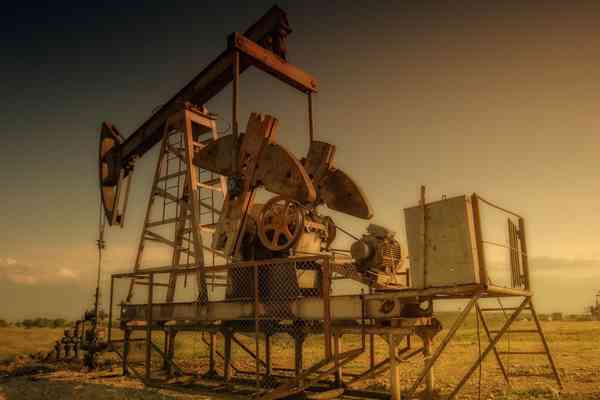
Leaking orphaned wells release methane, a greenhouse gas that drives global warming far more strongly than carbon dioxide. Corroded pipes can also contaminate groundwater, increasing the pressure on authorities to act. The problem grows the closer authorities look: in 1992, the Interstate Oil and Gas Compact Commission (IOGCC) counted around 49,700 orphaned wells; by the end of 2023, there were almost three times as many. And the number continues to grow: in Colorado, the number of orphaned wells rose to a record 994. According to a report by the Colorado Sun, an average of around 300 were added each year over the past three years. Although the state plugged a record 161 wells last year, another 1,200 could soon be abandoned by their operators. Plugging a well there costs around USD 100,000 on average, and operators' bonds often cover only a fraction of this.
Meanwhile, the oil market has recently moved lower: Brent fell from around USD 115 per barrel at the end of October to below USD 92 at times. This does little to change the underlying problem. Many old, barely productive wells end up with small operators, and if these run into difficulties, the wells become the state's responsibility. The state therefore bears most of the costs: the 2021 Infrastructure Act provides USD 4.677 billion to plug orphaned wells.
Government contracts through 2029
Zefiro operates through its subsidiary Plants & Goodwin in 15 US states, with Indiana and Michigan the latest additions. The company covers every stage, from methane measurement to land reclamation. The largest item in the order backlog is a USD 19.6 million contract with the state of Ohio for around 200 wells, alongside three other Ohio projects worth USD 5.0 million. In September, Zefiro also won a government contract in the Great Lakes region worth USD 11.5 million, which also runs through June 2029. The company intends to complete around USD 4.9 million of its backlog in the current quarter alone, ending in December.
Zefiro can command lucrative prices for this work: on two Ohio projects from September, the company receives an average of around USD 184,000 per well, more than 40% above the average for the state programme, and Zefiro was the sole bidder on one of them. A new addition is an exploration contract under which Zefiro examines wells before plugging them. In West Virginia, the company has already measured methane at 849 wells and, according to its own figures, achieved roughly twice the margin of its well-plugging business. Zefiro has now even plugged wells in Ohio's Cuyahoga Valley National Park. In October, the company also raised CAD 5.0 million, generating net proceeds of around USD 3.35 million, primarily for operations and potential acquisitions.
Data centres as a second business pillar
Private-sector customers also pay for Zefiro's services: developers are turning to former industrial sites for new data centres and gas-fired power plants, where open wells are blocking planning approval. With the equipment acquired from Viking Well Service in May, Zefiro secured seven framework agreements, mainly with gas producers. According to the company, this means it now works for almost all major gas producers in the northeastern United States. In August and September alone, the new equipment generated around USD 1.5 million in revenue, equivalent to more than USD 9 million on an annualised basis. This B2B business makes Zefiro less dependent on time-limited government programmes.
Growth initially comes at the expense of margins
However, the quarterly figures also show the downside. From July to September, Zefiro generated revenue of USD 12.1 million, 30.7% more than in the previous quarter. However, the gross margin fell to 20.4% from 37.8%, as new equipment and field teams increased costs and the previous year's high-margin revenue from credits was absent. The bottom line was a net loss of USD 2.4 million. The new management has already reduced administrative costs since 2025.
Further potential lies in the credit business, which Zefiro intends to resume as soon as the registry Isometric finalises its new protocol for orphaned wells—the public consultation on the draft ended on November 14. The credits are based on a measurement taken directly at the well before plugging, with verification carried out 12 to 18 months later. Zefiro co-funded the protocol's development and was the first company to sell credits from plugged orphaned wells under an older methodology.
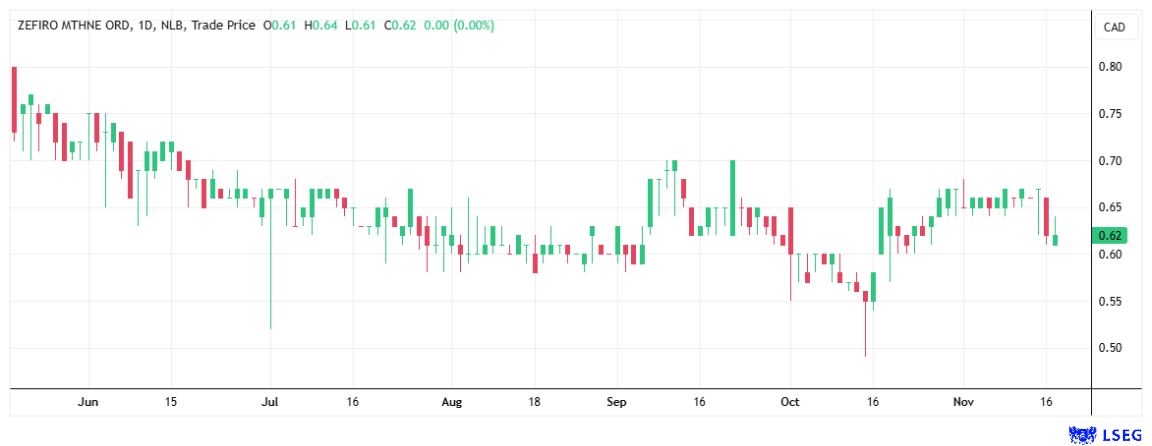
GBC analysts expect revenue of USD 57.92 million and EBITDA of around USD 10.0 million for the 2026/27 financial year. For 2027/28, they forecast revenue of USD 66.85 million, with EBITDA expected to rise to around USD 15.0 million by 2028/29. With higher capacity utilisation, the analysts also expect margins to improve again. In an update published on November 18, they confirmed their Buy rating and raised the price target slightly to USD 1.47, from USD 1.42 at the end of October.
Conclusion: the contracts are in place; now margins matter
Zefiro Methane has a broad base, with government contracts through to 2029, a growing private-sector business and its own specialist equipment. The company must now translate its high capacity utilisation into better margins. Risks include upfront financing for major contracts and a thin capital base. However, the imminent return of the credit business offers hope. The shares look promising at the current level.
Conflict of interest
Pursuant to §85 of the German Securities Trading Act (WpHG), we point out that Apaton Finance GmbH as well as partners, authors or employees of Apaton Finance GmbH (hereinafter referred to as "Relevant Persons") may hold shares or other financial instruments of the aforementioned companies in the future or may bet on rising or falling prices and thus a conflict of interest may arise in the future. The Relevant Persons reserve the right to buy or sell shares or other financial instruments of the Company at any time (hereinafter each a "Transaction"). Transactions may, under certain circumstances, influence the respective price of the shares or other financial instruments of the Company.
In addition, Apaton Finance GmbH is active in the context of the preparation and publication of the reporting in paid contractual relationships.
For this reason, there is a concrete conflict of interest.
The above information on existing conflicts of interest applies to all types and forms of publication used by Apaton Finance GmbH for publications on companies.
Risk notice
Apaton Finance GmbH offers editors, agencies and companies the opportunity to publish commentaries, interviews, summaries, news and the like on news.financial. These contents are exclusively for the information of the readers and do not represent any call to action or recommendations, neither explicitly nor implicitly they are to be understood as an assurance of possible price developments. The contents do not replace individual expert investment advice and do not constitute an offer to sell the discussed share(s) or other financial instruments, nor an invitation to buy or sell such.
The content is expressly not a financial analysis, but a journalistic or advertising text. Readers or users who make investment decisions or carry out transactions on the basis of the information provided here do so entirely at their own risk. No contractual relationship is established between Apaton Finance GmbH and its readers or the users of its offers, as our information only refers to the company and not to the investment decision of the reader or user.
The acquisition of financial instruments involves high risks, which can lead to the total loss of the invested capital. The information published by Apaton Finance GmbH and its authors is based on careful research. Nevertheless, no liability is assumed for financial losses or a content-related guarantee for the topicality, correctness, appropriateness and completeness of the content provided here. Please also note our Terms of use.