November 13th, 2026 | 05:20 CET
Zefiro Methane: The climate emergency brake with 200% share price upside
Created and published on behalf of Zefiro Methane Corp.
At the world climate conference in Antalya, methane is the topic of the moment. This brings into focus a problem that the public has largely ignored until now: millions of orphaned oil and gas wells from which the greenhouse gas escapes unchecked. Zefiro Methane plugs the bubbling holes and is increasingly turning into a money-making machine. At the helm is a former Wall Street executive for whom profitability is at the top of the agenda. Following the operational turnaround, analysts already expect a significant bottom-line net profit for the current financial year. Their price target is three times the current share price. After months of sideways trading, the chart is also showing the first signs of a breakout.
time to read: 7 minutes | Author: Jens Castner
ISIN: Zefiro Methane Corp | CA98926D1069
Table of contents:
Author

Jens Castner
The Nuremberg native brings over three decades of capital markets experience, backed by a career shaped by deep market insight and a genuine passion for investing. His journey began in 1994 through an investment club among colleagues – a formative experience that sparked a lifelong dedication to identifying compelling investment opportunities.
Following senior editorial roles at Nürnberger Nachrichten, €uro am Sonntag, and €uro, he went on to serve as Editor-in-Chief of the renowned investor magazine Börse Online from 2014, where he played a key role in shaping high-quality financial journalism for a broad investor audience.
Tag cloud
Shares cloud
A gas moves into the spotlight
Recep Tayyip Erdoğan is a controversial figure in Western democracies. As host of the COP 31 world climate conference in Antalya, however, the Turkish president found words that hardly anyone would disagree with: "We have no other sky, no other earth". The Turkish head of state called global warming one of humanity's gravest existential crises. Unlike at previous climate summits, the focus this time is on a gas that has so far received little attention in the CO₂ debate: methane. Over a 20-year period, it warms the atmosphere more than 80 times as much as carbon dioxide. The Turkish COP presidency therefore impressed upon the delegations of the assembled countries that reducing methane was "among the fastest and most effective strategies for slowing the near-term rise in temperatures".
Climate campaigners say this does not go far enough. Deutsche Umwelthilfe is calling for the "climate emergency brake" to be applied and criticises the hosts for focusing primarily on landfill sites. Yet agriculture (42%) and the energy sector (38%) account for the lion's share of emissions. The latter includes a problem that hardly anyone sees because it lies underground: abandoned oil and gas wells that were never properly plugged after production ended. Canadian specialist Zefiro Methane has declared war on precisely this problem.
Millions of open wounds
In the US alone, analysts at GBC Research estimate that around 2 million oil and gas wells have not been properly plugged. There are also approximately 1.2 million undocumented wells that do not appear on any map. Around 14 million Americans live less than a mile, or about 1.6 km, from a known orphan well. Methane escapes from many of them, and some threaten groundwater and soil. Because the former operators often can no longer be traced, the government steps in. Washington has allocated USD 4.7 billion for remediation. But that is only a fraction of the estimated total cost of around USD 280 billion.
Germany also faces this problem, albeit on a much smaller scale. Thousands of old wells exist in Germany. Those responsible are mostly well-known corporations that pay for the plugging. Drilling specialist Daldrup & Söhne has only just discovered this line of business, as CEO Andreas Tönies recently explained at an investor event in Frankfurt. In the US, by contrast, the scale is entirely different, and the task will take decades.
A family tradition from Pennsylvania
Anyone wanting to understand what drives Zefiro should speak to Luke Plants. "The oldest oil well in the United States is just 2 km from the place in Pennsylvania where I grew up", he says. His family has run Plants & Goodwin for more than 50 years, and the business now forms Zefiro's operational core. Plants & Goodwin used to be a service provider for oil and gas producers. Today, the company makes its money cleaning up the legacy of that very industry: remediation crews measure how much gas is escaping, fill the wells with cement, and restore the land. Investors wishing to learn more about the environmental problem of orphan wells in the fracking haven of the US and Zefiro's business model should watch the documentary "The Hazard Below":
Demand for Zefiro's services is so strong that the company has significantly expanded its capacity. In May this year, the Canadians acquired five drilling rigs, along with vehicles and equipment, from Viking Well Service for USD 4.3 million. Management expects this to generate around USD 10 million in additional annual revenue. Around USD 1.54 million was already generated in August and September. The order backlog from government projects totals around USD 40 million and extends through June 2029. The state of Ohio alone has awarded Zefiro a three-year, USD 19.6 million contract to plug around 200 wells. Private orders from oil and gas producers are not even included in this sum. Data centre operators are also increasingly knocking on the door, as abandoned wells often lie beneath their building plots and must be plugged before ground is broken.
From Wall Street to the well
Catherine Flax has led Zefiro since June 2025. Anyone who speaks to her quickly realises that the 61-year-old New Yorker is in a different league from what one might expect at a company with a market capitalisation of around USD 50 million. After studying economics, she built a career on Wall Street, including in senior positions at major banks JPMorgan Chase and BNP Paribas. She also served on the board of the US financial industry association SIFMA. Ask her about her plans for Zefiro's future, and the first word she says is: "Profitability".
The figures show that this is no empty phrase. In the 2025/26 financial year, which ended in late June, revenue rose 31.1% to a record USD 42.5 million. Significantly more revenue remained after deducting direct project costs than a year earlier: the gross margin climbed from 23.0% to 29.2%. Operating earnings before interest, tax, depreciation and amortisation (EBITDA), adjusted for exceptional items, swung from minus USD 4.0 million to plus USD 3.8 million. Although the bottom line still showed a loss of USD 3.5 million, it was more than two-thirds lower than in the previous year. At the end of October, Zefiro also raised around CAD 5 million in fresh capital without using a bank as an intermediary. The money is primarily intended to secure pre-financing for the growing number of projects. Further acquisitions are not ruled out either, as equipment and personnel are the bottleneck in this multibillion-dollar market.
Certified clean air
A second business line could soon improve the economics significantly: the sale of voluntary emissions certificates, known in industry jargon as carbon credits. The principle is simple. Before plugging, the amount of methane escaping from a well is measured. The climate impact avoided in this way can be converted into credits that companies buy to polish their own emissions record. The company has already sold offset credits covering 92,956 t of CO₂ equivalent. Buyers included commodities trader Mercuria and EDF Trading.
This business is currently on hold because the responsible body, the American Carbon Registry, is revising its calculation methodology. In parallel, London-based certification firm Isometric is working on its own framework for orphaned wells, which Zefiro has co-funded and supported with technical expertise. Isometric's clients include Microsoft, Boeing and JPMorgan Chase; in September, the parent company of the New York Stock Exchange also joined. The public consultation ends on November 14. After that, the following applies: measurements are taken directly on site, credits are extrapolated over 20 years and, after 12 to 18 months, checks are carried out to establish whether the well is actually plugged. Only wells not covered by a government programme are eligible. The credits therefore complement the existing business rather than taking contracts away from it. Luke Plants is already thinking ahead: "We must try to sell carbon credits directly to data centre operators, no longer just through intermediaries. We have the contacts because we plug wells on their premises". Once the new methodology is in place, he says, the milestone of 1 million credits would be no illusion either.
Analysts See Multibagger Potential
Analysts Cosmin Filker and Matthias Greiffenberger of GBC Research explicitly do not yet factor credit trading into their forecasts. Nevertheless, for the current 2026/27 financial year, they expect revenue to jump by 36% to USD 57.9 million and a first-ever profit of USD 4.2 million, or USD 0.04 per share. At the current share price of USD 0.46, this equates to a price-to-earnings (P/E) ratio of 11.5. Investors are therefore paying less than 12 times expected annual earnings per share. For 2028/29, analysts forecast USD 0.08 per share, which would bring the P/E ratio below 6. GBC's price target of USD 1.42 (CAD 2.01) is three times the current level, and the recommendation is accordingly a Buy.
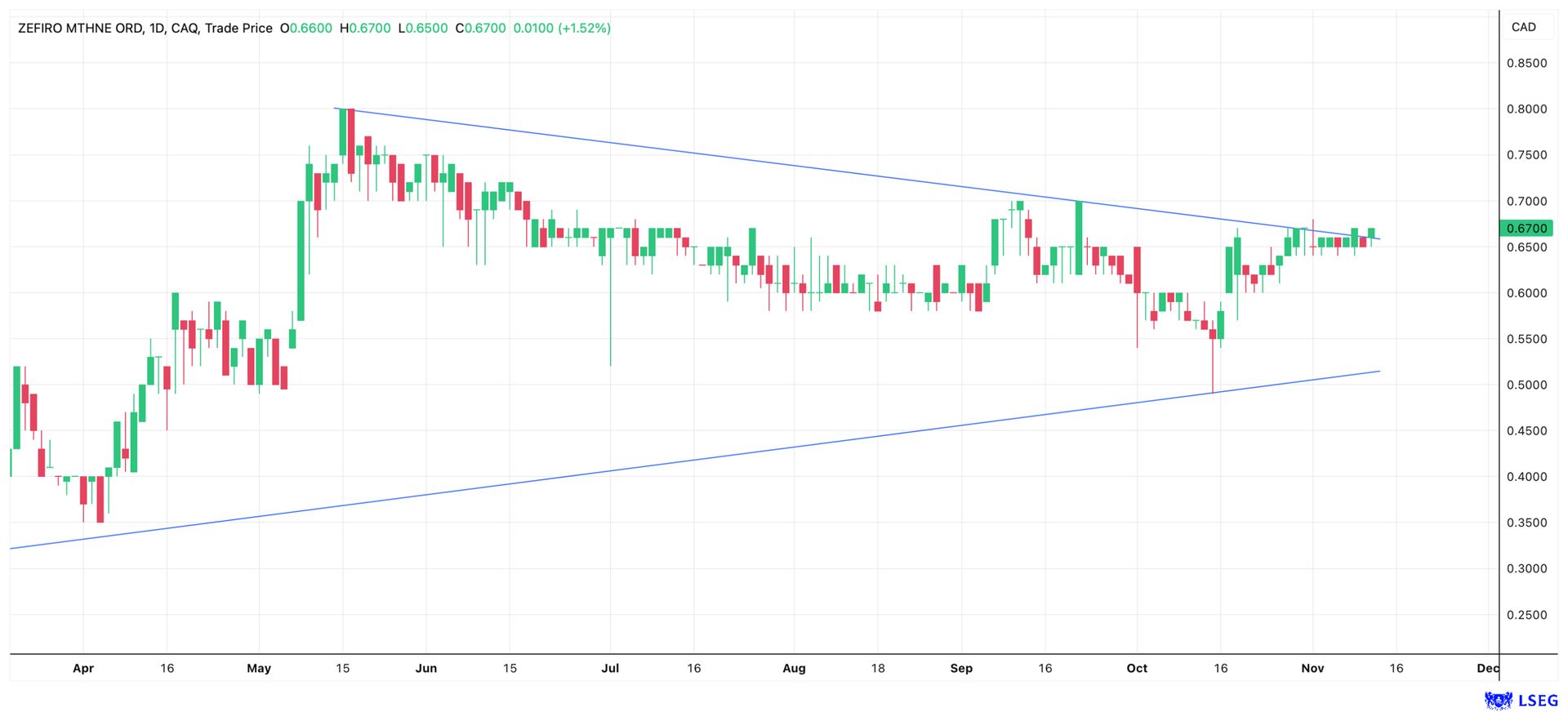
On its home exchange in Canada, Zefiro shares are currently trading at CAD 0.67; in the US at USD 0.46; and on German trading venues between EUR 0.41 and EUR 0.42. From a technical analysis perspective, the long-term uptrend that has been in place for a year remains fully intact. A doubling of the share price to CAD 0.80 between early April and mid-May was followed by a consolidation phase that has now lasted half a year. But its end is in sight. The share is currently in the process of leaving the short-term downtrend behind.
Investor Day: Experience Zefiro live!
Anyone wishing to form their own impression of this exceptional investment story will soon have the opportunity to do so. On Thursday, November 19, 2026, at 17:00 Central European Time, GBC Research and Apaton Finance invite you to the virtual Zefiro Investor Day. Over the course of an hour, Catherine Flax and Luke Plants will present the company's business model, latest developments and prospects. The subsequent Q&A session will be moderated by GBC analyst Matthias Greiffenberger. The event will take place via Zoom, and participation is free following registration. Register here:
https://us06web.zoom.us/webinar/register/WN_C1iZ6V1oRymqeOaaSVy5nQ#/registration
Investors can send questions to Markus Nellessen, Head of Investor Relations at Apaton Finance, by November 18, 2026. (m.nellessen@apaton.com)
Conflict of interest
Pursuant to §85 of the German Securities Trading Act (WpHG), we point out that Apaton Finance GmbH as well as partners, authors or employees of Apaton Finance GmbH (hereinafter referred to as "Relevant Persons") currently hold or hold shares or other financial instruments of the aforementioned companies and speculate on their price developments. In this respect, they intend to sell or acquire shares or other financial instruments of the companies (hereinafter each referred to as a "Transaction"). Transactions may thereby influence the respective price of the shares or other financial instruments of the Company.
In this respect, there is a concrete conflict of interest in the reporting on the companies.
In addition, Apaton Finance GmbH is active in the context of the preparation and publication of the reporting in paid contractual relationships.
For this reason, there is also a concrete conflict of interest.
The above information on existing conflicts of interest applies to all types and forms of publication used by Apaton Finance GmbH for publications on companies.
Risk notice
Apaton Finance GmbH offers editors, agencies and companies the opportunity to publish commentaries, interviews, summaries, news and the like on news.financial. These contents are exclusively for the information of the readers and do not represent any call to action or recommendations, neither explicitly nor implicitly they are to be understood as an assurance of possible price developments. The contents do not replace individual expert investment advice and do not constitute an offer to sell the discussed share(s) or other financial instruments, nor an invitation to buy or sell such.
The content is expressly not a financial analysis, but a journalistic or advertising text. Readers or users who make investment decisions or carry out transactions on the basis of the information provided here do so entirely at their own risk. No contractual relationship is established between Apaton Finance GmbH and its readers or the users of its offers, as our information only refers to the company and not to the investment decision of the reader or user.
The acquisition of financial instruments involves high risks, which can lead to the total loss of the invested capital. The information published by Apaton Finance GmbH and its authors is based on careful research. Nevertheless, no liability is assumed for financial losses or a content-related guarantee for the topicality, correctness, appropriateness and completeness of the content provided here. Please also note our Terms of use.