March 5th, 2026 | 10:00 CET
War, destruction, and the next oil crisis? RE Royalties' financing model as a driver of green infrastructure inspires
The global restructuring of energy supply is no longer a vision, but an economic and social necessity. Rising demand for electricity due to digitalization, electromobility, and AI infrastructure is meeting ambitious climate targets. In particular, there is enormous pressure to reduce emissions sustainably. This is precisely where it will be decided whether sufficient capital will flow into clean technologies quickly, efficiently, and scalably. Sustainable financing programs are therefore not a "nice-to-have," but a key lever for security of supply, competitiveness, and climate protection. The company RE Royalties exemplifies how capital markets and climate protection can work hand in hand. What is more, investors can reap high returns while keeping their conscience clear!
time to read: 4 minutes | Author: André Will-Laudien
ISIN: RE ROYALTIES LTD | CA75527Q1081 | TSXV: RE , OTCQX: RROYF
Table of contents:
Author

André Will-Laudien
Born in Munich, he first studied economics and graduated in business administration at the Ludwig-Maximilians-University in 1995. As he was involved with the stock market at a very early stage, he now has more than 30 years of experience in the capital markets.
Tag cloud
Shares cloud
Predictable cash flows from the energy transition – The royalty principle as a return booster
RE Royalties Ltd. operates with a financing approach that is still rare in the energy sector. The company acquires revenue-based royalty interests in renewable energy projects instead of acting as an operator itself. In doing so, it applies the royalty principle familiar from the raw materials industry to solar, wind, hydro, and storage projects. Project developers receive non-dilutive capital, while RE Royalties receives contractually fixed shares of gross revenue over decades in return. Since the remuneration is based on revenue rather than profits, the company remains largely protected from operational cost increases at the project level. Capital returns from loans are often realized within a few years, while royalty payments typically run for 20 to 25 years or longer. This model combines predictable cash flows with high scalability while reducing technological and operational risks, as only commercially established technologies are financed.
Global presence, strong pipeline – The foundation for steady growth
The portfolio now comprises more than 100 individual investments in North America, South America, and Asia. The regional focus is increasingly shifting to the US, where electricity demand is rising significantly due to digitalization and AI infrastructure. In the decentralized energy supply segment in particular, the company is positioning itself as a financing partner for developers with scalable project pipelines. At the same time, the debt structure has been optimized, among other things through the extensive redemption of previously issued green bonds. The underlying green bond framework received a top rating from S&P Global Ratings, underscoring its ESG quality.
CEO Bernard Tan explains his business strategy in an interview with IIF moderator Lyndsay Malchuk.
Fresh news flow and active portfolio management as price drivers
The latest announcement on the second financing tranche confirms the consistent implementation of the US strategy. The company emphasizes that it cooperates with high-quality developers to secure long-term cash flows. Developers also viewed the additional capital as a sign of confidence, enabling projects to move more quickly from the development to the construction phase. In addition to operational progress, the adjustment of individual existing financing arrangements, in which improved terms and additional royalty components were agreed, is also noteworthy. This active portfolio management increases the quality of earnings and demonstrates negotiating leverage. Overall, the impression is growing that RE Royalties is not only growing but also systematically optimizing its structure.
US offensive with Solaris – Scaling up in the billion-dollar market for decentralized energy
At the heart of the expansion is the partnership with Solaris Energy. Following an initial financing tranche, a further investment of USD 800,000 was announced in February 2026, bringing the total commitment in the first portfolio to USD 4.8 million. This comprises 15 decentralized solar projects in several US states, including California, Maine, and Colorado, most of which are already under construction or nearing commissioning. A second portfolio is currently in the due diligence phase; the total investment volume is expected to grow to USD 9 million. The royalty structure is designed to deliver a target return over 25 years, with additional cash flows over the remaining project term. RE Royalties is thus strategically targeting the market for commercial and industrial self-consumption solutions, which is benefiting from the rising energy demand of data-intensive applications.
Double-digit dividend meets revaluation potential
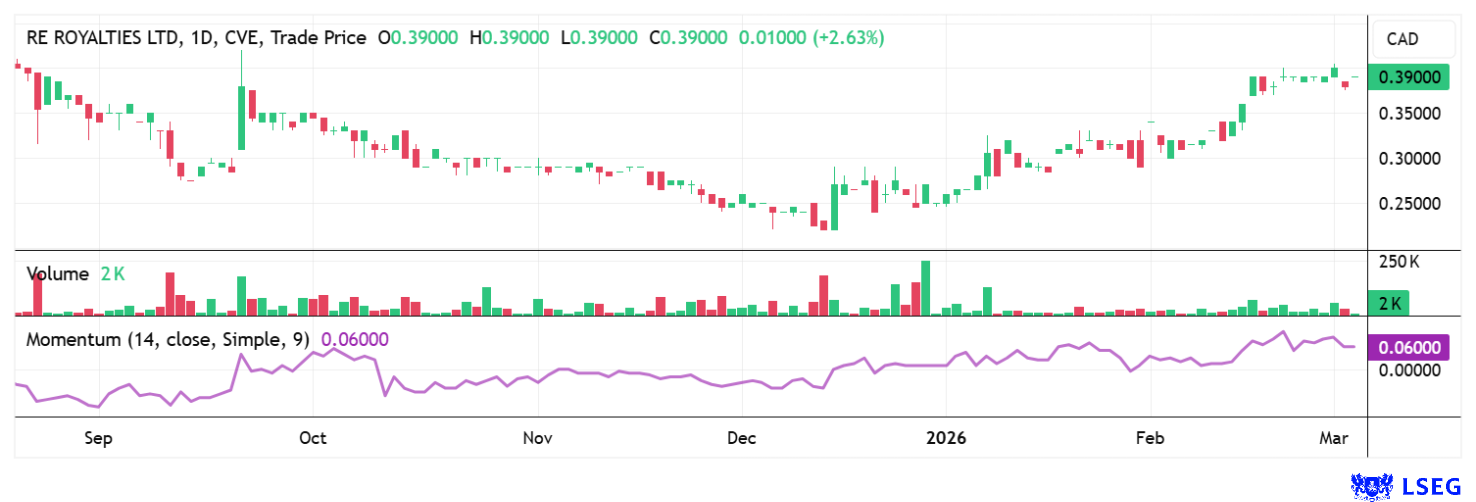
With a share price of around CAD 0.39, the market capitalization of CAD 17 million only partially reflects the growth potential. With an expected annual dividend of CAD 0.04, this results in a double-digit yield of around 10%, which is remarkable in the current interest rate environment. The attractiveness results from the combination of ongoing income and structural growth through the reinvestment of freed-up funds. Unlike traditional utilities, there is no direct operator or electricity price risk, as revenues are contractually linked to sales. At the same time, broad diversification across numerous individual projects ensures risk diversification. Should the US business continue to gain momentum, a revaluation of the stock appears plausible, especially if cash flows continue to stabilize.
Attractive source of income with a strategic future profile
This business model is refreshing and unique! RE Royalties occupies a niche between infrastructure financing and sustainable dividend strategy. The royalty model enables predictable, long-term revenues with limited operational risk. The expansion into the US market, particularly in the area of decentralized solar energy, addresses a structural boom in demand that is being reinforced by electrification and AI-driven data centers. On top of that, the business model offers a high dividend yield as an immediate income incentive, while the reinvestment model generates additional growth. Risks primarily exist in project delays or regulatory changes, but appear to be cushioned by diversification. The stock is far too cheap in the overall context, and a rapid revaluation is highly likely.
The bar is set high – but responsibility and sustainability are non-negotiables today! RE Royalties embodies a modern impact investment that combines consistent ESG standards with structural growth in the renewable energy sector. The company taps directly into the source of financing for the energy transition and makes the global sustainability trend investable. This results in predictable returns, measurable environmental impact, and a future-oriented business model that successfully combines returns and responsibility.
Conflict of interest
Pursuant to §85 of the German Securities Trading Act (WpHG), we point out that Apaton Finance GmbH as well as partners, authors or employees of Apaton Finance GmbH (hereinafter referred to as "Relevant Persons") currently hold or hold shares or other financial instruments of the aforementioned companies and speculate on their price developments. In this respect, they intend to sell or acquire shares or other financial instruments of the companies (hereinafter each referred to as a "Transaction"). Transactions may thereby influence the respective price of the shares or other financial instruments of the Company.
In this respect, there is a concrete conflict of interest in the reporting on the companies.
In addition, Apaton Finance GmbH is active in the context of the preparation and publication of the reporting in paid contractual relationships.
For this reason, there is also a concrete conflict of interest.
The above information on existing conflicts of interest applies to all types and forms of publication used by Apaton Finance GmbH for publications on companies.
Risk notice
Apaton Finance GmbH offers editors, agencies and companies the opportunity to publish commentaries, interviews, summaries, news and the like on news.financial. These contents are exclusively for the information of the readers and do not represent any call to action or recommendations, neither explicitly nor implicitly they are to be understood as an assurance of possible price developments. The contents do not replace individual expert investment advice and do not constitute an offer to sell the discussed share(s) or other financial instruments, nor an invitation to buy or sell such.
The content is expressly not a financial analysis, but a journalistic or advertising text. Readers or users who make investment decisions or carry out transactions on the basis of the information provided here do so entirely at their own risk. No contractual relationship is established between Apaton Finance GmbH and its readers or the users of its offers, as our information only refers to the company and not to the investment decision of the reader or user.
The acquisition of financial instruments involves high risks, which can lead to the total loss of the invested capital. The information published by Apaton Finance GmbH and its authors is based on careful research. Nevertheless, no liability is assumed for financial losses or a content-related guarantee for the topicality, correctness, appropriateness and completeness of the content provided here. Please also note our Terms of use.