July 1st, 2026 | 07:00 CEST
Volkswagen in Crisis, Rheinmetall Plummets: Could Volatus Aerospace Be the One to Benefit?
Drones have forever changed the face of modern warfare and are forcing nations around the globe to make drastic adjustments. Driven by the sometimes harsh lessons learned from the war in Ukraine, South Korea is now also planning a radical military reform. In the future, each of the country's 500,000 active-duty soldiers is to be trained as a drone pilot to counter the ever-growing threat from North Korea. Meanwhile, the military escalation in Europe continues to accelerate. As the Ukrainian Navy uses agile combat boats in the Black Sea to intercept Russian drones and protect the vital ports of Odesa, concerns are mounting in Moscow. Fearing Ukrainian counterstrikes, the Kremlin is tightening its defensive perimeter by deploying additional S-400 air defence systems, reportedly even on the grounds of a foundation linked to Russian President Vladimir Putin's daughter. In our latest report, we examine how the rise of unmanned weapon systems is fueling a global arms race and what it could mean for the shares of Volkswagen, Rheinmetall, and Volatus Aerospace.
time to read: 5 minutes | Author: Matthias Schomber
ISIN: VOLATUS AEROSPACE INC | CA92865M1023 | TSXV: FLT , OTCQB: TAKOF , RHEINMETALL AG | DE0007030009 , VOLKSWAGEN AG VZO O.N. | DE0007664039
Table of contents:
Author

Matthias Schomber
Raised in Giessen, Hesse, Matthias Schomber discovered his passion for the financial markets as early as the 1990s—at a time when stock trading was still largely the domain of true, die-hard traders. After completing his banking apprenticeship, he worked for a private bank there and witnessed the rise and fall of the Neuer Markt firsthand on the trading floor of the Frankfurt Stock Exchange, drawing lessons from the experience that continue to shape his thinking as a trader, author, and trading system developer to this day.
Tag cloud
Shares cloud
Volkswagen: Total Crisis, Mass Layoffs, and a Broken Alliance
The situation in Wolfsburg is coming to a dramatic head. The automaker's stock has recently taken another heavy hit, reaching its lowest level in over 10 years at around EUR 72. A major reason for the enormous uncertainty among investors is the announced end of the partnership with Bosch. Approximately EUR 1.5 billion had already been invested in the joint development of autonomous driving systems, but the results apparently fell well short of the expectations of VW subsidiary Cariad. The project is on hold for the time being, and Volkswagen must look for new ways to catch up technologically.
As if this technological setback were not enough, massive workforce cuts are on the horizon. Figures circulating in the media suggest that up to 100,000 jobs could be eliminated worldwide. This would amount to a doubling of the previous cost-cutting targets. Germany could be hit particularly hard. The plants in Hanover, Zwickau, Emden, and Neckarsulm face a medium-term threat of closure once current models are phased out. This radical cost-cutting measure is, of course, provoking immense political resistance. Lower Saxony's Minister President Olaf Lies has already taken a clear stand against plant closures. Instead, he proposes producing models developed with partners in China directly in Germany in the future. This could stabilize the low capacity utilization of domestic factories and save important jobs.
While in Wolfsburg it is primarily internal structural problems and strategic missteps that are weighing on the share price, at the defence contractor Rheinmetall, an unexpected external shock caused significantly painful losses in the share price.
Rheinmetall: Setback and Insider Purchase
For a long time, Rheinmetall's stock was considered a seemingly unstoppable investor favourite. But now the Düsseldorf-based company has suffered a major setback. The German government scrapped a firmly planned billion-euro contract for the F126 frigate program at NVL, the shipyard owned by the group. Instead, the contract for new frigates went to competitor thyssenkrupp Marine Systems. For Rheinmetall, this meant the loss of a key strategic building block for achieving decisive growth in maritime shipbuilding.
The stock market's reaction was merciless. The share plummeted sharply, temporarily losing around EUR 10 billion in market capitalization and falling below the psychologically important EUR 1,000 mark for the first time in quite a while. From a technical analysis perspective, the picture looks quite battered following this sharp decline. However, many financial experts remain remarkably calm. Although analysts at DZ Bank and Jefferies have significantly lowered their price targets to approximately EUR 1,705 and EUR 1,300, respectively, they are maintaining their "Buy" recommendations. They argue that the strong core business in ammunition, tanks, and air defence remains completely intact and that the current market reaction is excessive. However, the biggest sign of confidence came from CEO Armin Papperger himself. Following the stock's plunge, he promptly purchased more than EUR 3 million worth of the company's own shares. Such an insider investment clearly demonstrates that management continues to believe in the company's fundamental strengths and considers the reduced market value to be attractive.
Once again, it becomes clear that investors who focus exclusively on the largest, most established names need strong nerves during periods of market turbulence. Instead, it may be worth looking across the Atlantic at a small but agile company: Volatus Aerospace.
Volatus Aerospace: New Financial Resources
The Canadian aerospace company Volatus Aerospace is currently doing a lot right and is gradually expanding its market position. In recent weeks, the company has announced three major developments.
On June 4, Catherine Loubier joined the board of directors. As an official nominee of Investissement Quebec, she brings a wealth of expertise in international relations, infrastructure, and economics—knowledge that is likely to be of considerable value for the company's global expansion plans in the US and Canada.
Just one day later, on June 5, another announcement followed. Volatus Aerospace successfully completed a public financing round, raising an impressive CAD 34.5 million. The new shares were priced at CAD 0.65. This fresh capital gives management the necessary leeway to advance its long-term growth strategy. The company plans to use the funds to expand production capacity, develop new RPAS drone systems for the defence sector, and pursue strategic acquisitions.
The most recent news came on June 23. At the innovation center in Mirabel, near Montreal, Volatus officially opened a modern production facility spanning approximately 53,000 square feet. Production there is already in full swing. Initially, smart drone docking stations will be produced for commercial customers, before production of the new V-Series aircraft begins shortly thereafter. With this move, Volatus Aerospace is establishing a manufacturing base for autonomous systems in North America, which could be an enormous competitive advantage given rising global defence spending.
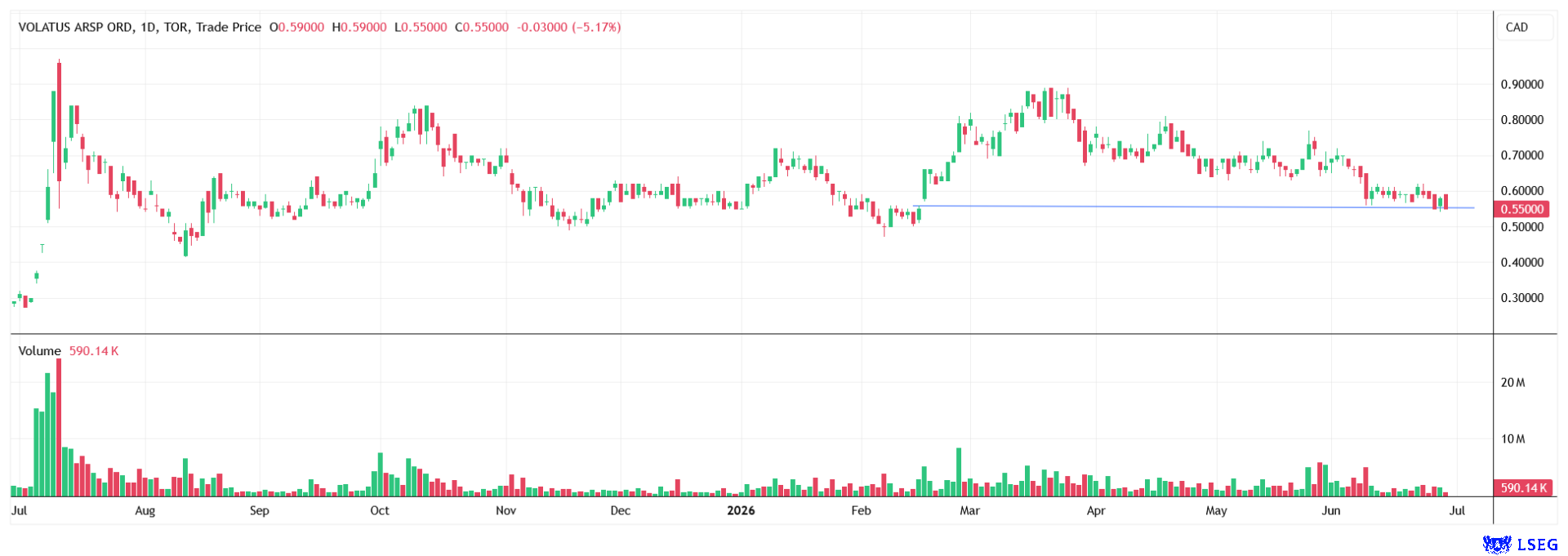
A look at the stock's share price performance also offers a slightly more optimistic outlook following a brief period of weakness. The share has recently rebounded, closing the open gap from mid-February 2026 at CAD 0.55 in an almost textbook fashion. Now this detail has also been neatly resolved on the chart. Following the successful completion of the capital placement, the stock is currently trading even below that level; it could now resume its long-term upward trend toward the psychological mark of CAD 1. Before that, however, it will likely head toward the placement price of CAD 0.65. For that to happen, though, the stock would need to break out of its current sideways range to the upside. This would be definitively confirmed if the price sustainably stays above CAD 0.70. Investors can now buy the stock at roughly a CAD 0.10 discount to the price paid by participants in the recent private placement. That appears to be an attractive entry point.
The current situation on the stock markets always calls for a cool head. Volkswagen urgently needs to overcome internal resistance and prove to the market that the drastic cost cuts are actually feasible. Although Rheinmetall has suffered a bitter short-term setback in its maritime business, its fundamentals remain very solid, supported by robust international defence demand. Below EUR 1,000, the stock appears to be a bargain. Volatus Aerospace, on the other hand, currently offers an exciting outlook. Thanks to its recent stock offering, the company is well-financed, gaining momentum operationally, and, from a technical analysis perspective, is in an interesting position following its recent consolidation. Investors looking to diversify their portfolios will find here a drone company that could continue to perform well in the coming months.
Conflict of interest
Pursuant to §85 of the German Securities Trading Act (WpHG), we point out that Apaton Finance GmbH as well as partners, authors or employees of Apaton Finance GmbH (hereinafter referred to as "Relevant Persons") may hold shares or other financial instruments of the aforementioned companies in the future or may bet on rising or falling prices and thus a conflict of interest may arise in the future. The Relevant Persons reserve the right to buy or sell shares or other financial instruments of the Company at any time (hereinafter each a "Transaction"). Transactions may, under certain circumstances, influence the respective price of the shares or other financial instruments of the Company.
In addition, Apaton Finance GmbH is active in the context of the preparation and publication of the reporting in paid contractual relationships.
For this reason, there is a concrete conflict of interest.
The above information on existing conflicts of interest applies to all types and forms of publication used by Apaton Finance GmbH for publications on companies.
Risk notice
Apaton Finance GmbH offers editors, agencies and companies the opportunity to publish commentaries, interviews, summaries, news and the like on news.financial. These contents are exclusively for the information of the readers and do not represent any call to action or recommendations, neither explicitly nor implicitly they are to be understood as an assurance of possible price developments. The contents do not replace individual expert investment advice and do not constitute an offer to sell the discussed share(s) or other financial instruments, nor an invitation to buy or sell such.
The content is expressly not a financial analysis, but a journalistic or advertising text. Readers or users who make investment decisions or carry out transactions on the basis of the information provided here do so entirely at their own risk. No contractual relationship is established between Apaton Finance GmbH and its readers or the users of its offers, as our information only refers to the company and not to the investment decision of the reader or user.
The acquisition of financial instruments involves high risks, which can lead to the total loss of the invested capital. The information published by Apaton Finance GmbH and its authors is based on careful research. Nevertheless, no liability is assumed for financial losses or a content-related guarantee for the topicality, correctness, appropriateness and completeness of the content provided here. Please also note our Terms of use.