August 12th, 2026 | 07:25 CEST
Dividend Yield or Growth Potential? The Opportunities Offered by Bayer, BASF, and Volatus Aerospace
The war in Ukraine remains a source of uncertainty that continues to weigh on global markets. Russia and Ukraine are continuing their attacks on infrastructure and industrial facilities, while diplomatic solutions are still nowhere in sight. For investors, this means that energy prices, commodity markets, and security-related sectors remain vulnerable to sudden news developments. In particular, defence and aerospace stocks, as well as companies focused on autonomous and security-related technologies, including drones, stand to benefit from rising defence budgets and the growing need for technological independence. Investors entering the market at this time should therefore consider this underlying geopolitical tension as a permanent factor in their risk assessment. Against this backdrop, we take a closer look at Bayer, BASF, and Volatus today.
time to read: 5 minutes | Author: Matthias Schomber
ISIN: VOLATUS AEROSPACE INC | CA92865M1023 | TSXV: FLT , OTCQB: TAKOF , BASF SE NA O.N. | DE000BASF111
Table of contents:
Author

Matthias Schomber
Raised in Giessen, Hesse, Matthias Schomber discovered his passion for the financial markets as early as the 1990s—at a time when stock trading was still largely the domain of true, die-hard traders. After completing his banking apprenticeship, he worked for a private bank there and witnessed the rise and fall of the Neuer Markt firsthand on the trading floor of the Frankfurt Stock Exchange, drawing lessons from the experience that continue to shape his thinking as a trader, author, and trading system developer to this day.
Tag cloud
Shares cloud
Bayer AG: Operational Recovery and Persistent Legal Risks
Bayer remains in the midst of a challenging transformation process. The Leverkusen-based pharmaceutical and agricultural conglomerate is torn. On the one hand, the ongoing legal disputes surrounding the weed killer glyphosate in the US are still weighing on its balance sheet and investor confidence—in some cases quite significantly—even though the situation has recently improved and hope for better times has clearly returned. On the other hand, price pressure in the agricultural segment is dampening expectations for free cash flow. Despite these headwinds, the second quarter showed that the operating units are performing well. In some areas, the results even exceeded the market's rather conservative estimates.
On the stock market, the share is currently trading in the range of around EUR 49. Some analyst firms see the fair value of the stock returning above the EUR 55.00 mark in the medium term. Whether this optimism prevails depends largely on how quickly management can work through the remaining legacy issues and how sustainable the margin in the pharmaceutical business remains. Nevertheless, in the longer term, and partly due to the strong momentum, the share price could surge toward EUR 60.
BASF SE: Restructuring and Low Water
While Bayer is primarily addressing legacy legal issues, BASF, Germany's second-longest-established conglomerate, is taking a noticeably tougher stance on corporate restructuring. The Ludwigshafen-based chemical giant is currently trading at around EUR 51.50, putting it within striking distance of its 52-week high of around EUR 55. Operationally, the company delivered a positive surprise in the second quarter. Revenue climbed 16% to EUR 17.2 billion. EBITDA before special items rose to a substantial EUR 2.4 billion, prompting the Executive Board to raise its full-year forecast. This supported the share price and even helped it rise further.
In addition, a new share buyback program with a volume of EUR 1 billion was launched in August. In the first week of August alone, 545,000 shares were repurchased, further supporting the share price and providing additional downside protection.
BASF is also receiving a boost from the US Food and Drug Administration (FDA), which has approved the innovative UV filter Tinosorb S. This opens up a lucrative segment for BASF in the US market for sunscreen products. However, there is also a minor issue, though it appears to be well managed—at least as far as low water levels are concerned. The historically low water level of the Rhine at Kaub—below 20 cm—is threatening the supply of raw materials to the main plant in Ludwigshafen and driving up transportation costs.
The company is now increasingly relying on rail and truck transport. So far, this seems to be working quite well. Adding to these problems are an environmental lawsuit in Rouen, France, over PFAS discharges, as well as the closure of Care Chemicals facilities in Dahej, India.
To secure the targeted return on equity of 10% by 2028, the Executive Board is implementing drastic cuts to the workforce. Regarding job cuts at the headquarters, management openly refers to using an "axe" rather than "pruning shears," which creates a mixed operational picture between impressive quarterly figures and internal tensions. Nevertheless, this should be well received by investors, as cost-cutting measures are viewed as a sign of success in their eyes.
If the stock manages to break above the EUR 55 threshold, the price could, based on technical analysis, quickly gain momentum toward EUR 65–70.
Volatus Aerospace: Drones for Defence and Other Applications
The Canadian company Volatus Aerospace has established itself as a specialist in unmanned aerial systems, autonomous sensor technology, and defence solutions.
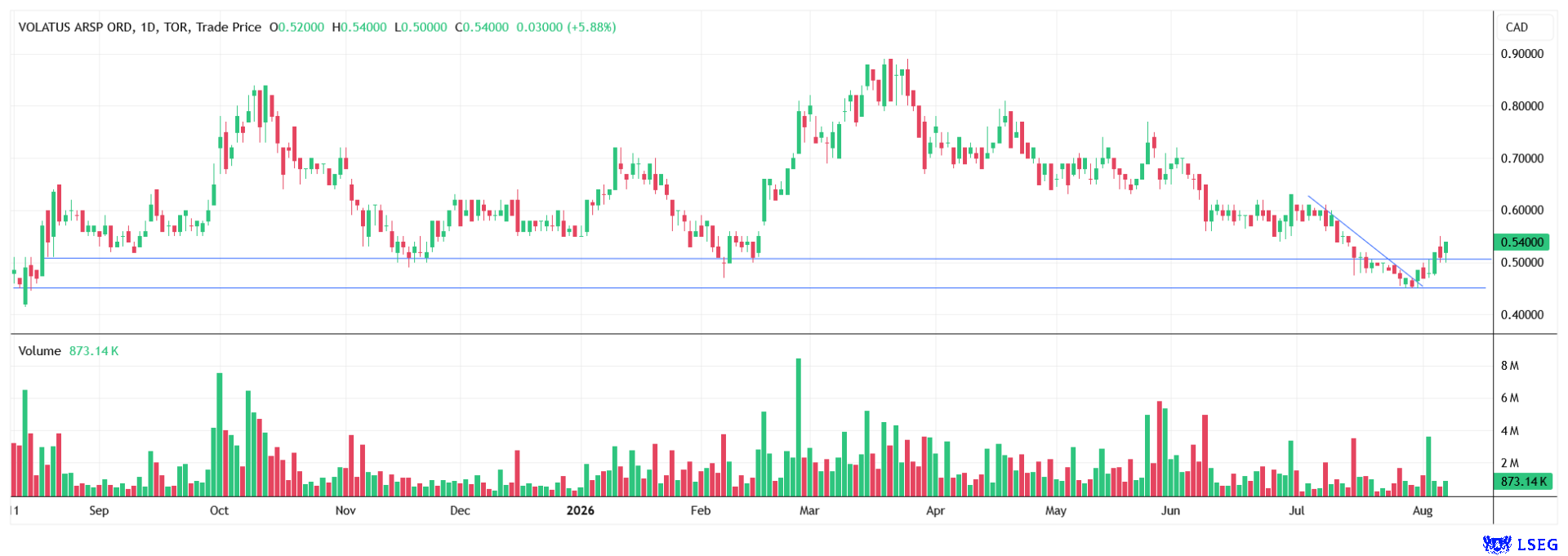
Following a somewhat prolonged correction phase after its spectacular rise in 2025 from below CAD 0.30 to just under CAD 1, the share is currently trading at around CAD 0.54 on the Toronto Stock Exchange. From a technical analysis perspective, the share has broken above its short-term downtrend and has managed to sustainably climb back above the key support zone of CAD 0.50 to 0.51.
The stock now needs to form a stable consolidation and a solid floor above this level. If it succeeds, the path will open up for a recovery toward the zone between CAD 0.60 and CAD 0.70. However, as long as the share price does not dynamically break above this range, this remains, for the time being, a classic rebound attempt. A sustained breakout from the months-long consolidation phase would only be complete with a return above the CAD 0.75 mark. But given the current global political situation and ongoing conflicts, drones are a key topic for the future, and this could provide the stock with the sustained momentum it needs to climb further.
Strategic Milestones Drive Growth
On the operational front, the company is underpinning its ambitious goals with a series of strategic moves made in recent weeks. It all began on July 21 with a partnership with Concordia University's Volt-Age research program. The goal of this agreement is to develop cutting-edge energy technologies for unmanned aerial systems. In doing so, Volatus is strengthening the domestic supply chain and advancing Canada's technological sovereignty in strategic drone components.
Shortly thereafter, two groundbreaking agreements in the fields of disaster response and defence followed. On August 4, Volatus announced a partnership with Singular Aircraft. Together, they plan to bring the heavy autonomous utility aircraft FlyOx 1 to Canada. With a maximum takeoff weight of approximately 4,000 kg and a payload capacity of 1,560 litres of water or fire retardant, this specialized amphibious aircraft opens up entirely new dimensions in wildfire suppression.
Further news followed on August 5 with the agreement with Kraus Hamdani Aerospace. Volatus has thereby secured exclusive rights as the Canadian partner for the ultra-long-range electric drone K1000ULE and the highly resilient ATNE++ communications network. The K1000ULE has already logged over 6,000 flight hours in military operations and boasts uninterrupted flight times of more than 75 hours. Domestic production is set to be gradually ramped up at the Mirabel manufacturing site in Quebec, Canada.
As a result, Volatus will cover a comprehensive spectrum of applications in the future, ranging from early fire detection and rescue coordination to Arctic surveillance and defence.
Conclusion: Where Are the Opportunities?
Bayer remains an investment for patient investors who are banking on a final resolution of the legal risks. BASF stands out with strong operating figures and a shareholder-friendly dividend, but must overcome logistical risks along the Rhine and ensure acceptance of tough cost-cutting measures. Volatus Aerospace, on the other hand, presents itself as an attractive growth stock in the future market of unmanned aviation. Recent partnerships underscore the company's technological clout and its focus on profitable niches in the defence and security sectors. If the share manages to establish a solid floor at its current level of CAD 0.54, it offers promising prospects for risk-conscious investors.**
Conflict of interest
Pursuant to §85 of the German Securities Trading Act (WpHG), we point out that Apaton Finance GmbH as well as partners, authors or employees of Apaton Finance GmbH (hereinafter referred to as "Relevant Persons") may hold shares or other financial instruments of the aforementioned companies in the future or may bet on rising or falling prices and thus a conflict of interest may arise in the future. The Relevant Persons reserve the right to buy or sell shares or other financial instruments of the Company at any time (hereinafter each a "Transaction"). Transactions may, under certain circumstances, influence the respective price of the shares or other financial instruments of the Company.
In addition, Apaton Finance GmbH is active in the context of the preparation and publication of the reporting in paid contractual relationships.
For this reason, there is a concrete conflict of interest.
The above information on existing conflicts of interest applies to all types and forms of publication used by Apaton Finance GmbH for publications on companies.
Risk notice
Apaton Finance GmbH offers editors, agencies and companies the opportunity to publish commentaries, interviews, summaries, news and the like on news.financial. These contents are exclusively for the information of the readers and do not represent any call to action or recommendations, neither explicitly nor implicitly they are to be understood as an assurance of possible price developments. The contents do not replace individual expert investment advice and do not constitute an offer to sell the discussed share(s) or other financial instruments, nor an invitation to buy or sell such.
The content is expressly not a financial analysis, but a journalistic or advertising text. Readers or users who make investment decisions or carry out transactions on the basis of the information provided here do so entirely at their own risk. No contractual relationship is established between Apaton Finance GmbH and its readers or the users of its offers, as our information only refers to the company and not to the investment decision of the reader or user.
The acquisition of financial instruments involves high risks, which can lead to the total loss of the invested capital. The information published by Apaton Finance GmbH and its authors is based on careful research. Nevertheless, no liability is assumed for financial losses or a content-related guarantee for the topicality, correctness, appropriateness and completeness of the content provided here. Please also note our Terms of use.