March 3rd, 2026 | 07:05 CET
Volatus Aerospace takes off: From drone service provider to defensive software house
Sometimes timing is everything. For years, Canada's Volatus Aerospace has been quietly building a business that goes far beyond selling drones. Now that governments around the world are redefining security and Canada is massively redirecting its defense spending toward domestic high-tech solutions, the company suddenly finds itself among the winners. The launch of its own software platform, SKYDRA™, is the latest evidence of a smart evolution. Volatus is transforming itself from an operational service provider for inspections into a tech company with recurring revenues, and at just the right moment.
time to read: 4 minutes | Author: Armin Schulz
ISIN: VOLATUS AEROSPACE INC | CA92865M1023 | TSXV: FLT , OTCQB: TAKOF
Table of contents:
Author

Armin Schulz
Born in Mönchengladbach, he studied business administration in the Netherlands. In the course of his studies he came into contact with the stock exchange for the first time. He has more than 25 years of experience in stock market business.
Tag cloud
Shares cloud
New business area
One does not need to follow Volatus Aerospace for long to see that management is building the company strategically. For years, Volatus has been accumulating flight hours, securing coveted approvals for beyond visual line of sight (BVLOS) flights, and integrating acquisitions into a coherent whole. At its heart is a central operations control center in Toronto, from which drone missions are controlled for pipeline operators, energy suppliers, and now also defense customers.
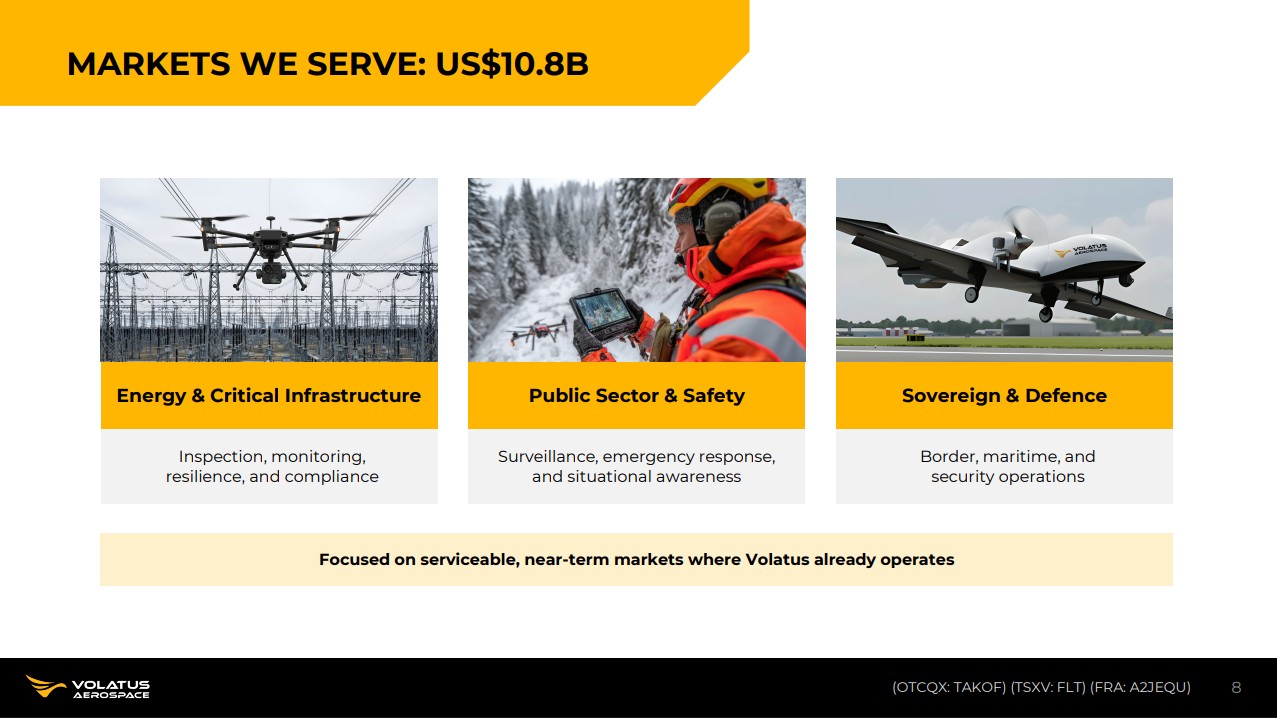
But the announcement on March 2 marks a turning point. With SKYDRA™, Volatus is launching its first proprietary Software-as-a-Service platform. It is all about defending against enemy drones, known as counter-UAS. In a world where attacks on critical infrastructure using small, cheap drones are part of everyday life, this is no longer a niche issue. The current conflicts in the Middle East have impressively demonstrated how powerful drones can be in asymmetric conflicts. No wonder, then, that demand for defense systems is exploding. Industry insiders expect the market to exceed CAD 20 billion by 2030.
SKYDRA™ is a digital twin for planning and simulating defense operations. Authorities or airport operators can practice how they would respond to a drone threat in a secure, virtual environment before purchasing expensive hardware or sending personnel into the field. "The global threat landscape related to unmanned systems is constantly evolving," explains CEO Glen Lynch. "SKYDRA™ represents an important milestone for Volatus as our first SaaS platform, creating a recurring software revenue stream within our defense strategy."
The economics of SKYDRA™
For investors, the model behind SKYDRA™ is almost more exciting than the product itself. Expected gross margins are between 80 and 85%, which is a completely different caliber than the hardware business. Each additional customer incurs negligible costs, and the economies of scale are enormous.
The goal is to secure multi-year subscriptions in the low six-figure range per year for individual government agencies or operators of critical infrastructure. With an expected customer lifetime of 3-5 years, this results in a customer value in the high six- to low seven-figure range.
The target group is broad, ranging from armed forces to airports, ports, and energy facilities. Geographically, the initial focus is on Canada, NATO partners, and the Middle East. The Gulf states, in particular, are likely to be fertile ground with their high density of critical infrastructure.
In the longer term, EBITDA margins of 30-45% are expected for such defense SaaS platforms. Even if SKYDRA™ initially contributes only a small portion of total revenue, the increasing mix with software will boost the Group's overall profit profile.
Canada's new rules of the game: 70% for the home country
What is further fueling SKYDRA™ and the entire Volatus strategy is a fundamental policy change in Ottawa. The Canadian government has rewritten the rules of the game with its new defense industry strategy. In the future, 70% of procurement spending will go to Canadian companies, rather than three-quarters going abroad. This is backed by a budget of around CAD 82 billion for the modernization of the armed forces.
The government has explicitly declared unmanned and autonomous systems to be one of ten "core sovereign capabilities." Drones and the associated software should be developed, produced, and controlled in the country as far as possible. For Volatus, which is ramping up production in Mirabel and holds its own patents, this is a game-changer.
Anyone who wants to win contracts in the drone sector in Canada must demonstrate domestic value creation, control over intellectual property, and an existing infrastructure. Volatus can demonstrate all of this, from BVLOS approval to its own production facility.
The foundation counts
The strategy is not based on thin air. In December, Volatus secured a CAD 9 million contract for a training system for a NATO partner, followed by another training contract in February. At the same time, Krish Srinivasan, who previously managed EU-funded defense programs worth EUR 40 million, was appointed as the new Chief Technology Officer.
Added to this is the announcement of the company's listing on the Toronto Stock Exchange. *"Conditional approval for listing on the Toronto Stock Exchange is an important milestone for Volatus* and reflects the size and discipline of the aerospace platform we have built," said Lynch. The move is a clear signal to institutional investors.
Figures that inspire confidence
In the third quarter of 2025, revenue climbed 60% to CAD 10.6 million. The operating loss was reduced from around CAD 3 million to less than CAD 500,000. At the end of the year, Volatus had approximately CAD 40 million in cash. According to research by Maxim Group, the order pipeline is bulging with the equivalent of over CAD 600 million. If Ottawa now brings its 70% target to life, Volatus is likely to be one of the first Canadian champions in the field of autonomous systems to benefit disproportionately.
This view is shared by four analysts, who have issued price targets between CAD 0.80 and CAD 1.25. The share is currently trading at CAD 0.78.

Volatus Aerospace is not a quick fix, but the result of years of consistent development. The company stands at the intersection of three megatrends: the automation of the economy, the rising demand for security, and the return to national technological sovereignty. With SKYDRA™, the company now offers its own software for the first time, which can improve its margin profile and deepen customer loyalty. For investors seeking a defensively positioned tech stock with real revenues and a clear growth outlook, this represents one of the most exciting opportunities in the Canadian market.
Conflict of interest
Pursuant to §85 of the German Securities Trading Act (WpHG), we point out that Apaton Finance GmbH as well as partners, authors or employees of Apaton Finance GmbH (hereinafter referred to as "Relevant Persons") currently hold or hold shares or other financial instruments of the aforementioned companies and speculate on their price developments. In this respect, they intend to sell or acquire shares or other financial instruments of the companies (hereinafter each referred to as a "Transaction"). Transactions may thereby influence the respective price of the shares or other financial instruments of the Company.
In this respect, there is a concrete conflict of interest in the reporting on the companies.
In addition, Apaton Finance GmbH is active in the context of the preparation and publication of the reporting in paid contractual relationships.
For this reason, there is also a concrete conflict of interest.
The above information on existing conflicts of interest applies to all types and forms of publication used by Apaton Finance GmbH for publications on companies.
Risk notice
Apaton Finance GmbH offers editors, agencies and companies the opportunity to publish commentaries, interviews, summaries, news and the like on news.financial. These contents are exclusively for the information of the readers and do not represent any call to action or recommendations, neither explicitly nor implicitly they are to be understood as an assurance of possible price developments. The contents do not replace individual expert investment advice and do not constitute an offer to sell the discussed share(s) or other financial instruments, nor an invitation to buy or sell such.
The content is expressly not a financial analysis, but a journalistic or advertising text. Readers or users who make investment decisions or carry out transactions on the basis of the information provided here do so entirely at their own risk. No contractual relationship is established between Apaton Finance GmbH and its readers or the users of its offers, as our information only refers to the company and not to the investment decision of the reader or user.
The acquisition of financial instruments involves high risks, which can lead to the total loss of the invested capital. The information published by Apaton Finance GmbH and its authors is based on careful research. Nevertheless, no liability is assumed for financial losses or a content-related guarantee for the topicality, correctness, appropriateness and completeness of the content provided here. Please also note our Terms of use.