January 28th, 2026 | 07:05 CET
The next major battery story is not being written in China – it is being led by the TSMC clone, NEO Battery Materials
The tech revolution has a blind spot. While billions are being poured into the development of AI, advanced robotics, and autonomous systems, one fundamental problem often remains unresolved: energy storage. The performance of these high-tech devices is determined by their weakest component - and increasingly that component is the battery. China dominates the mass market, but a critical gap is emerging: namely, demand for flexible, high-performance, non-Chinese battery solutions. This is precisely the vacuum NEO Battery Materials is stepping into with an approach that mirrors the semiconductor industry.
time to read: 4 minutes | Author: Armin Schulz
ISIN: NEO BATTERY MATERIALS LTD | CA62908A1003
Table of contents:
Author

Armin Schulz
Born in Mönchengladbach, he studied business administration in the Netherlands. In the course of his studies he came into contact with the stock exchange for the first time. He has more than 25 years of experience in stock market business.
Tag cloud
Shares cloud
Same approach as TSMC
Imagine if Apple or NVIDIA had to not only design their own chips, but also manufacture them themselves. The costs would be astronomical, the complexity unaffordable. Instead, they rely on specialists such as TSMC, who, as pure manufacturing service providers ("foundries"), transform their customers' blueprints into high-precision silicon wafers. This division of labor has revolutionized the tech world.
Now NEO Battery Materials is applying this proven model to the battery market, which is crying out for it. The parallels are striking. Major automotive, electronics, and drone manufacturers need customized batteries for their specialized applications. But setting up their own cell production is a billion-dollar undertaking with high technical risk. The alternative, purchasing standard cells from mass production, around 80% of which currently come from China, often means painful compromises in terms of performance, form factor, and supply chain sovereignty.
The "Battery Foundry" model: Flexibility instead of mass production
NEO Battery Materials sees itself as precisely this specialized manufacturing partner. The Company positions itself as a "one-stop shop" – from material development and electrode production to the assembly of finished cells. In a way, the model is similar to that of TSMC in the semiconductor industry. NEO Battery produces batteries according to customer designs, relieving them of the need for high investments in their own manufacturing capacities.
This service is meeting with a perfect geopolitical and industrial storm. The "onshoring" or "friendshoring" of critical supply chains has become a strategic priority for Western governments and manufacturers. Support programs, such as the US infrastructure bill with billions of dollars for autonomous systems, are further accelerating this development. Manufacturers, especially in the sensitive defense and high-tech sectors, are actively seeking reliable partners outside the dominant Chinese supply chain.
The proprietary advantage: A cost-effective silicon revolution
A pure manufacturing service would be easy to copy in the long term. NEO Battery's real and sustainable performance lever lies in its own material innovation. The Company relies on silicon as an additive material in the battery anode, which partially replaces conventional graphite. In theory, silicon can increase capacity ninefold and enable ultra-fast charging. The well-known problem is that silicon expands significantly during charging, leading to premature wear.
Here, NEO Battery Materials has gained a decisive advantage with a new approach. Instead of expensive nano-silicon particles or hazardous gases, the Company relies on cost-effective metal silicon and a special wet grinding process. The promised result is a significant cost reduction of more than 60% compared to other silicon anodes on the market, while maintaining high capacity. It is this combination of dramatically improved performance and superior cost-effectiveness that is attracting the interest of industry.
From concept to competitiveness: The leap into production
Without its own production capacities, the promising model and innovative technology would be just another laboratory story. NEO Battery recently took the decisive step towards commercialization by leasing a ready-to-operate electrode manufacturing facility in South Korea. This facility serves as the basis for fulfilling initial customer orders and is a strategically wise choice. It avoids years of construction time and commissioning risks and enables the Company to become operational immediately.
Existing customer demand validates the entire concept. The Company has multi-year purchase agreements totaling approximately CAD 10 million from Asian drone and robotics manufacturers. These customers were explicitly looking for alternatives to standard Chinese batteries that did not meet their performance requirements. In addition, there are two orders from Fortune 500 automotive companies in North America and Asia. In the latter case, NEO Batteries was awarded the status of a certified OEM or supplier partner, which shows that the solutions are being accepted by customers.
An adjacent site also offers space for expansion to complete cell production. In order to make rapid progress here on the way to becoming a full-range supplier of cylindrical and prismatic cells, a private placement of CAD 7 million was recently completed.
The strategic map: Niches as a springboard to the mass market
The current focus on high-performance niches is a smart move. Instead of initially rushing into the highly competitive mass market for electric vehicles, NEO Battery is addressing applications with acute and willing-to-pay performance requirements: drones, robotics, portable energy storage for AI systems, and special electronics. These markets are less price-sensitive, but urgently need better energy densities and shorter charging times to fully exploit their potential.
This is where the long-term opportunity lies. These niches serve as an ideal testing ground to validate the technology, perfect manufacturing processes, and achieve profitable economies of scale. The long-term goal is clear: To establish scaled production outside China in order to serve as a secure, high-performance partner for Western electronics manufacturers. The Company is thus positioning itself at the intersection of several megatrends, such as advancing electrification, the AI revolution, and the geopolitical realignment of global supply chains.
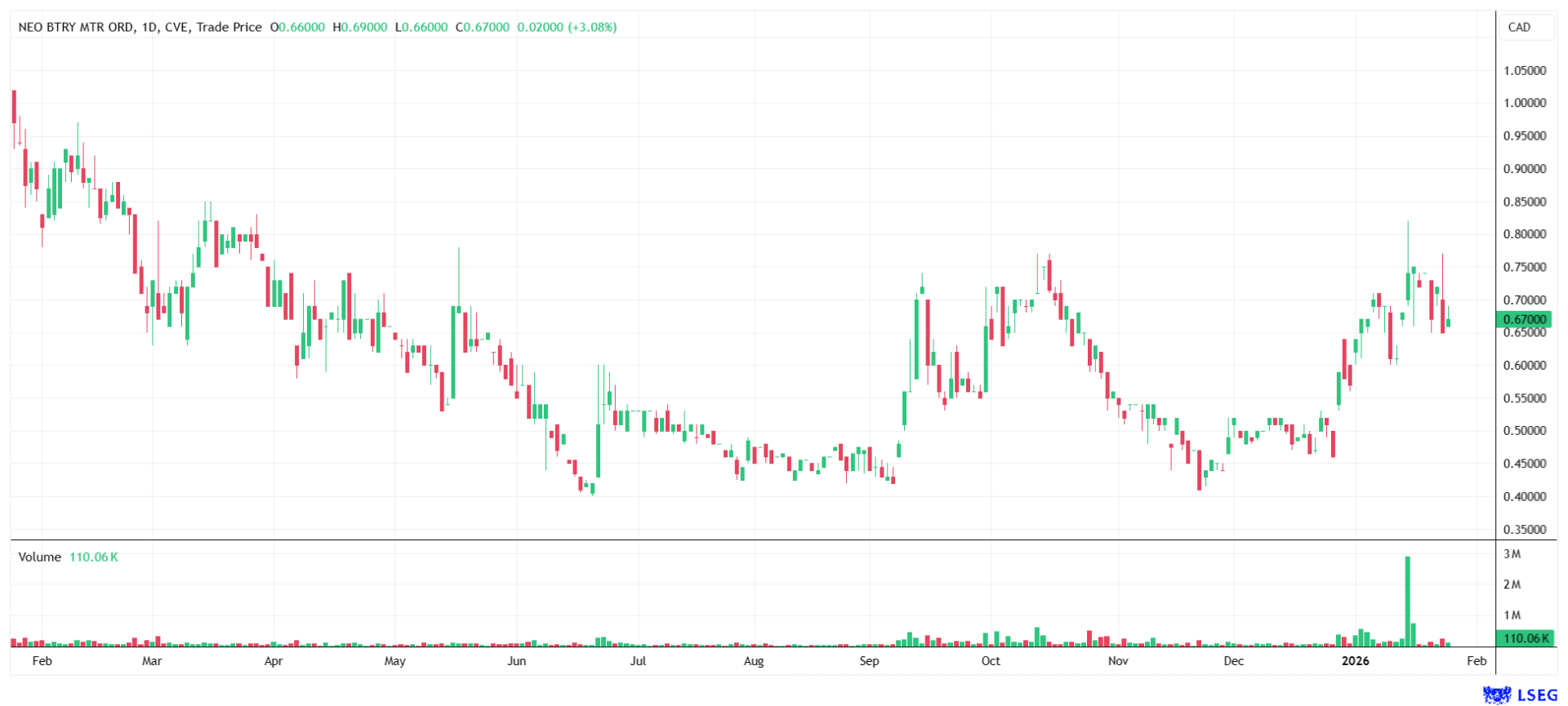
Thanks to the good news and geopolitical tailwinds, the stock has gained significantly since the beginning of the year and is currently trading at CAD 0.67.
NEO Battery Materials combines a clever business model inspired by the semiconductor industry with a proprietary and cost-effective material innovation. It addresses not only a clear technological bottleneck, but also an acute geopolitical need for diversified supply chains. Whether the Company can fully exploit the potential of its "battery foundry" remains to be seen in reliable series production. The strategic conditions and timing could hardly be more favorable. For investors interested in the fundamentals of the tech future, this offers a remarkably concrete story.
Conflict of interest
Pursuant to §85 of the German Securities Trading Act (WpHG), we point out that Apaton Finance GmbH as well as partners, authors or employees of Apaton Finance GmbH (hereinafter referred to as "Relevant Persons") currently hold or hold shares or other financial instruments of the aforementioned companies and speculate on their price developments. In this respect, they intend to sell or acquire shares or other financial instruments of the companies (hereinafter each referred to as a "Transaction"). Transactions may thereby influence the respective price of the shares or other financial instruments of the Company.
In this respect, there is a concrete conflict of interest in the reporting on the companies.
In addition, Apaton Finance GmbH is active in the context of the preparation and publication of the reporting in paid contractual relationships.
For this reason, there is also a concrete conflict of interest.
The above information on existing conflicts of interest applies to all types and forms of publication used by Apaton Finance GmbH for publications on companies.
Risk notice
Apaton Finance GmbH offers editors, agencies and companies the opportunity to publish commentaries, interviews, summaries, news and the like on news.financial. These contents are exclusively for the information of the readers and do not represent any call to action or recommendations, neither explicitly nor implicitly they are to be understood as an assurance of possible price developments. The contents do not replace individual expert investment advice and do not constitute an offer to sell the discussed share(s) or other financial instruments, nor an invitation to buy or sell such.
The content is expressly not a financial analysis, but a journalistic or advertising text. Readers or users who make investment decisions or carry out transactions on the basis of the information provided here do so entirely at their own risk. No contractual relationship is established between Apaton Finance GmbH and its readers or the users of its offers, as our information only refers to the company and not to the investment decision of the reader or user.
The acquisition of financial instruments involves high risks, which can lead to the total loss of the invested capital. The information published by Apaton Finance GmbH and its authors is based on careful research. Nevertheless, no liability is assumed for financial losses or a content-related guarantee for the topicality, correctness, appropriateness and completeness of the content provided here. Please also note our Terms of use.