March 6th, 2026 | 07:25 CET
"Security energies" – how to invest: RWE, Iberdrola, and RE Royalties as stable sources of returns
The energy debate has been conducted differently for some time now than it was in the 2010s. While decarbonization was long considered an ecological necessity, it has now become a question of national sovereignty under the banner of "security energies." This new perspective is being fueled by current geopolitical upheavals and the de facto blockade of the Strait of Hormuz, which once again reveals the fragility of our supply chains. With around 20% of global oil consumption passing through this bottleneck, prices for crude oil and liquefied gas have already risen significantly. In this context, German Federal Environment Minister Carsten Schneider coined the term "security energies" to emphasize the decentralized nature of renewable energy as a shield against exogenous shocks. Renewable energy projects are not subject to the logic of geopolitical conflicts and also generate added value in the region, as a wind farm, for example, can generate annual revenues of around EUR 200,000 for a municipality. Renewable energy can also become a safety anchor for investors thanks to stable cash flows.
time to read: 3 minutes | Author: Nico Popp
ISIN: RWE AG INH O.N. | DE0007037129 , IBERDROLA INH. EO -_75 | ES0144580Y14 , RE ROYALTIES LTD | CA75527Q1081 | TSXV: RE , OTCQX: RROYF
Table of contents:
Author

Nico Popp
At home in Southern Germany, the passionate stock exchange expert has been accompanying the capital markets for about twenty years. With a soft spot for smaller companies, he is constantly on the lookout for exciting investment stories.
Tag cloud
Shares cloud
RWE is driving forward the expansion of green capacity
The major energy suppliers form the backbone of this development. RWE has largely completed its transformation from a coal-based utility to a leading player in the field of renewable energy. The company now operates a portfolio of 38.7 GW of green generation capacity, which is being supplemented by a pipeline of a further 11.4 GW under construction. The performance of this portfolio was evident in the first three quarters of 2025, when RWE achieved adjusted EBITDA of EUR 3.5 billion. Onshore wind and solar in particular recorded strong growth to EUR 1.242 billion. To meet the rising demand for electricity from AI, RWE is also positioning itself as a direct partner to technology companies, as evidenced by the lucrative sale of a data center project in the UK for EUR 225 million. The Group plans to make net investments of EUR 35 billion between 2025 and 2030, with a focus on expanding offshore wind power in the North Sea. This strategy is flanked by the early phase-out of coal by 2030, which offers investors the prospect of growing earnings per share of EUR 4 in 2030 and rising dividends.
Iberdrola delivers stability through smart grids
Spanish energy heavyweight Iberdrola complements this approach with a clear focus on expanding smart power grids. With a valuation of over EUR 125 billion, the group has established itself as the world's second-largest utility company. The foundation of its business model lies in its regulated network business, which contributes around 30% of net profit and around 40% of EBITDA. Pure energy production secures the remaining revenues, with over 85% of production fixed through long-term contracts, protecting the company from price fluctuations on the spot market. In an environment of rising interest rates and geopolitical instability, these government-guaranteed investments, together with long-term power purchase agreements, provide a high degree of financial predictability for investors.
Under the leadership of Ignacio Galán, Iberdrola has increased its investment budget for the period up to 2028 to EUR 58 billion. Of this, EUR 37 billion will go directly toward the digitalization and expansion of the electricity grids in the US and the UK. The goal is to increase the regulated asset base to EUR 70 billion and guarantee investors a reliable dividend – the dividend yield is currently over 4%.
RE Royalties as an energy transition financier and dividend payer
Those who want to fully exploit the strengths of renewable energy projects far away from the major utilities are turning to the RE Royalties model. The Canadian company acts as a specialist financier of the energy transition and has successfully transferred the royalty model familiar from the mining industry to green technologies. Instead of operating its own plants or bearing the operational risks of maintenance and decommissioning, RE Royalties provides capital to project developers. In return, the company secures a percentage share of the gross revenues of the respective energy projects. The portfolio now includes licenses for over 100 projects worldwide, ranging from large-scale solar plants and onshore wind farms to battery storage facilities. This model allows investors to participate in the cash flows of a large number of plants without direct operational risks, while largely avoiding dilution of existing shareholders.
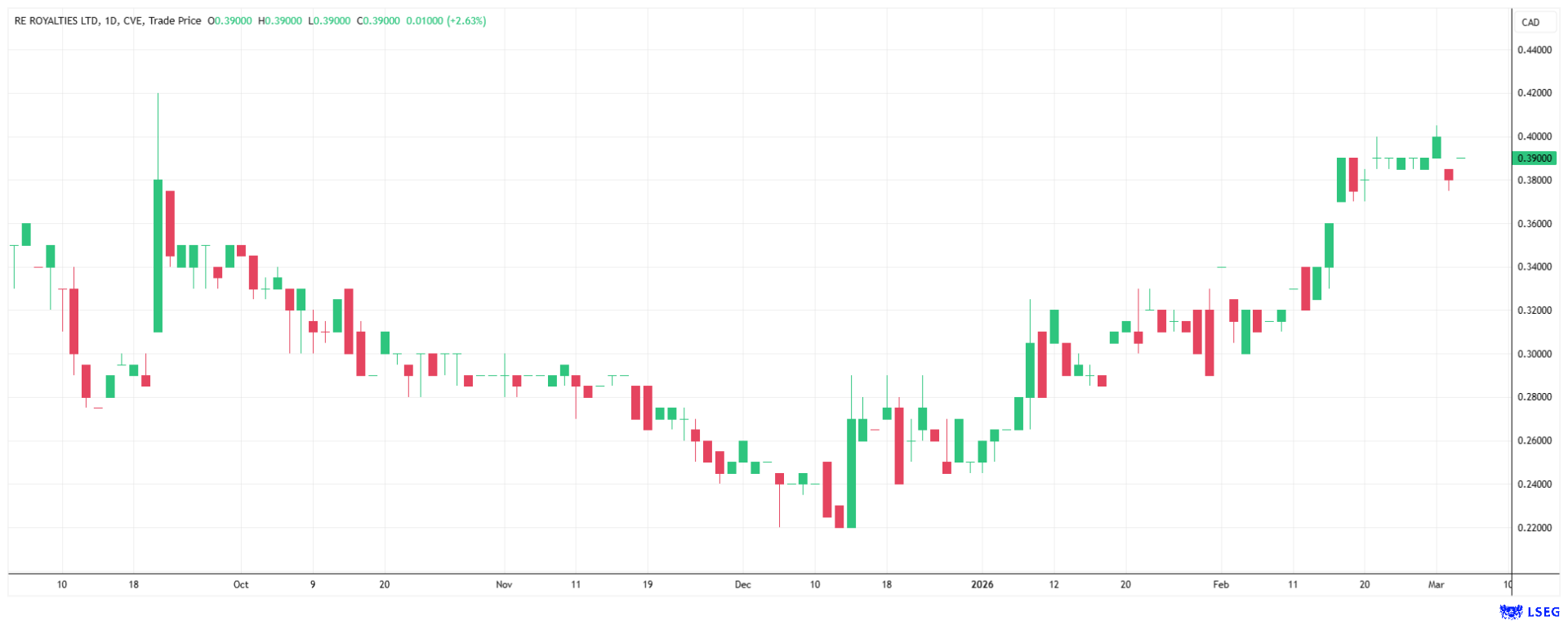
RE Royalties is currently driving its expansion through targeted new investments. A core project is the partnership with Solaris Energy, in which RE Royalties is investing up to USD 9 million to acquire interests in portfolios of distributed solar installations in the US. These projects serve commercial customers in states such as California and Maine and offer stable returns over a period of 25 years. For yield-oriented investors, the dividend policy is the decisive factor. The company has paid dividends continuously for over seven years and, with a current quarterly dividend of CAD 0.01 and a share price of around CAD 0.40, offers an attractive forward yield of around 10%. In order to increase financial flexibility for investments in new projects, management plans to pay an annual dividend instead of a quarterly dividend in the future. The green bonds issued by RE Royalties to finance projects could also be of interest. These offer coupons in the high single-digit range.
Watch YouTube videoConflict of interest
Pursuant to §85 of the German Securities Trading Act (WpHG), we point out that Apaton Finance GmbH as well as partners, authors or employees of Apaton Finance GmbH (hereinafter referred to as "Relevant Persons") may hold shares or other financial instruments of the aforementioned companies in the future or may bet on rising or falling prices and thus a conflict of interest may arise in the future. The Relevant Persons reserve the right to buy or sell shares or other financial instruments of the Company at any time (hereinafter each a "Transaction"). Transactions may, under certain circumstances, influence the respective price of the shares or other financial instruments of the Company.
In addition, Apaton Finance GmbH is active in the context of the preparation and publication of the reporting in paid contractual relationships.
For this reason, there is a concrete conflict of interest.
The above information on existing conflicts of interest applies to all types and forms of publication used by Apaton Finance GmbH for publications on companies.
Risk notice
Apaton Finance GmbH offers editors, agencies and companies the opportunity to publish commentaries, interviews, summaries, news and the like on news.financial. These contents are exclusively for the information of the readers and do not represent any call to action or recommendations, neither explicitly nor implicitly they are to be understood as an assurance of possible price developments. The contents do not replace individual expert investment advice and do not constitute an offer to sell the discussed share(s) or other financial instruments, nor an invitation to buy or sell such.
The content is expressly not a financial analysis, but a journalistic or advertising text. Readers or users who make investment decisions or carry out transactions on the basis of the information provided here do so entirely at their own risk. No contractual relationship is established between Apaton Finance GmbH and its readers or the users of its offers, as our information only refers to the company and not to the investment decision of the reader or user.
The acquisition of financial instruments involves high risks, which can lead to the total loss of the invested capital. The information published by Apaton Finance GmbH and its authors is based on careful research. Nevertheless, no liability is assumed for financial losses or a content-related guarantee for the topicality, correctness, appropriateness and completeness of the content provided here. Please also note our Terms of use.