May 18th, 2026 | 07:50 CEST
Act Now or Miss Out – Sharp Correction in Siemens Energy, RE Royalties, and Nel ASA Amid Ongoing Upswing
The global energy transition is increasingly facing a structural financing challenge. While governments worldwide are announcing ambitious decarbonization targets, the cost of capital is rising dramatically. However, higher interest rates, skyrocketing government debt, and a weaker economy are fundamentally altering the risk assessment of long-term infrastructure projects. According to analyses by the International Energy Agency (IEA), global investment in clean energy would have to accelerate significantly by 2030 to keep the agreed-upon climate targets within reach. Yet this is precisely where the dilemma begins: many countries have long since reached their fiscal limits. In Europe, North America, and parts of Asia, capital markets are therefore growing increasingly skeptical of heavily subsidized transition models. Against this backdrop, we take a broader view beyond the "green revolution"—where can solid returns still realistically be expected?
time to read: 5 minutes | Author: André Will-Laudien
ISIN: RE ROYALTIES LTD | CA75527Q1081 | TSXV: RE , OTCQX: RROYF , SIEMENS ENERGY AG NA O.N. | DE000ENER6Y0 , NEL ASA NK-_20 | NO0010081235
Table of contents:
Author

André Will-Laudien
Born in Munich, he first studied economics and graduated in business administration at the Ludwig-Maximilians-University in 1995. As he was involved with the stock market at a very early stage, he now has more than 30 years of experience in the capital markets.
Tag cloud
Shares cloud
RE Royalties – The next phase of the energy transition begins on the capital market
Investors are increasingly questioning whether public subsidy programs in their current form can remain financially sustainable in the long term. Capital-intensive projects with long payback periods—such as offshore wind farms, hydrogen infrastructure, or massive grid expansions—are particularly affected. The result is a paradigm shift within the green finance world. A shift away from purely politically driven visions toward cash-flow-oriented, lower-risk financing models with predictable returns. Just a few years ago, capital flowed almost unconditionally into ESG and cleantech projects. A study by McKinsey & Company shows that financing costs are now among the biggest obstacles for many energy projects. Young companies in particular are suffering from the combination of higher refinancing costs and more cautious capital markets. Low interest rates made long-term infrastructure investments extremely attractive, even when profitability was often far off. This environment has changed fundamentally. Today, investors demand significantly higher returns, faster cash flows, and more robust business models.
In this environment, models that rely less on speculative future scenarios and instead deliver stable cash flows are gaining importance. Similarly, investors are increasingly seeking structures that benefit from the energy transition without bearing the full technological or operational risks. This is precisely where new niches are currently emerging within the green finance sector. RE Royalties is positioning itself particularly well in this regard. The Canadian company follows a model that is still largely unknown in Europe but fits the current market phase strategically very well. Instead of developing solar, wind, or storage projects itself, the company finances selected energy facilities and receives long-term revenue shares in return. As a result, the model resembles royalty or streaming structures from the commodities sector more than those of traditional project developers.
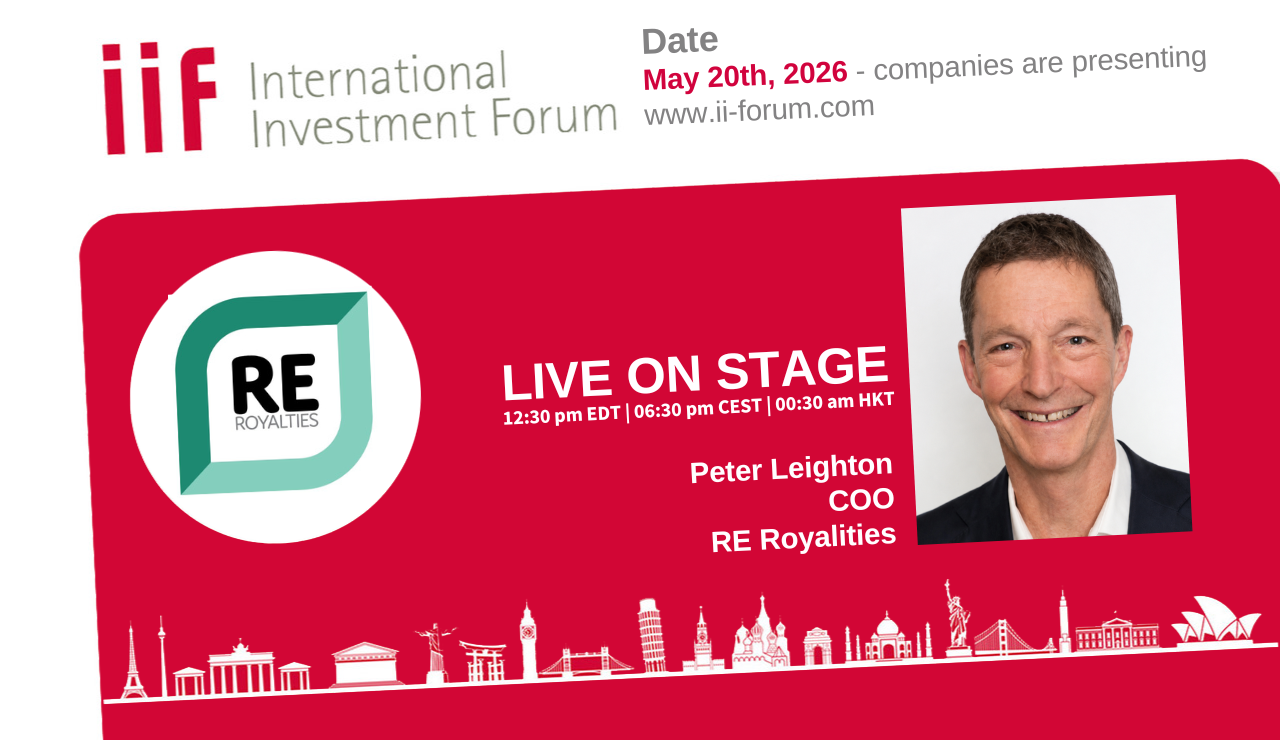
COO Peter Leighton will explain at the 19th International Investment Forum on May 20, 2026, how this approach can generate strong returns. Click here to register for free.
The key advantage lies in the risk structure. RE Royalties participates in the revenue generated by the facilities without bearing operational responsibility for construction, maintenance, or operations. This results in a comparatively lean business model with recurring revenue and high scalability. At the same time, the Canadian company benefits indirectly from the global expansion of renewable energy and rising electricity demand. Above all, the boom in artificial intelligence and data centers is significantly changing the outlook for many energy investments. This is because AI infrastructure is currently emerging as one of the largest electricity consumers of the coming decade. The company's portfolio now includes more than 100 investments in solar energy, wind power, battery storage, hydropower, and energy efficiency projects.
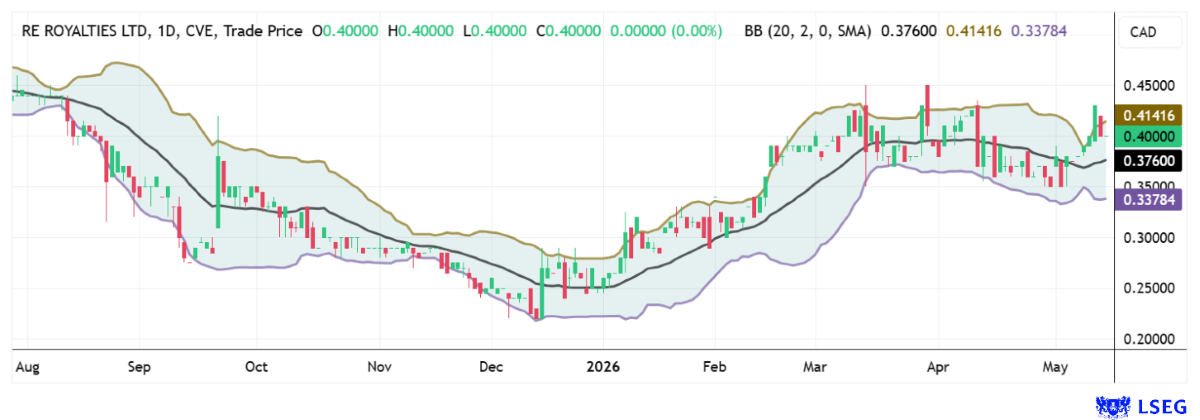
While many cleantech companies face high financing costs, royalty structures generate comparatively stable, predictable cash flows. At the same time, project developers continue to need capital, but without further diluting their own shareholders through capital increases. This is precisely where RE Royalties comes in with non-dilutive financing solutions. There is another important factor: inflation protection. Since compensation models are partly based on electricity production volume, the revenue structures remain relatively robust in the face of volatile energy prices. In a world of structurally higher inflation and rising capital costs, this characteristic becomes significantly more important. The company itself now describes its revenue structure almost as sustainable infrastructure coupon payments with additional growth potential. The low valuation of just CAD 17 million remains intriguing, but it comes with an upward stock trend! Buy up!
Nel ASA – Hydrogen Remains a Bullish Theme
Finally! Over the past 4 weeks, the Norwegian hydrogen pioneer has finally been able to flex its muscles. The rally pushed the price up to just under EUR 0.33—nearly a doubling from the yearly low of EUR 0.17 in February. Since the Middle East crisis and the surge in energy prices, the production of green hydrogen has once again become en vogue. This is driving up the share prices of old sector favourites like Nel ASA and Plug Power. The latter has even surged by over 400% from its low. However, these initial attempts at recovery at Nel ASA have only convinced one analyst so far: Kulwinder Rajpal of Alpha Value. He expects a price target of 4.12 kroner—a roughly 30% premium over the current price. On the LSEG Refinitiv platform, in addition to 7 "Neutral" ratings, there are also 6 strong "Sell" recommendations; the 12-month consensus is therefore a low NOK 2.35. Nevertheless, at NOK 3.22, the price is now at an important breakout level to the upside. It is certainly hoped that this move succeeds for the long-suffering Norwegians.
Siemens Energy – Analysts are getting nervous at record levels
What else is CEO Christian Bruch supposed to do? Since the beginning of 2024, Siemens Energy's stock has surged by 1,500%, yet skepticism persists. This is because the Q2 figures were once again impressive. Revenue rose by nearly 9% to EUR 10.3 billion, while adjusted profit climbed by 29% to EUR 1.16 billion. Gas Services and Grid Technologies performed particularly well, while Gamesa continues its turnaround but remains weak in terms of order intake. Management sees itself fully on track and is raising its forecasts for the seventh consecutive time. Revenue for 2026 is now expected to grow by 14-16%, and after-tax profit is projected to climb to around EUR 4 billion. While Berenberg, Goldman Sachs, and JPMorgan, with their "Buy" ratings, now expect share prices between EUR 200 and 225, mwb research continues to confirm a "Buy" rating, but sets the price target at only EUR 100. We would call this somewhat inconsistent, as Friday's closing price was EUR 169. Anyone displaying such high skepticism should also have the courage to issue a "Sell" recommendation. Anything else is somewhat difficult for investors to understand! Investors should now place their stop price quite close to EUR 159, because things are getting tight here!**
The golden era of virtually free green finance funds is over. Governments must cut costs, subsidy programs are becoming more selective, and investors are paying closer attention to risks and seeking real returns on investment. This is shifting the balance of power within the energy sector. The focus is no longer solely on technology providers, but increasingly on companies that can efficiently organize financing. RE Royalties occupies precisely this intersection between the capital market and the energy transition. Nel ASA may finally turn the chart around, while at Siemens Energy, the one-way street to the top seems to be quietly changing direction.
Conflict of interest
Pursuant to §85 of the German Securities Trading Act (WpHG), we point out that Apaton Finance GmbH as well as partners, authors or employees of Apaton Finance GmbH (hereinafter referred to as "Relevant Persons") currently hold or hold shares or other financial instruments of the aforementioned companies and speculate on their price developments. In this respect, they intend to sell or acquire shares or other financial instruments of the companies (hereinafter each referred to as a "Transaction"). Transactions may thereby influence the respective price of the shares or other financial instruments of the Company.
In this respect, there is a concrete conflict of interest in the reporting on the companies.
In addition, Apaton Finance GmbH is active in the context of the preparation and publication of the reporting in paid contractual relationships.
For this reason, there is also a concrete conflict of interest.
The above information on existing conflicts of interest applies to all types and forms of publication used by Apaton Finance GmbH for publications on companies.
Risk notice
Apaton Finance GmbH offers editors, agencies and companies the opportunity to publish commentaries, interviews, summaries, news and the like on news.financial. These contents are exclusively for the information of the readers and do not represent any call to action or recommendations, neither explicitly nor implicitly they are to be understood as an assurance of possible price developments. The contents do not replace individual expert investment advice and do not constitute an offer to sell the discussed share(s) or other financial instruments, nor an invitation to buy or sell such.
The content is expressly not a financial analysis, but a journalistic or advertising text. Readers or users who make investment decisions or carry out transactions on the basis of the information provided here do so entirely at their own risk. No contractual relationship is established between Apaton Finance GmbH and its readers or the users of its offers, as our information only refers to the company and not to the investment decision of the reader or user.
The acquisition of financial instruments involves high risks, which can lead to the total loss of the invested capital. The information published by Apaton Finance GmbH and its authors is based on careful research. Nevertheless, no liability is assumed for financial losses or a content-related guarantee for the topicality, correctness, appropriateness and completeness of the content provided here. Please also note our Terms of use.