January 5th, 2026 | 07:20 CET
Problems at Masan High-Tech Materials, low grades at Xiamen Tungsten: How Almonty is becoming a strategic lifeline for Boeing, Rheinmetall & Co.
In the world of critical metals, a lesson in market power and geopolitical dependence is currently unfolding. Tungsten, which is indispensable for the defense industry, toolmaking, and semiconductor technology due to its extreme hardness and heat resistance, is becoming scarcer and more expensive – prices for APT are expected to reach four-figure territory by 2026. For many years, Chinese market leader Xiamen Tungsten has impressively demonstrated how lucrative the tungsten business can be. However, while Western industrial companies such as Rheinmetall and Boeing are desperately searching for material, it is becoming apparent that existing alternatives in Vietnam, namely Masan High-Tech Materials, cannot fill the gap due to geological limitations. It is precisely into this supply vacuum that Almonty Industries is moving. With the commissioning of the high-grade Sangdong mine in South Korea and the planned expansion in the US, Almonty offers much-needed security of supply and enables investors to participate in the high margins of the sector, but without the geopolitical risk of China and with additional unique advantages.
time to read: 3 minutes | Author: Nico Popp
ISIN: ALMONTY INDUSTRIES INC. | CA0203987072
Table of contents:
Author

Nico Popp
At home in Southern Germany, the passionate stock exchange expert has been accompanying the capital markets for about twenty years. With a soft spot for smaller companies, he is constantly on the lookout for exciting investment stories.
Tag cloud
Shares cloud
Xiamen Tungsten: The art of profitable scarcity
To understand the opportunity around Almonty, it is worth analyzing the strategy of the dominant market player. China controls more than 80% of global tungsten production, and Xiamen Tungsten is the sector's leading company. In recent quarters, Beijing has tightened export quotas and environmental regulations, significantly constraining global supply. For Xiamen Tungsten, this was the perfect scenario: the Company was able to dictate prices and recorded rising margins as fixed costs were spread over a smaller but significantly more expensive volume. Such pricing dynamics have long been a structural feature of China's role in critical raw materials. More recently, however, there are growing indications that margin expansion at Xiamen Tungsten may be reaching its limits.
Masan High-Tech Materials: When geology sets the limits
For a long time, Vietnam was seen as the great hope for breaking China's stranglehold. Masan High-Tech Materials, operator of the Nui Phao mine, positioned itself as the ethical alternative for Western buyers. But a look at the current operating data is sobering. Masan is struggling with the physical reality of mining: declining ore grades in the mine are making it increasingly costly to produce the required quantities of concentrate. Although the Company is likely to have excellent processing technology at its disposal since the takeover of Germany's H.C. Starck, it is increasingly lacking its own cost-effective supply from the ground. Even the recently approved expansion of Nui Phao toward underground mining will not yield results in the short term. Masan simply cannot close the gap opened up by China through volume alone, as the mine appears to have passed its peak. The promise that Vietnam could replace China is faltering.
Almonty: The game changer from South Korea
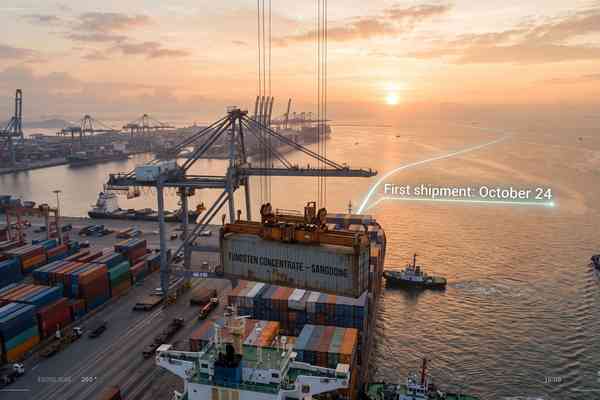
Almonty is jumping into this gap with timing that could hardly be better. The Company is currently completing the full commissioning of the Sangdong mine in South Korea. This project is geologically unique, as it has tungsten grades that are well above the global average and also significantly higher than those of its Chinese and Vietnamese competitors. High grades mean low costs per ton mined, giving Almonty a margin that is likely to exceed that of Xiamen Tungsten in the future – but in an OECD jurisdiction that is politically firmly anchored in the Western camp. Almonty thus replicates the profitability of the Chinese, but eliminates the China risk for investors.
The strategy, however, extends beyond Asia. With planned activities in the US, expected to become relevant in the second half of 2026, Almonty is building a transatlantic supply bridge. While details around the ramp-up of US capacity are still being finalized, the strategic direction is clear: together with its Panasqueira mine in Portugal, Almonty is positioning itself as one of the few Western tungsten producers with multiple geopolitically secure, independently operating assets.
Technology leader instead of just a rock crusher
What further distinguishes Almonty from players such as Masan is its technological ambition. Under CEO Lewis Black, the management team places strong emphasis on advanced data analytics, artificial intelligence, and modern geological modeling in mine planning. By applying these technologies to ore body analysis, Almonty aims to minimize ore dilution and maximize recovery, further leveraging the advantages of its already high-grade deposits. Investors are therefore not backing an antiquated mining company here, but a technology-driven leader that has made operational efficiency its core principle. At Sangdong, production costs are expected to be around half those of many Chinese competitors.
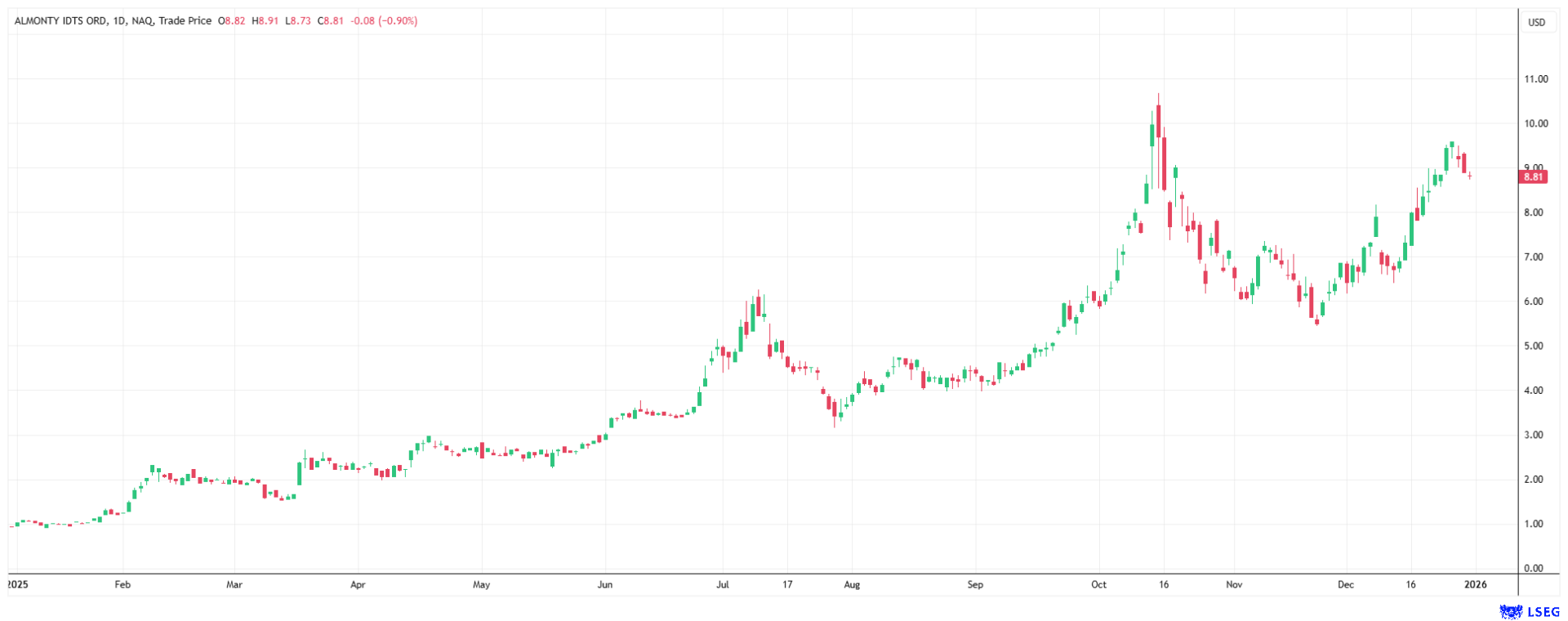
The investment thesis for Almonty is therefore unusually clear in a complex sector. While Xiamen Tungsten benefits from constrained supply and Masan faces geological limitations, Almonty offers exactly what the market is seeking: high-grade, geopolitically secure, and economically attractive tungsten supply. Once the mine in South Korea reaches full operation and the US expansion takes effect in 2026, the current valuation gap relative to other critical metals companies could narrow significantly. Almonty thus represents a logical bet on the realignment of global commodity security and, for investors, the commodity option for 2026.
Conflict of interest
Pursuant to §85 of the German Securities Trading Act (WpHG), we point out that Apaton Finance GmbH as well as partners, authors or employees of Apaton Finance GmbH (hereinafter referred to as "Relevant Persons") currently hold or hold shares or other financial instruments of the aforementioned companies and speculate on their price developments. In this respect, they intend to sell or acquire shares or other financial instruments of the companies (hereinafter each referred to as a "Transaction"). Transactions may thereby influence the respective price of the shares or other financial instruments of the Company.
In this respect, there is a concrete conflict of interest in the reporting on the companies.
In addition, Apaton Finance GmbH is active in the context of the preparation and publication of the reporting in paid contractual relationships.
For this reason, there is also a concrete conflict of interest.
The above information on existing conflicts of interest applies to all types and forms of publication used by Apaton Finance GmbH for publications on companies.
Risk notice
Apaton Finance GmbH offers editors, agencies and companies the opportunity to publish commentaries, interviews, summaries, news and the like on news.financial. These contents are exclusively for the information of the readers and do not represent any call to action or recommendations, neither explicitly nor implicitly they are to be understood as an assurance of possible price developments. The contents do not replace individual expert investment advice and do not constitute an offer to sell the discussed share(s) or other financial instruments, nor an invitation to buy or sell such.
The content is expressly not a financial analysis, but a journalistic or advertising text. Readers or users who make investment decisions or carry out transactions on the basis of the information provided here do so entirely at their own risk. No contractual relationship is established between Apaton Finance GmbH and its readers or the users of its offers, as our information only refers to the company and not to the investment decision of the reader or user.
The acquisition of financial instruments involves high risks, which can lead to the total loss of the invested capital. The information published by Apaton Finance GmbH and its authors is based on careful research. Nevertheless, no liability is assumed for financial losses or a content-related guarantee for the topicality, correctness, appropriateness and completeness of the content provided here. Please also note our Terms of use.