March 12th, 2026 | 08:20 CET
Drone revolution and defense boom: Why Volatus Aerospace is emerging as a new aerospace player
The daily news reports currently begin with war coverage. This is not a desirable situation, but it is a bitter reality. Nowadays, much reconnaissance and destructive power is achieved "unmanned." This is demonstrated by the dramatic increase in autonomous air operations in conflict regions and illustrates the strategic relevance of modern drone technologies. Volatus Aerospace is positioning itself in this environment as an integrated platform provider: from manned flight and unmanned drone systems to AI-supported analysis and security services. The growing demand for highly scalable solutions in Europe, North America, and NATO partner countries is driving structural, double-digit growth in the defense and security market. Analysts see enormous potential for companies with platform expertise such as Volatus. Investors are taking notice, as the valuation remains reasonable and major developments are in the pipeline!
time to read: 7 minutes | Author: André Will-Laudien
ISIN: VOLATUS AEROSPACE INC | CA92865M1023 | TSXV: FLT , OTCQB: TAKOF
Table of contents:
Author

André Will-Laudien
Born in Munich, he first studied economics and graduated in business administration at the Ludwig-Maximilians-University in 1995. As he was involved with the stock market at a very early stage, he now has more than 30 years of experience in the capital markets.
Tag cloud
Shares cloud
Geopolitical conflicts make drones critical infrastructure
The cost imbalance of Iranian low-cost drones has become a major issue. According to recent reports, defending against a single Iranian Shahed drone often costs the US many times its purchase price because very expensive interceptor missiles are often used. While a Shahed costs tens of thousands of dollars, a single Patriot defense missile burns through several million USD per shot, a factor of 100. Unmanned aviation is increasingly becoming a key technology in modern security, infrastructure, and industrial architectures. Systems that were long considered primarily experimental technology are now an integral part of data-driven deployment strategies. Geopolitical conflicts in recent years, in particular, have shown how much autonomous air systems are reshaping modern warfare and security-related operations. At the same time, demand is also growing rapidly in civilian applications. Energy companies, infrastructure operators, border protection authorities, and disaster management organizations are increasingly relying on airborne data collection to reduce costs, minimize risks, and respond more quickly.
Modern defense budgets are changing their appearance
Parallel to this technological transformation, a political paradigm shift is taking place. Many countries are significantly increasing their defense budgets and placing greater emphasis on national technologies and industrial value creation. Autonomous systems are considered a core strategic capability. In Canada, for example, large parts of future defense programs are to be implemented with domestic industry partners. At the intersection of technological transformation and increasing security policy demand, Volatus Aerospace is positioning itself as an integrated provider of manned and unmanned air systems, operational services, and data-driven analysis platforms. And the Canadians are proceeding in a structured and cautious manner, because training and education concepts are developed and integrated after every technological innovation. Volatus' business model thus differs significantly from that of traditional drone manufacturers. While many competitors primarily develop and sell hardware, Volatus combines the development and production of unmanned aircraft systems with operational flight services, software solutions, and AI-supported data analysis. Comprehensive services for government agencies and industry round out the program.
CEO Glen Lynch explained his medium-term strategy at the 18th International Investment Forum.
Operational momentum: Record quarter and accelerated growth
The company's operational performance shows a significant increase in momentum. Volatus generated CAD 10.6 million in Q3 2025, reflecting strong growth compared with previous periods. In a recent study, research firm Desjardins calculates an enterprise value to sales ratio (EV/Sales) of 14.9 for the first full fiscal year (FY1), while the peer group average is 34.3. This would indicate a 2.5-fold understatement in the valuation. Of course, there is currently no net surplus, as the high investment costs offset the available cash flow.
The change in the revenue mix is particularly striking. Whereas services previously accounted for the largest share, more than 53% of revenues recently came from the sale of drone systems and technical equipment. This indicates that demand for physical system solutions is picking up significantly and that the market is increasingly entering a phase of scaling. The situation has also improved significantly on the financing side. Following several capital measures, Volatus now has a liquidity reserve of around CAD 40 million. These funds are to be invested primarily in the expansion of production capacities, technology development, and international expansion.
Technology platform: AI, autonomy, and data analysis as growth drivers
A central component of the long-term strategy is the development of a technological platform for autonomous flight operations. It combines AI-based analysis methods with autonomous control systems, remote operations infrastructure, and data-driven decision support. With the help of pattern recognition algorithms, large amounts of data from aerial images can be analyzed and translated into usable information. In addition, the company is working on solutions for three-dimensional reconstructions, automated situation assessment, and AI-supported threat detection. To complement this, SKYDRA, a digital platform for drone defense, was introduced. This enables emergency services to simulate and execute complex defense scenarios in real time. Such software and analysis levels create an additional layer of value that is significantly more scalable than traditional aviation activities. This is an area that is attracting the attention of military clients.
Expansion of the industrial base and consolidation of investments
Parallel to its technological expansion, Volatus is investing heavily in its industrial infrastructure. The Mirabel site in the Canadian province of Quebec is currently being expanded into a center of excellence for manufacturing, system integration, and engineering. Among other things, long-range drones that meet international security and defense standards will be produced there in the future. The goal is to establish a sovereign supply chain for autonomous air systems and the capability to mass-produce complex drone platforms.
Another strategic step is the complete integration of the company's aviation activities. At the beginning of March, Volatus announced that it would acquire the remaining minority shares in Synergy Aviation, thereby taking over 100% of the company. The transaction is to be carried out through the issuance of new shares and is expected to be completed in mid-March. Full consolidation will allow all commercial flight operations to be bundled under the Volatus brand in the future. In addition, the company is currently establishing an operational aviation base in the US state of Oklahoma, from which it will primarily serve the oil and gas sector in North America.
New contract: A strong footprint in the offshore wind turbine maintenance business
Volatus Aerospace has signed a strategic agreement with a major offshore wind energy company to develop and bring to market heavy-lift drones for logistics operations at sea. The focus is on a new delivery model in which drones transport tools, spare parts, and critical components with a payload of up to 100 kilograms directly from supply ships to the nacelles of offshore wind turbines. This could significantly speed up maintenance and service processes while reducing costly and risky manual lifting and transfer operations. Volatus is responsible for the entire operational implementation of the program – from mission planning, regulatory approvals, and technical integration to flight operations. Operations are controlled centrally from the company's Operations Control Center, which enables real-time monitoring, operational coordination, and the highest safety standards.
Strategically, this project could extend far beyond a single contract, as offshore wind farms are being rapidly expanded worldwide, and autonomous logistics solutions could become an integral part of maintenance infrastructure in the future. If Volatus succeeds in scaling the model, it will open up a new business area for maritime drone logistics – with corresponding growth potential in the millions.
"Our focus is on operational implementation and economic viability," said Greg Colacitti, COO of Volatus Aerospace. "This funded program is structured to integrate a heavy-lift offshore delivery model into the routine maintenance of wind turbines. Centralized control and monitoring of missions by our Operations Control Center provides an industrial delivery model that is repeatable, scalable, and economically viable for long-term deployment in offshore wind farms and other demanding maritime logistics environments."
Capital markets meet politics: Tailwind with highest priority
In addition to its operational development, the company is also benefiting from structural tailwinds at the political and capital market levels. Defense budgets are rising worldwide, and autonomous systems are increasingly becoming the focus of national security strategies. In Canada, a new defense and industrial policy is currently being implemented that aims to integrate domestic suppliers more closely into national programs. The capital markets are also seeing important catalysts due to the switch to the TSX and remaining plans for a listing on a major US technology exchange. Management is therefore currently challenged on all fronts.
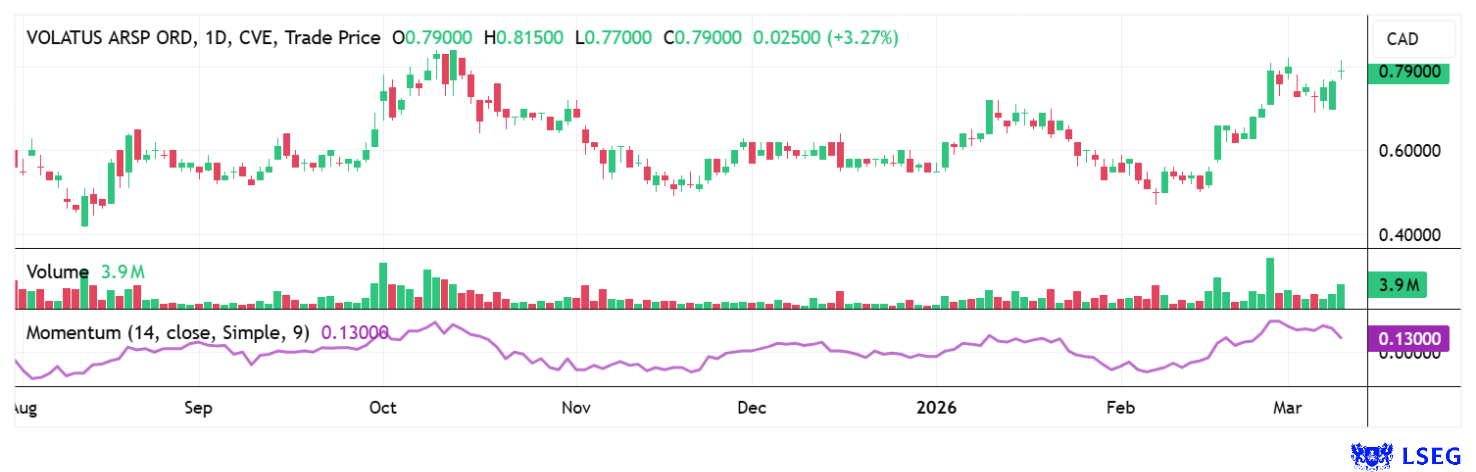
Volatus Aerospace is in a crucial transition phase. After several years of building an integrated technology ecosystem, the focus is now increasingly on scaling. Several analyst firms are actively tracking Volatus. Current revenue estimates for 2026 show multiples of 7 to just under 15, depending on how much of the existing orders can ultimately be invoiced. The target ranges for Volatus shares (ticker: FLT) are CAD 0.85 to CAD 1.25 over a 12-month horizon. Institutional interest is likely to kick in once annual revenues exceed CAD 100 million. In the current environment, things can move very quickly here! The market for autonomous air systems is only at the beginning of a long-term growth cycle, and Volatus Aerospace offers everything one would expect in an air data ecosystem. Yesterday, the stock surged past the CAD 0.80 mark with huge revenue – very exciting!
Conflict of interest
Pursuant to §85 of the German Securities Trading Act (WpHG), we point out that Apaton Finance GmbH as well as partners, authors or employees of Apaton Finance GmbH (hereinafter referred to as "Relevant Persons") currently hold or hold shares or other financial instruments of the aforementioned companies and speculate on their price developments. In this respect, they intend to sell or acquire shares or other financial instruments of the companies (hereinafter each referred to as a "Transaction"). Transactions may thereby influence the respective price of the shares or other financial instruments of the Company.
In this respect, there is a concrete conflict of interest in the reporting on the companies.
In addition, Apaton Finance GmbH is active in the context of the preparation and publication of the reporting in paid contractual relationships.
For this reason, there is also a concrete conflict of interest.
The above information on existing conflicts of interest applies to all types and forms of publication used by Apaton Finance GmbH for publications on companies.
Risk notice
Apaton Finance GmbH offers editors, agencies and companies the opportunity to publish commentaries, interviews, summaries, news and the like on news.financial. These contents are exclusively for the information of the readers and do not represent any call to action or recommendations, neither explicitly nor implicitly they are to be understood as an assurance of possible price developments. The contents do not replace individual expert investment advice and do not constitute an offer to sell the discussed share(s) or other financial instruments, nor an invitation to buy or sell such.
The content is expressly not a financial analysis, but a journalistic or advertising text. Readers or users who make investment decisions or carry out transactions on the basis of the information provided here do so entirely at their own risk. No contractual relationship is established between Apaton Finance GmbH and its readers or the users of its offers, as our information only refers to the company and not to the investment decision of the reader or user.
The acquisition of financial instruments involves high risks, which can lead to the total loss of the invested capital. The information published by Apaton Finance GmbH and its authors is based on careful research. Nevertheless, no liability is assumed for financial losses or a content-related guarantee for the topicality, correctness, appropriateness and completeness of the content provided here. Please also note our Terms of use.