October 16th, 2026 | 05:20 CEST
Power Metallic Mines, Siemens Energy and BYD: The Export Boom in Electric Vehicles Drives Demand for Copper and Electricity
A single Chinese automaker sold 180,700 new energy vehicles overseas in September. That accounts for about 39% of its sales, more than double the figure from a year earlier. Behind this growth lies a substantial demand for raw materials, including copper and nickel for batteries and electric motors, as well as platinum-group metals for catalytic converters in hybrid vehicles. Electricity is also essential to charge all these vehicles. This illustrates what supply chains must look like to keep electric vehicles running. This plays right into the hands of raw material producers and electricity generators. Today, we take a closer look at Power Metallic Mines, Siemens Energy and BYD.
time to read: 5 minutes | Author: Armin Schulz
ISIN: Power Metallic Mines Inc | CA73929R1055 , SIEMENS ENERGY AG NA | DE000ENER6Y0 , BYD CO. LTD H | CNE100000296
Author

Armin Schulz
Born in Mönchengladbach, he studied business administration in the Netherlands. In the course of his studies he came into contact with the stock exchange for the first time. He has more than 25 years of experience in stock market business.
Tag cloud
Shares cloud
Power Metallic Mines: Copper in the Ground, Depth Still Undetermined
On September 8, Power Metallic Mines presented its maiden resource estimate for the Lion Zone, the discovery at the Nisk project in Québec. SGS Canada reports 4.145 million tonnes in the “indicated” category at 3.86% copper equivalent (CuEq), plus 0.601 million tonnes “inferred” at 4.01%. More than 85% of the resource therefore falls into the higher-confidence category. Palladium, platinum, gold, silver and nickel accompany the copper. As the mineralisation extends to surface, this favours open-pit mining. The foundation is in place.
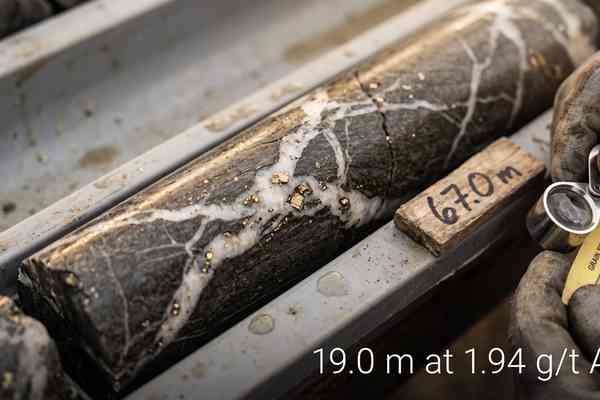
The question for investors is: how far does the orebody extend? The latest deep drill hole, reported on September 22, provides an initial answer. At a vertical depth of around 800 m, the geologists encountered a 5.70 m interval grading 14.00% CuEq adjusted for recovery rates, including 2.15 m at 24.62%. According to the company, the hole is around 25% deeper than the deepest hole in the resource estimate, and the company says grades are even increasing there. This could boost the resource. The results of another drill hole are still pending. Company CEO Terry Lynch plans to drill to a depth of around 1,200 m. That means going even deeper.
On October 5, Power Metallic commissioned engineering firm BBA to prepare a preliminary economic assessment (PEA). It covers the Lion and Nisk Main deposits, with Lion as the focus. The results are due in the first half of 2027, with the work funded from existing cash reserves. CEO Terry Lynch is initially considering an open pit and expects the investment to pay for itself just over a year after production starts. The study is intended to show what Lion is worth. New metallurgical studies from SGS are also due by year-end. If they turn out well, Nisk Main could achieve a breakthrough.
Siemens Energy: Order Book Full, Outlook Confirmed
The Munich-based company is firing on all cylinders. On September 30, the group reaffirmed that the gas turbine market amounts to around 110 to 120 gigawatts (GW) annually, with additional potential of 10 to 20 GW from data centres. In the first three quarters of the financial year, Siemens Energy booked around 40 GW in firm orders for gas turbines, including 15 GW in the third quarter. Including reservation agreements, customer commitments stand at 95 GW. At the end of September, an agreement with US company Dynamis Power Solutions was announced, covering gas turbine cores from Lincoln in the UK. Demand remains high.
The third tranche of the share buyback programme began on September 24. It amounts to up to EUR 2 billion and is due to be completed by March 31, 2027 at the latest. The entire programme is designed to total up to EUR 6 billion by the end of the 2028 financial year. The dividend policy remains unchanged, with 40 to 60% of net profit attributable to shareholders being distributed. Those holding shares will therefore receive a larger slice of the pie, as long as the group continues to make money. The Munich-based company aims to maintain more cash than debt throughout the cycle.
On November 11, Siemens Energy will present its fourth-quarter and full-year figures. The group confirmed its outlook on September 30, with profitability expected to be at the upper end of the range. Nevertheless, issues remain. Siemens Gamesa recently posted its first positive quarterly result since the fourth quarter of the 2022 financial year, with break-even as the full-year target. Order intake for offshore wind farms fell short of expectations because project decisions slipped into the next financial year. Gamesa is not out of the woods yet.
BYD: Exports Drive Growth, Brussels Could Put on the Brakes
In September, BYD sold 463,561 new energy vehicles, more than in any other month this year. Of these, 273,143 were battery-only vehicles. That is 33.2% more than a year ago. Over the first nine months, the group's total stands at 3,131,576 vehicles, a decline of 3.9% compared with the same period last year. Overseas markets were the main driver of sales growth. Exports rose by 92.7% to 1,342,960 vehicles from January to September. In its home market of China, BYD sold 282,861 vehicles in September. Overseas demand is keeping the company on track, although the year-on-year figure remains negative.
BYD aims to establish a lasting foothold in Europe. According to a report dated October 12, Vice President Stella Li made it clear at the Paris Motor Show that the commitment is long-term. The workforce on the continent is set to grow to around 40,000 employees by the end of 2029. The first plant in Hungary is close to opening, while the company is considering a second in France or Spain, with a decision due by the end of the year. Long term, BYD plans three assembly plants and a battery factory. The dealer network is also set to expand, and models will be tailored more closely to European buyers. BYD will also launch hybrid models for the market.
However, headwinds are looming from Brussels. According to Bloomberg, the EU wants to cap imports of Chinese hybrids at 350,000 vehicles a year, possibly from December 1. That would pose a risk for BYD. In Germany, plug-in hybrids account for 61.5% of BYD registrations this year, according to figures from the Federal Motor Transport Authority. For now, the group is not selling passenger vehicles in the US, as geopolitics presents a major hurdle, according to Li. If it succeeds in building its own plants in Europe, BYD would be less dependent on imports.
Conclusion
Electrification needs raw materials, electricity and buyers, and all three links in the chain are in flux. Power Metallic Mines has reached several milestones in just a few weeks with the resource estimate, deep drilling and the upcoming economic assessment. If mineralisation at depth is confirmed, the project's potential could increase further. Siemens Energy has confirmed its guidance and is returning money to shareholders through the buyback, but Gamesa remains a problem area. BYD is growing strongly abroad, but must keep an eye on decisions from Brussels. The chain ultimately depends on raw materials.
Conflict of interest
Pursuant to §85 of the German Securities Trading Act (WpHG), we point out that Apaton Finance GmbH as well as partners, authors or employees of Apaton Finance GmbH (hereinafter referred to as "Relevant Persons") currently hold or hold shares or other financial instruments of the aforementioned companies and speculate on their price developments. In this respect, they intend to sell or acquire shares or other financial instruments of the companies (hereinafter each referred to as a "Transaction"). Transactions may thereby influence the respective price of the shares or other financial instruments of the Company.
In this respect, there is a concrete conflict of interest in the reporting on the companies.
In addition, Apaton Finance GmbH is active in the context of the preparation and publication of the reporting in paid contractual relationships.
For this reason, there is also a concrete conflict of interest.
The above information on existing conflicts of interest applies to all types and forms of publication used by Apaton Finance GmbH for publications on companies.
Risk notice
Apaton Finance GmbH offers editors, agencies and companies the opportunity to publish commentaries, interviews, summaries, news and the like on news.financial. These contents are exclusively for the information of the readers and do not represent any call to action or recommendations, neither explicitly nor implicitly they are to be understood as an assurance of possible price developments. The contents do not replace individual expert investment advice and do not constitute an offer to sell the discussed share(s) or other financial instruments, nor an invitation to buy or sell such.
The content is expressly not a financial analysis, but a journalistic or advertising text. Readers or users who make investment decisions or carry out transactions on the basis of the information provided here do so entirely at their own risk. No contractual relationship is established between Apaton Finance GmbH and its readers or the users of its offers, as our information only refers to the company and not to the investment decision of the reader or user.
The acquisition of financial instruments involves high risks, which can lead to the total loss of the invested capital. The information published by Apaton Finance GmbH and its authors is based on careful research. Nevertheless, no liability is assumed for financial losses or a content-related guarantee for the topicality, correctness, appropriateness and completeness of the content provided here. Please also note our Terms of use.