July 2nd, 2026 | 07:05 CEST
Oil on Sale, Gas and Hydrogen in Vogue! Nel ASA, Pure One, Plug Power, and Shell in the Spotlight
A Fragile Ceasefire! Tensions between the US and Iran remain high, even though the recent de-escalation has provided short-term relief for the oil markets. There is no sign of a robust peace agreement; rather, the situation remains characterized by a fragile political framework, military incidents, and diplomatic feelers. This is particularly relevant for the oil market because the Strait of Hormuz, as a key transport route, remains a geopolitical risk factor. Accordingly, Brent reacts sensitively to any new news from the region. After falling to around USD 72 per barrel, it could rebound at any time. Investment banks are now significantly scaling back their short-term price targets of up to USD 150 set in April, but remain cautious overall for 2026. Depending on the firm, forecasts for Brent now range from USD 70 to USD 85 per barrel, with geopolitical risks, OPEC policy, and the development of the global economy remaining key influencing factors. For investors, this means that oil prices are currently more of a tactical positioning matter and are unsuitable as a long-term investment. It is therefore worth taking a critical look at viable alternatives in the energy sector. But let's get one thing out of the way first: high volatility is here to stay!
time to read: 5 minutes | Author: André Will-Laudien
ISIN: PURE ONE CORPORATION LIMITED | AU0000442865 | ASX: P1E , PLUG POWER INC. DL-_01 | US72919P2020 , NEL ASA NK-_20 | NO0010081235
Table of contents:
Author

André Will-Laudien
Born in Munich, he first studied economics and graduated in business administration at the Ludwig-Maximilians-University in 1995. As he was involved with the stock market at a very early stage, he now has more than 30 years of experience in the capital markets.
Tag cloud
Shares cloud
Shell: Europe's Energy Transition - Between Ambition and Reality
European decarbonization policy aims for a profound transformation of the region's energy supply. Traditional energy companies and new technology providers are converging in this environment, even though they play different roles in the transition. As a global oil and gas company, Shell remains a key stabilizing force in today's energy supply; in the gas sector, the British-Dutch multinational is even one of the world's largest traders. Gas plays a vital bridging role in the transition to other technologies until innovations make alternative energies competitive.
Shell demonstrated its operational strength in the first quarter of 2026 with a profit attributable to shareholders of USD 5.7 billion. The company responded by increasing its dividend by 5% and launching another share buyback program worth USD 3 billion. Added to this is the company's world-leading LNG infrastructure, which remains strategically important for Europe given tight gas supplies and geopolitical risks. Shell therefore remains an attractive investment for investors despite the recent decline in oil prices. The stock has already lost about 20% from its peak, yet it offers a dividend yield of over 4% and trades at a P/E ratio of about 7.5 based on the 2026 estimate. Historically speaking, this valuation does not appear particularly high. From a technical perspective, the support zone of EUR 30 to 34 offers good buying opportunities.
Nel ASA and Plug Power: Innovations in the alternative energy sector are in demand
A study by the International Energy Agency (IEA) concludes that the global transformation of the energy system goes far beyond the mere expansion of renewable energy and requires additional investments in grids, storage, and flexible generation. According to the IEA's assessment, the demand for such infrastructure components will remain high through 2030 because power systems with a growing share of wind and solar energy are significantly more reliant on balancing capacity. This leads to a clear economic conclusion for Europe: without robust backup structures, costs and risks for both industry and consumers will rise simultaneously. Natural gas, in particular, therefore retains its importance as a flexible bridge technology, as it can cushion generation peaks and close supply gaps during periods of low feed-in.
Hydrogen remains a wild card. While the long-term outlook for the green variant is attractive, in the short term it remains marked by high costs, limited scale, and a slow market ramp-up. Nel ASA and Plug Power are thus two companies that, while operating in a future-oriented market, still see their commercial success heavily dependent on government subsidies, infrastructure development, and industrial demand. For investors, the key medium-term factor is that the market for green hydrogen is growing noticeably. Currently, this growth is only evident in the public sector. Overall, however, all countries lack the necessary funds to get this initiative off the ground. While the target for green hydrogen in industry is set at 42% by 2030, this binding EU requirement will rise to 60% by 2035. Shares of the two key players, Nel ASA and Plug Power, saw a sharp surge in the first quarter of 2026. Share buybacks and hopes for a turnaround after four years of decline were key factors here. The rapid returns of 125 to 150% since the start of the year are currently eroding very quickly. Caution is advised.
Pure One: Australia's Bridge Between Natural Gas and Zero-Emission Mobility
Pure One, the Australian specialist in energy-efficient mobility solutions, has identified the logistics and fleet segment as its primary target market. This is because rising energy prices, ambitious decarbonization targets, and growing pressure to modernize heavy-duty transportation are currently creating a market environment in which integrated energy concepts are becoming significantly more attractive. The business model is not very capital-intensive and combines traditional energy investments with zero-emission transportation solutions—all of which are future markets with excellent growth prospects. While the global market for zero-emission vehicles (ZEVs) is projected to grow at a compound annual growth rate (CAGR) of around 15% through 2032, the electrification of freight and passenger transport in particular is driving the market's rapid expansion. Global investments in electrified transportation have reached over USD 750 billion in the past 5 years. The global market for electric trucks has developed rapidly. In the heavy-duty segment, zero-emission trucks accounted for approximately 9% of total global sales. Pure One develops and markets hydrogen, battery, and hybrid solutions for commercial transportation, complemented by battery-swap systems and infrastructure across the entire value chain. This ensures that everything, from energy supply to vehicle deployment, remains under one roof. Pure One deliberately relies on a capital-light platform model: development, sales, and customer service remain in-house, while production is handled by specialized industrial partners, thereby significantly reducing investment costs and operational risks.
A significant asset remains the approximately 69.4% stake in the publicly traded Eastern Gas Corporation, whose projects could gain considerable strategic importance starting in 2028, given the expected gas supply shortage on Australia's east coast. At the same time, the successful sale of the stake in the Turquoise Group provides additional financial flexibility to consistently drive forward the growth strategy in the clean-tech segment. The sale will generate a total of AUD 5 million in tranches, while simultaneously realizing a significant book gain of AUD 3.4 million. On the operational front, there are increasing signs that Pure One is moving beyond the pure development phase. For example, the new Alpha Series marks the start of the commercial rollout of battery-electric trucks, which, thanks to a battery-swapping system, are back in service within minutes, thereby mitigating a major drawback of conventional electric trucks. The portfolio is complemented by hybrid vehicles, electric buses, and other specialty vehicles for municipal and industrial applications. The company's international focus is particularly noteworthy. Sales partnerships and cooperation agreements now extend from Australia through North and South America to Europe and Asia. With industrial companies such as Heidelberg Materials, Pure One already has its first major reference customers, which could facilitate entry into additional fleet programs.
The balance sheet also presents a solid picture for a micro-cap company. Including the cash inflow from the sale of its stake and existing credit lines, Pure One has sufficient financial resources to fund its next expansion steps, while its asset-light model limits capital requirements. Analyst estimates project a strong increase in revenue to just under AUD 145 million by 2028, along with a gradual improvement in profitability; the first contribution to operating earnings is expected in 2027. New investors can currently still jump on board at a valuation of EUR 10 million.
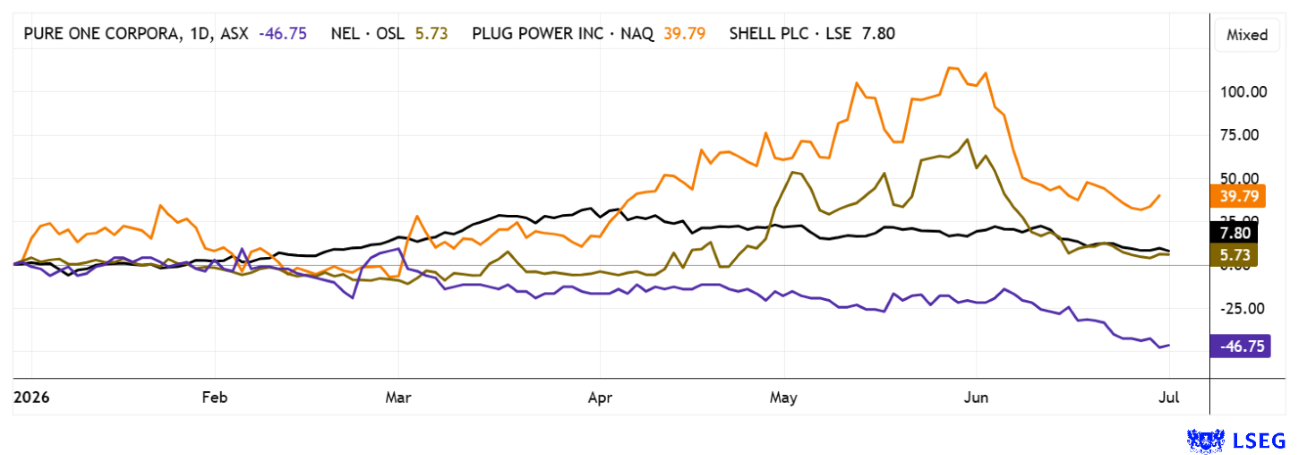
The energy sector has been one of the most volatile segments of the stock market this year. The Middle East conflict initially led to significant repricing, but these very gains are now gradually unwinding. Hydrogen-related stocks also saw a brief recovery, although sentiment has turned negative again following another halving from their peak. Meanwhile, cleantech specialist Pure One is undergoing a successful strategic repositioning and is currently trading at an extremely low valuation.
Conflict of interest
Pursuant to §85 of the German Securities Trading Act (WpHG), we point out that Apaton Finance GmbH as well as partners, authors or employees of Apaton Finance GmbH (hereinafter referred to as "Relevant Persons") currently hold or hold shares or other financial instruments of the aforementioned companies and speculate on their price developments. In this respect, they intend to sell or acquire shares or other financial instruments of the companies (hereinafter each referred to as a "Transaction"). Transactions may thereby influence the respective price of the shares or other financial instruments of the Company.
In this respect, there is a concrete conflict of interest in the reporting on the companies.
In addition, Apaton Finance GmbH is active in the context of the preparation and publication of the reporting in paid contractual relationships.
For this reason, there is also a concrete conflict of interest.
The above information on existing conflicts of interest applies to all types and forms of publication used by Apaton Finance GmbH for publications on companies.
Risk notice
Apaton Finance GmbH offers editors, agencies and companies the opportunity to publish commentaries, interviews, summaries, news and the like on news.financial. These contents are exclusively for the information of the readers and do not represent any call to action or recommendations, neither explicitly nor implicitly they are to be understood as an assurance of possible price developments. The contents do not replace individual expert investment advice and do not constitute an offer to sell the discussed share(s) or other financial instruments, nor an invitation to buy or sell such.
The content is expressly not a financial analysis, but a journalistic or advertising text. Readers or users who make investment decisions or carry out transactions on the basis of the information provided here do so entirely at their own risk. No contractual relationship is established between Apaton Finance GmbH and its readers or the users of its offers, as our information only refers to the company and not to the investment decision of the reader or user.
The acquisition of financial instruments involves high risks, which can lead to the total loss of the invested capital. The information published by Apaton Finance GmbH and its authors is based on careful research. Nevertheless, no liability is assumed for financial losses or a content-related guarantee for the topicality, correctness, appropriateness and completeness of the content provided here. Please also note our Terms of use.