August 11th, 2026 | 07:50 CEST
AI Infrastructure Rally 3.0: Siemens Energy, A.H.T. Syngas, Nordex, and SpaceX in Focus
By 2035, Europe plans to fundamentally transform its electricity mix toward renewables to achieve near-complete climate neutrality and drastically reduce its dependence on fossil fuel imports. This ambitious project requires a perfectly coordinated interplay of massive large-scale infrastructure, smart grid technology, and decentralized energy solutions. Wind power pioneer Nordex SE is driving the rapid expansion of onshore capacity as the technological leader. Infrastructure giant Siemens Energy AG is an indispensable full-service provider, stabilizing fluctuating green power production with state-of-the-art transformers and grid connections and meeting the massive energy demands of AI data centers. To close the remaining gaps in weather-dependent generation, flexible, local backup is becoming increasingly important. Here, the specialist A.H.T. Syngas Technology fills the strategic gap for small and medium-sized enterprises by using compact gasification plants to convert industrial waste streams into clean synthesis gas and cost-effective green hydrogen right where it is generated. With this selection, investors can build a crisis-resistant, CO₂-free power grid of the future. If you are looking for an extra touch of speculative upside, there is always SpaceX—although investors should carefully consider which direction that particular bet is headed.
time to read: 6 minutes | Author: André Will-Laudien
ISIN: SIEMENS ENERGY AG NA O.N. | DE000ENER6Y0 , A.H.T. SYNGAS TECH. EO 1 | NL0010872388 , NORDEX SE O.N. | DE000A0D6554 , SPACE EXPLORATION TECHNOLOGIES CORP | US84615Q1031 | NASDAQ: SPCX
Table of contents:
Author

André Will-Laudien
Born in Munich, he first studied economics and graduated in business administration at the Ludwig-Maximilians-University in 1995. As he was involved with the stock market at a very early stage, he now has more than 30 years of experience in the capital markets.
Tag cloud
Shares cloud
Siemens Energy and Nordex: Technical Consolidation is Paying Off
The transatlantic boom in subsidies and regulations is entering the next phase, flooding the order books of Western cleantech pioneers with record sums. A recent market study by the renowned energy analysis firm Wood Mackenzie underscores that this is no short-term flash in the pan. After years of a "perfect storm" of supply chain shocks and commodity inflation, the global wind and grid infrastructure industry has finally completed its fundamental shift toward true operational profitability. Technological leaders such as Siemens Energy and Nordex are no longer merely chasing project volume but are now scaling up highly profitably. The latest quarterly results from both companies are an unmistakable statement of operational excellence, underscoring an impressive turnaround in margins since 2024 and marking the end of the race for subsidies alone.
Infrastructure giant Siemens Energy is thereby cementing its role as an indispensable pacemaker for global electrification. Driven by the extreme power hunger of new AI data centers, the DAX heavyweight delivered historic figures in Q3 of fiscal year 2025/26, with comparable quarterly revenue climbing by a staggering 18.5% to a record high of EUR 11.4 billion. Operating profit before special items more than tripled to a spectacular EUR 1.62 billion. The storm-tossed subsidiary Siemens Gamesa achieved a true milestone in its turnaround, posting a profit of EUR 56 million, its first profitable quarter since 2022, and boosting the Group's total order backlog to a staggering EUR 162 billion. Given this huge backlog, management is extremely optimistic about the future and confirmed the raised full-year forecast with an expected net profit of around EUR 4 billion.
On the MDAX front, the Hamburg-based wind power specialist Nordex provides the perfect, high-yield counterpart. Focused on highly efficient onshore turbine platforms, the North German company impressed in Q2 with double-digit revenue growth of 16.3% to around EUR 2.2 billion. However, the wind turbine manufacturer's real standout performance came in profitability, where EBITDA doubled to EUR 223.8 million and catapulted the much-watched EBITDA margin to a robust 10.3%. Bottom line, consolidated net income reached an impressive EUR 111.5 million, up from EUR 31 million in the prior year. For investors, these results herald the dawn of an era of genuine, operational returns and, in the current market environment, make both stocks fundamental core investments in the cleantech sector. Analysts on the LSEG Refinitiv platform underscore this significant upside potential with ambitious price targets of EUR 195.80 for Siemens Energy and EUR 47.70 for Nordex; the current consolidation phase has now been underway for several weeks.
A.H.T. Syngas Technology Moving Forward with Ambitious Goals
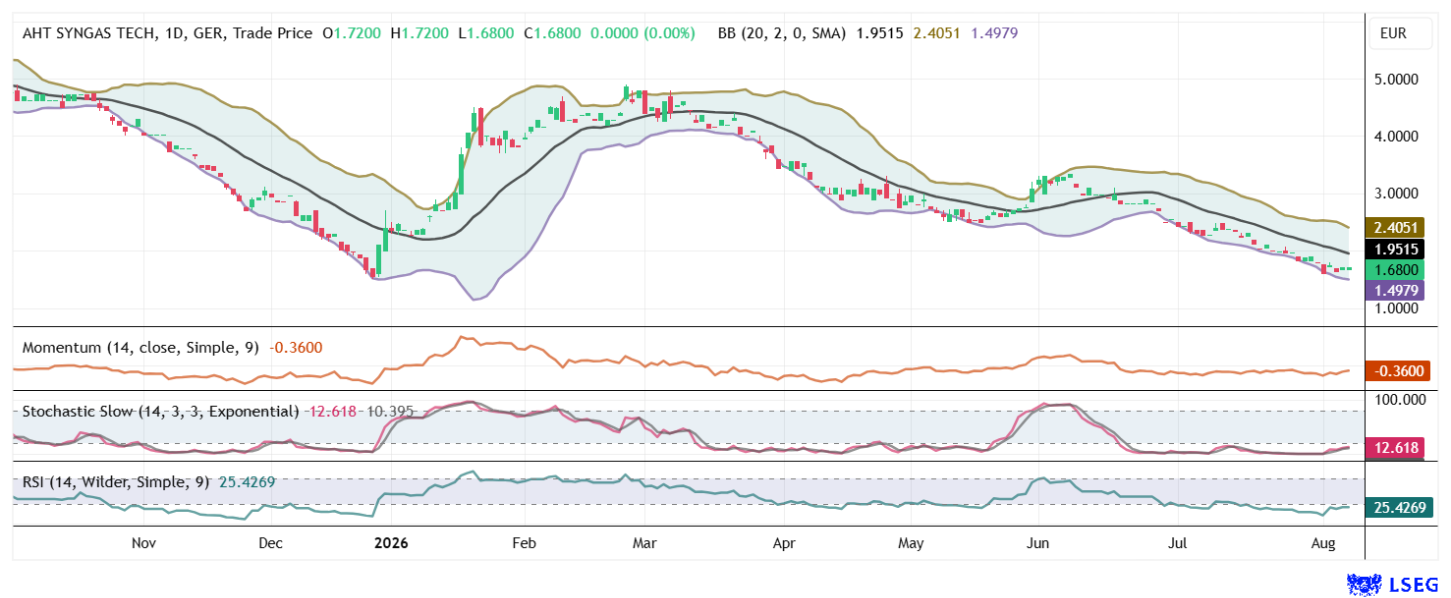
While hydrogen infrastructure projects worth billions are often still a long way off, A.H.T. Syngas Technology N.V. is establishing a ready-to-use, highly economical alternative in the European energy market. The company is breaking free from dependence on fossil fuels by consistently utilizing biogenic residues, industrial packaging waste, and sewage sludge directly at the source. The technological foundation is the patented dual-fire gasification process, which highly efficiently converts even challenging waste streams into extremely clean synthesis gas. Since the hydrogen content of this synthesis gas consistently exceeds the 40% mark, A.H.T. acts as a resilient base-load stabilizer for the power grid, flexibly compensating for weather-dependent generation gaps in solar and wind power.
Watch CEO Gero Ferges' presentation from the 19th International Investment Forum (IIF).
As management explained at the IIF, the cleantech company is currently undergoing a strategic transformation. The traditional project business, which focused solely on plant sales, is being replaced by a high-margin contracting model as an independent power plant operator, which will henceforth secure recurring revenue streams from the sale of clean electricity, industrial heat, and patented hydrogen applications. A German flagship project demonstrates that these investments pay for themselves rapidly: an investment of EUR 1.6 million saves the customer approximately EUR 600,000 in natural gas costs annually. A standardized 2-megawatt biomass power plant, in turn, generates approximately EUR 4 million in annual revenue with an investment volume of around EUR 8 million, underscoring the enormous leverage of the new strategy. The financial groundwork for this upcoming wave of scaling has already been laid through the successful placement of a EUR 2 million convertible bond.
The operational turnaround is imminent, as the integration of standardized product lines is massively accelerating profitability and allows us to forecast a rapid jump from approximately EUR 2.25 million in revenue in 2025 to over EUR 9 million in 2026, followed by an expansion to around EUR 23 million by 2028. Thanks to the strategic focus on long-term contracting agreements, operating profit margins are expected to surge from the current 10% to a target of 18%—a goal that can be achieved without any capacity constraints during the rollout, thanks to an established global network of OEM partners. The strategic alliance with the Polish project developer INNOTEC Energy is also proving to be a major catalyst. In light of the radical phase-out of coal in Eastern Europe, A.H.T.'s technology is filling a huge market gap and securing the company direct access to a well-stocked pipeline of 17 concrete large-scale projects in Poland. An immediate order volume of over EUR 10 million is expected from this as early as the coming months. For this compact micro-cap company, whose management and staff themselves hold around 40% of the shares, this deal marks a fundamental turning point. Given the extremely favorable entry level at an enterprise value of around EUR 5 million, the signs clearly point to a surge!
SpaceX: A Sell-Off Following the IPO
While Europe's energy sector is gradually establishing new structures, another megaplayer across the Atlantic is causing a volatile stir: SpaceX. Elon Musk's aerospace and technology holding company staged the largest initial public offering (IPO) in history in June 2026, briefly reaching a valuation of approximately USD 1.8 trillion—more than Meta and Tesla combined. However, the IPO pop was quickly followed by a 50% price correction from the previous high of USD 225. Despite strong first-quarter revenue of USD 7.8 billion, SpaceX remained in the red as expected, partly due to significant investments in Starlink, Starship, and AI infrastructure. Analysts are divided; Morningstar estimates the company's fair value at just USD 780 billion, which would amount to only USD 58 per share. Since there has been significant speculation on falling prices in recent weeks, short sellers must now cover their positions—in some cases at prices significantly higher than last week's levels before the end of the first lock-up period. It will be interesting to see how this plays out.
Alternative energies are key for Europe to strengthen long-term security of supply, limit price risks associated with fossil fuel imports, and realistically achieve climate targets. In this context, established players such as Siemens Energy and Nordex are coming into focus, driving the transformation forward with their distinct profiles. As a decentralized complement, A.H.T. Syngas Technology is gaining importance; with its patented gasification technology, the company converts waste materials into synthesis gas, thereby combining the circular economy with local energy production. Meanwhile, SpaceX is making volatile headlines following the largest initial public offering in history.
Conflict of interest
Pursuant to §85 of the German Securities Trading Act (WpHG), we point out that Apaton Finance GmbH as well as partners, authors or employees of Apaton Finance GmbH (hereinafter referred to as "Relevant Persons") currently hold or hold shares or other financial instruments of the aforementioned companies and speculate on their price developments. In this respect, they intend to sell or acquire shares or other financial instruments of the companies (hereinafter each referred to as a "Transaction"). Transactions may thereby influence the respective price of the shares or other financial instruments of the Company.
In this respect, there is a concrete conflict of interest in the reporting on the companies.
In addition, Apaton Finance GmbH is active in the context of the preparation and publication of the reporting in paid contractual relationships.
For this reason, there is also a concrete conflict of interest.
The above information on existing conflicts of interest applies to all types and forms of publication used by Apaton Finance GmbH for publications on companies.
Risk notice
Apaton Finance GmbH offers editors, agencies and companies the opportunity to publish commentaries, interviews, summaries, news and the like on news.financial. These contents are exclusively for the information of the readers and do not represent any call to action or recommendations, neither explicitly nor implicitly they are to be understood as an assurance of possible price developments. The contents do not replace individual expert investment advice and do not constitute an offer to sell the discussed share(s) or other financial instruments, nor an invitation to buy or sell such.
The content is expressly not a financial analysis, but a journalistic or advertising text. Readers or users who make investment decisions or carry out transactions on the basis of the information provided here do so entirely at their own risk. No contractual relationship is established between Apaton Finance GmbH and its readers or the users of its offers, as our information only refers to the company and not to the investment decision of the reader or user.
The acquisition of financial instruments involves high risks, which can lead to the total loss of the invested capital. The information published by Apaton Finance GmbH and its authors is based on careful research. Nevertheless, no liability is assumed for financial losses or a content-related guarantee for the topicality, correctness, appropriateness and completeness of the content provided here. Please also note our Terms of use.