May 12th, 2026 | 07:15 CEST
Nuclear Power for AI: How Amazon, Paladin Energy, and Standard Uranium Are Fueling the New Uranium Supercycle
The world is changing at an ever-faster pace. While the first phase of decarbonization was primarily driven by renewable energy from wind and solar power, the unprecedented rise of AI models has exposed a weakness in this strategy - the lack of carbon-free baseload power. For this reason, alliances are now forming between the tech giants of Silicon Valley and the resource pioneers of Canada's Athabasca Basin. The goal: to secure the future of digital infrastructure. The global energy landscape is thus at a turning point where purely ideological debate is giving way to harsh economic reality. While the years following the Paris Agreement were marked by ambitious goals, the current decade is defined by industrial sovereignty and profitability. We highlight opportunities.
time to read: 3 minutes | Author: Nico Popp
ISIN: AMAZON.COM INC. DL-_01 | US0231351067 , PALADIN ENERGY LTD. | AU000000PDN8 , STANDARD URANIUM LTD. | CA85422Q8487 | TSXV: STND , OTCQB: STTDF
Table of contents:
Author

Nico Popp
At home in Southern Germany, the passionate stock exchange expert has been accompanying the capital markets for about twenty years. With a soft spot for smaller companies, he is constantly on the lookout for exciting investment stories.
Tag cloud
Shares cloud
Amazon: Energy Supply as a Strategic Bottleneck
Amazon demonstrates just how comprehensive this shift is. The company recently reaffirmed its ambitions in nuclear power by advancing the development of up to 12 small modular reactors in the state of Washington. For Amazon, direct access to nuclear energy is no longer just a PR stunt, but a prerequisite for operating future AWS data centers, which require an uninterrupted power supply. Amazon knows that future market leadership in the cloud will no longer be determined solely by superior software algorithms, but largely by a reliable energy supply. Analysts point out that energy availability has replaced access to hardware as the bottleneck of AI development. Goldman Sachs estimates that investments in AI infrastructure will exceed USD 1 trillion by 2027, so the rush for power plants and energy sources such as uranium will continue.
Paladin Energy Consolidates World-Class Assets
The market's focus on this trend is evident in Fission Uranium's development, which was fully integrated into the Australian group following Paladin Energy's acquisition approximately two years ago. The Patterson Lake South project received its environmental permit in February. With reserves of over 93 million pounds of U3O8 at an exceptionally high grade of 1.41%, the project demonstrates the billions in value that are created when high-grade assets in politically stable regions reach production maturity. The fact that Paladin acquired the project two years ago underscores the trend toward consolidation in the sector—established producers must replace their resources to fulfill long-term supply contracts with utilities.
Standard Uranium: Significant leverage right at the source
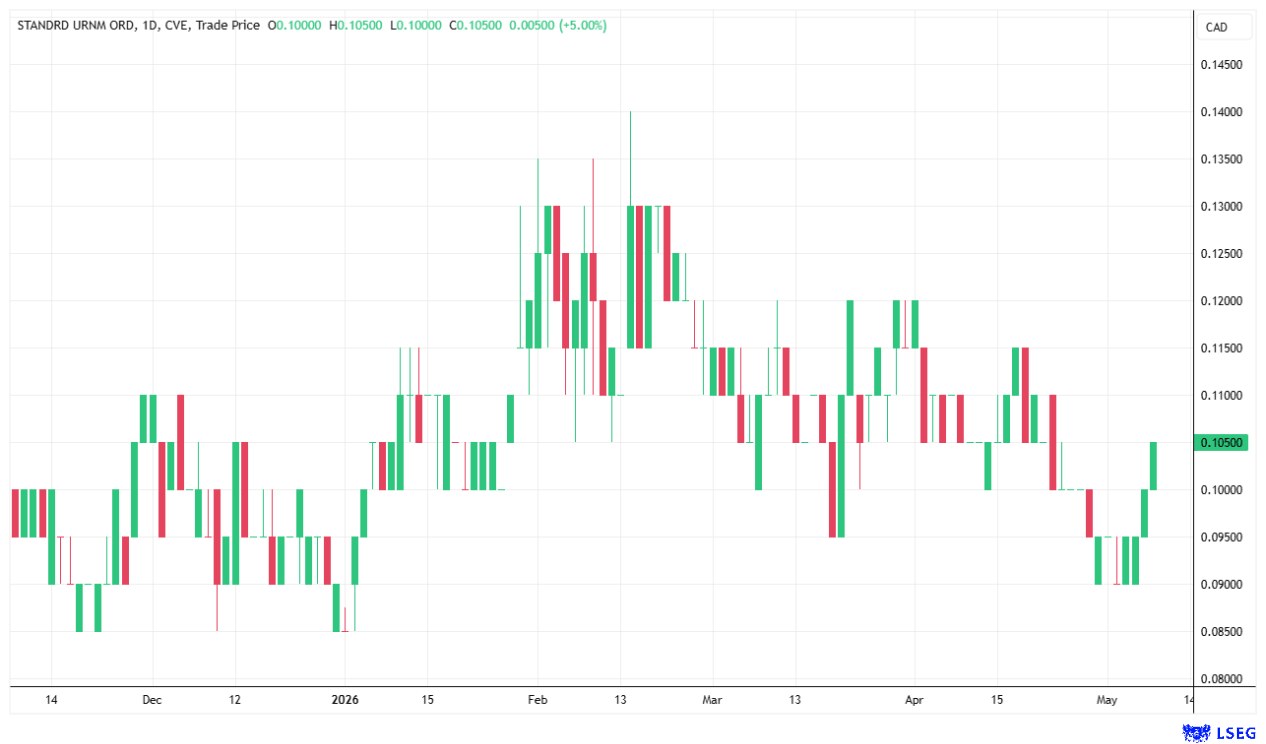
Standard Uranium currently finds itself in a strategically promising position. While former competitors have already been acquired, Standard Uranium is facing a decisive summer. The company recently launched an aggressive drilling program at its flagship Davidson River project, which is geologically situated within the same structural trends as the world-class projects of NexGen and Paladin. Standard Uranium is adopting a project-generator model, enabling partner-funded drilling on projects like Sun Dog while retaining full control over Davidson River. This approach minimizes financial risk for investors and increases the likelihood of new discoveries.
Uranium as the Fuel of the New Digital Era
The current momentum in the uranium market is not short-term speculation, but the result of a structural supply shortage coupled with exploding demand. McKinsey forecasts annual growth in electricity demand of 3% for the US through 2035, representing a dramatic increase after decades of stagnation. While tech giants like Amazon are bolstering the demand side with billions in investments, and majors like Paladin are snapping up advanced assets, Standard Uranium offers potential for the next generation of uranium mines.
In addition, the geopolitical context is fueling growing interest in uranium projects in stable regions. The current energy crisis demonstrates this. Energy independence is increasingly viewed as a matter of national security, and nuclear power is far less vulnerable to blockades of international shipping routes. This situation is providing a tailwind for the entire industry. Standard Uranium benefits in two ways: through potentially higher market prices and through a regulatory environment that promotes the expansion of new capacity—what was once a bureaucratic tug-of-war is now moving much faster.
Risk Management and Strategic Positioning
For investors, dynamic trends often raise the question of the right allocation. While conglomerates like Paladin promise stability, an agile explorer like Standard Uranium offers the chance for a revaluation as soon as the drill results are positive. Since the company builds on historically valid data and is located in close proximity to already proven world-class deposits, the geological risk is likely to be significantly lower compared to pure greenfield exploration. Experienced investors looking to capitalize on the ongoing uranium hype should take a closer look at Standard Uranium's stock. This growth stock offers many compelling key metrics and, with its focus, is perfectly in tune with the times.
Watch YouTube videoConflict of interest
Pursuant to §85 of the German Securities Trading Act (WpHG), we point out that Apaton Finance GmbH as well as partners, authors or employees of Apaton Finance GmbH (hereinafter referred to as "Relevant Persons") may hold shares or other financial instruments of the aforementioned companies in the future or may bet on rising or falling prices and thus a conflict of interest may arise in the future. The Relevant Persons reserve the right to buy or sell shares or other financial instruments of the Company at any time (hereinafter each a "Transaction"). Transactions may, under certain circumstances, influence the respective price of the shares or other financial instruments of the Company.
In addition, Apaton Finance GmbH is active in the context of the preparation and publication of the reporting in paid contractual relationships.
For this reason, there is a concrete conflict of interest.
The above information on existing conflicts of interest applies to all types and forms of publication used by Apaton Finance GmbH for publications on companies.
Risk notice
Apaton Finance GmbH offers editors, agencies and companies the opportunity to publish commentaries, interviews, summaries, news and the like on news.financial. These contents are exclusively for the information of the readers and do not represent any call to action or recommendations, neither explicitly nor implicitly they are to be understood as an assurance of possible price developments. The contents do not replace individual expert investment advice and do not constitute an offer to sell the discussed share(s) or other financial instruments, nor an invitation to buy or sell such.
The content is expressly not a financial analysis, but a journalistic or advertising text. Readers or users who make investment decisions or carry out transactions on the basis of the information provided here do so entirely at their own risk. No contractual relationship is established between Apaton Finance GmbH and its readers or the users of its offers, as our information only refers to the company and not to the investment decision of the reader or user.
The acquisition of financial instruments involves high risks, which can lead to the total loss of the invested capital. The information published by Apaton Finance GmbH and its authors is based on careful research. Nevertheless, no liability is assumed for financial losses or a content-related guarantee for the topicality, correctness, appropriateness and completeness of the content provided here. Please also note our Terms of use.